Imagine a map that never pinches, creases, or locally collapses space. Stand anywhere and it gives you a reliable nearby inverse: every small step in the output has one corresponding small step back. Surely, mathematicians long thought, such a map could not send two different starting points to the same destination. A famous conjecture said exactly that. In 2026, a counterexample showed how the map can keep its local promise and still cheat globally.
The Jacobian conjecture, posed in 1939, concerns polynomial maps: rules built from sums and products of coordinates. It asks whether a map whose Jacobian determinant is everywhere the same nonzero constant must have a polynomial inverse. The determinant is a compact way to track how the map changes nearby space. If it never vanishes, the map has a local inverse everywhere. The conjecture’s leap was from that local guarantee to a global one: one input, one output, with a polynomial rule to get back.
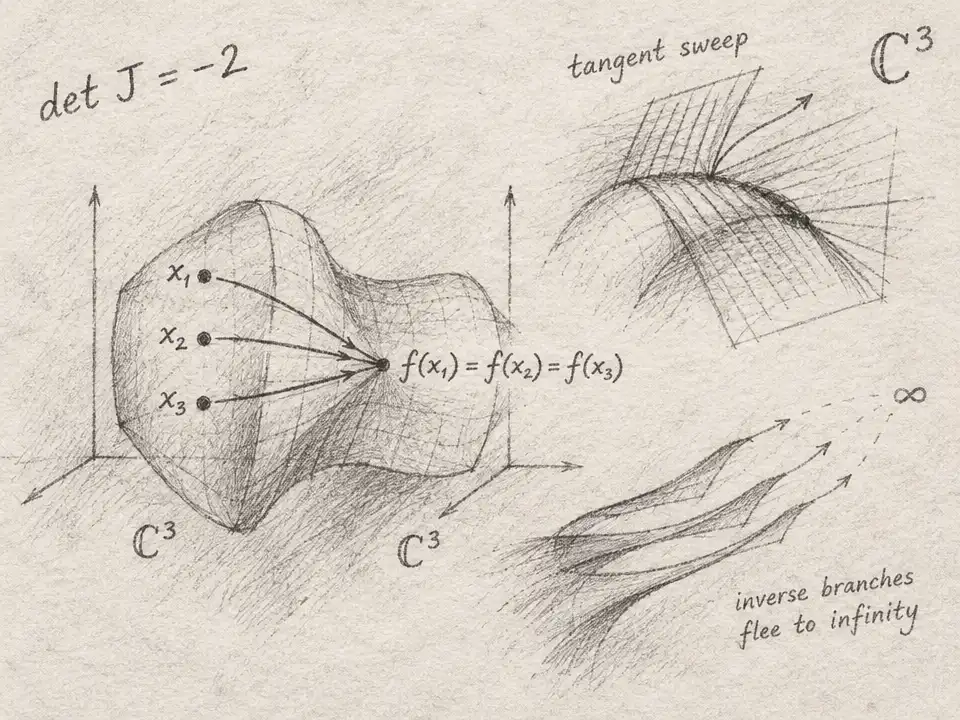
On July 19, 2026, Levent Alpöge announced a map in three complex dimensions that breaks that leap. Its Jacobian determinant is exactly -2 at every point, yet 3 distinct rational inputs share one output. The map is not merely missing an inverse formula; it is genuinely many-to-one. A later preprint by Shuhong Gao explains the geometry behind this surprise and extends the construction. Its key ingredient looks less like a machine than a drawing exercise: trace the tangent lines of a curve.
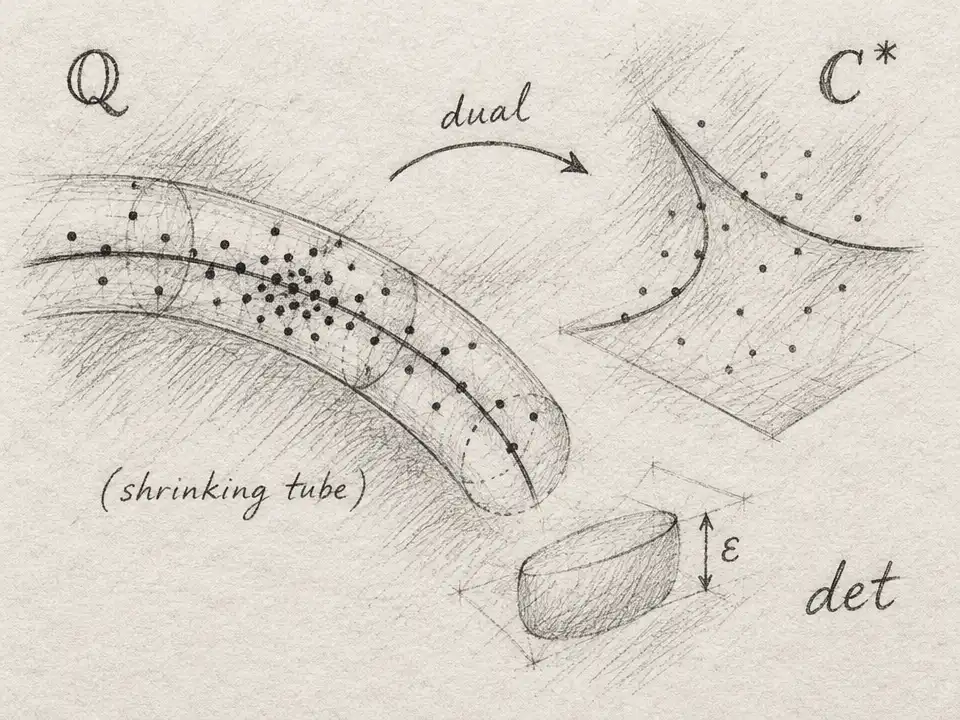
Picture a curve on a flat sheet. At each point, draw its tangent line, then let a point move along that line. The whole operation—choosing a point on the curve and a position along its tangent—sweeps out the plane. But a target point in the plane may lie on several tangents to the curve. Each contact point offers a different route to that same destination. For the cuspidal cubic used in the first example, a typical target is reached by 3 tangent lines. The sweep has several inputs for the same output built in from the start.
There is a catch: the raw sweep does not qualify as a counterexample. Right on the curve, its Jacobian vanishes. At those points the map really does lose its local inverse, so it fails the conjecture’s strict test. The construction’s clever turn is to rearrange and rescale coordinates with carefully chosen monomial operations. These operations cancel the sweep’s vanishing Jacobian factor, leaving a constant determinant. But the cancellation has a price: the troublesome contact points no longer sit in the ordinary finite part of the input space. The extra routes to an output can escape toward infinity.
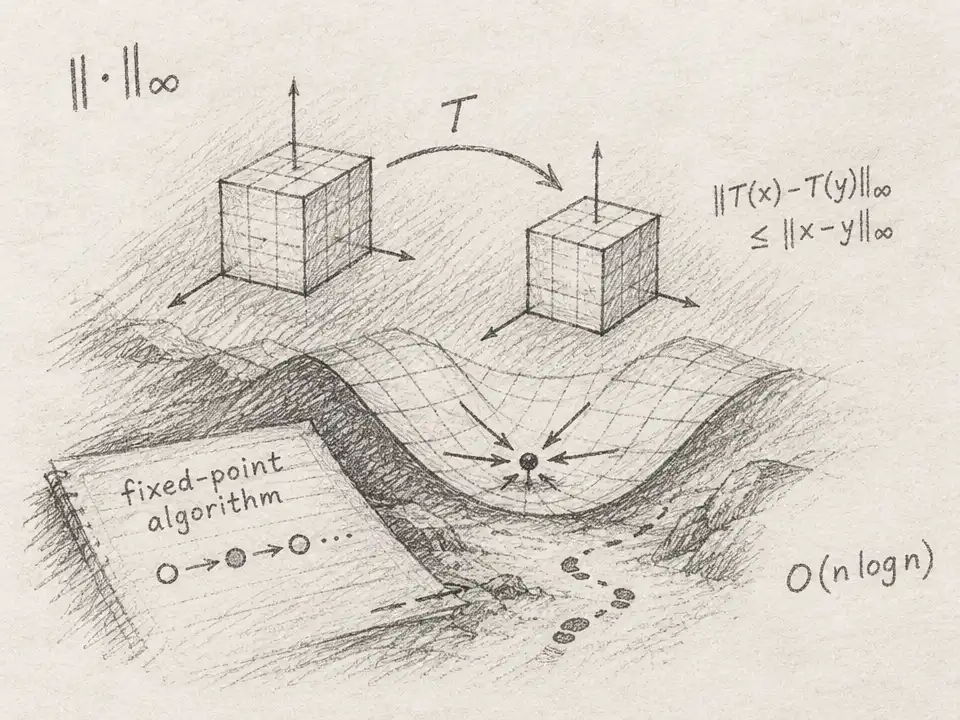
That escape matters because local invertibility does not rule out a global detour. A map with a nonzero Jacobian behaves smoothly and reversibly in every small neighborhood. Yet inputs can travel farther and farther away while their outputs approach a finite destination. In the language of the paper, the map is not proper: preimages of compact regions need not stay contained in a compact region. If the map were proper as well as locally invertible, its branches would form a covering of complex space. Since that space has no holes and the source is connected, there could be only one sheet. The counterexample slips past the argument through the boundary at infinity.
This is the expectation turned inside out. The determinant never signals a local breakdown; there is no hidden fold at an ordinary point where paths suddenly merge. Instead, the global map has multiple sheets, and some of them vanish from view by running off to infinity. The number of inputs over a particular output can drop when one of those inverse routes escapes—not because two inputs collide locally, but because one route has left the finite space being mapped.
Gao’s preprint makes the geometric trick into a framework, extending the tangent sweep from plane curves to direction fields on higher-dimensional surfaces. It gives 5 explicit maps: one in 3 dimensions with a typical output having 4 inputs; two in 4 dimensions, with typical fiber sizes of 5 and 10; and two in 5 dimensions, with sizes of 6 and 12. The paper also describes how counterexamples can be built in every dimension of 3 or more, with arbitrarily large typical numbers of inputs. Its exact polynomial identities are checked in rational arithmetic.
The result does not settle every version of the conjecture. The two-dimensional case remains open; these counterexamples work only from 3 dimensions upward. Nor does the geometry make the formulas simple—the examples are intricate. What it does provide is a clear explanation for how the old intuition failed: a local rule can be perfectly regular without controlling what happens at infinity. For decades, the determinant looked like a lock on the whole map. It turns out to secure only the neighborhood around each point.
That distinction is more than a technical loophole. It shows why a global question can survive a condition that looks decisive everywhere you inspect it locally. The tangent lines supply the repeated routes; the twist hides their local singularity; infinity gives the routes somewhere to go. The map never breaks its local rule. It just finds a way to arrive at the same destination by more than one path.