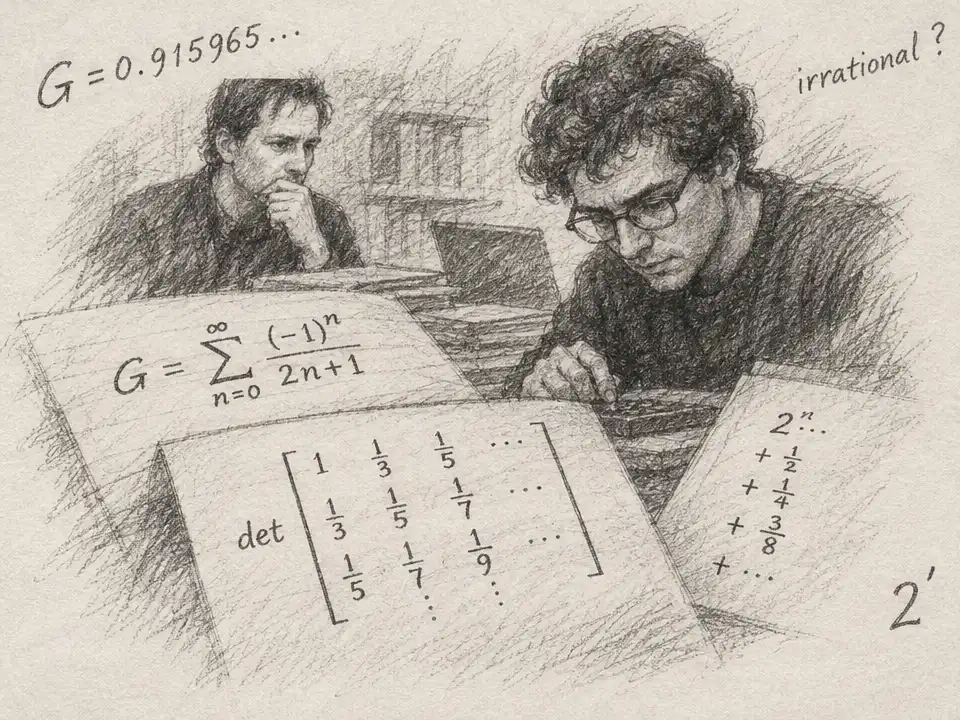
The number 0.915965594177219015… has an unusually simple recipe: add and subtract the reciprocals of odd numbers squared, one after another. It is Catalan’s constant, and mathematicians can calculate its digits to extraordinary precision. A more basic question has resisted proof for centuries: is this number irrational, meaning it cannot be written as a fraction of whole numbers?
On September 3, 2026, mathematician Zhi-Wei Sun posted a preprint claiming to prove that it is. Thirteen days later, Dane Wachs posted a mathematical audit arguing that the proof’s central estimate does not follow from its calculations. His critique does not show that Catalan’s constant is rational. It says the claimed proof has not established that it is irrational.
The exchange is a meeting of two kinds of mathematics: number theory’s delicate accounting of divisibility, and exact computation’s ability to check huge, intricate calculations without rounding away the details. Here, a computer-assisted audit did more than catch a typo. It traced a potential gap to a contribution from the smallest prime.
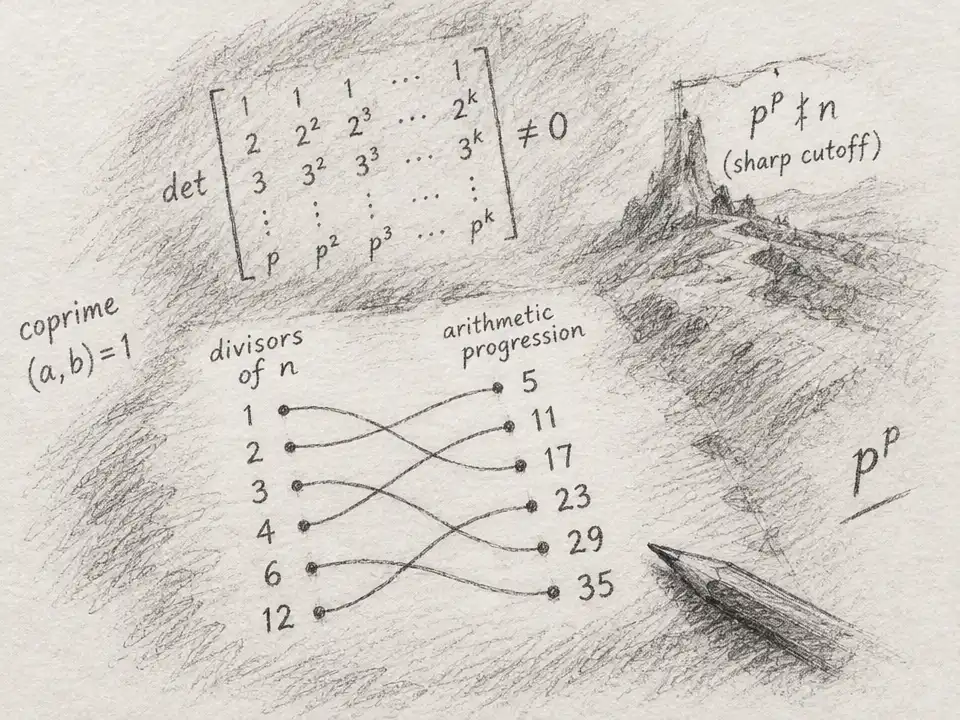
Sun’s strategy is a proof by contradiction. Imagine, temporarily, that Catalan’s constant really is a fraction, with some enormous denominator. From weighted tails of its alternating series, he builds a sequence of increasingly elaborate quantities involving matrices and determinants. If the constant were rational, multiplying each quantity by a carefully chosen integer would produce a nonzero whole number.
That sets a trap. Sun aims to prove that these whole numbers become smaller and smaller until their absolute value is less than one. But a nonzero whole number cannot fit between minus one and one. If both steps hold, the original assumption—that the constant is rational—must be wrong.
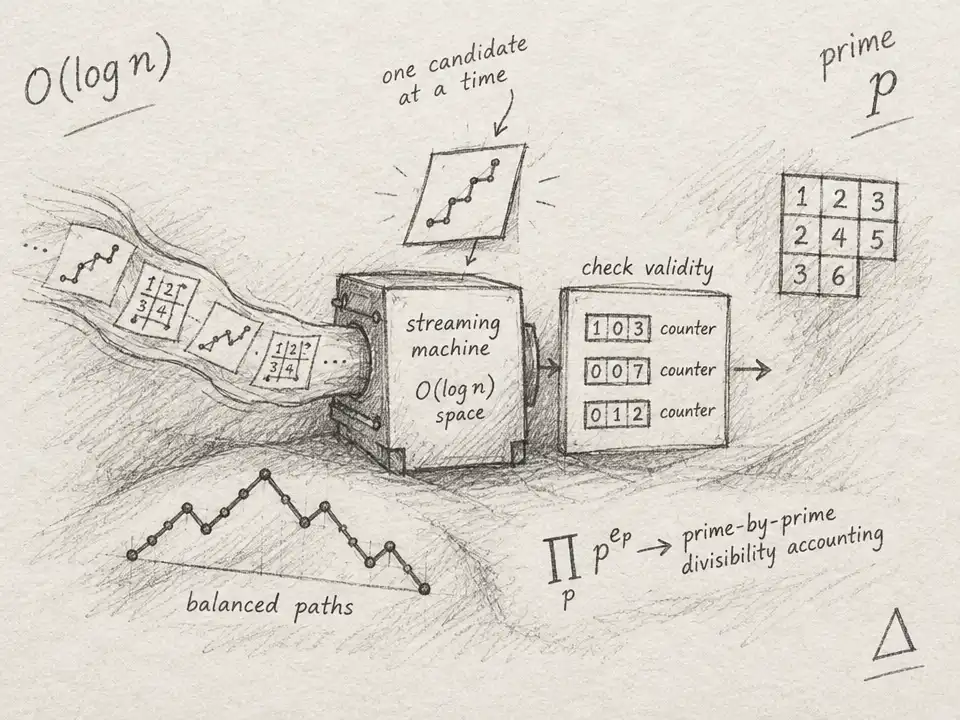
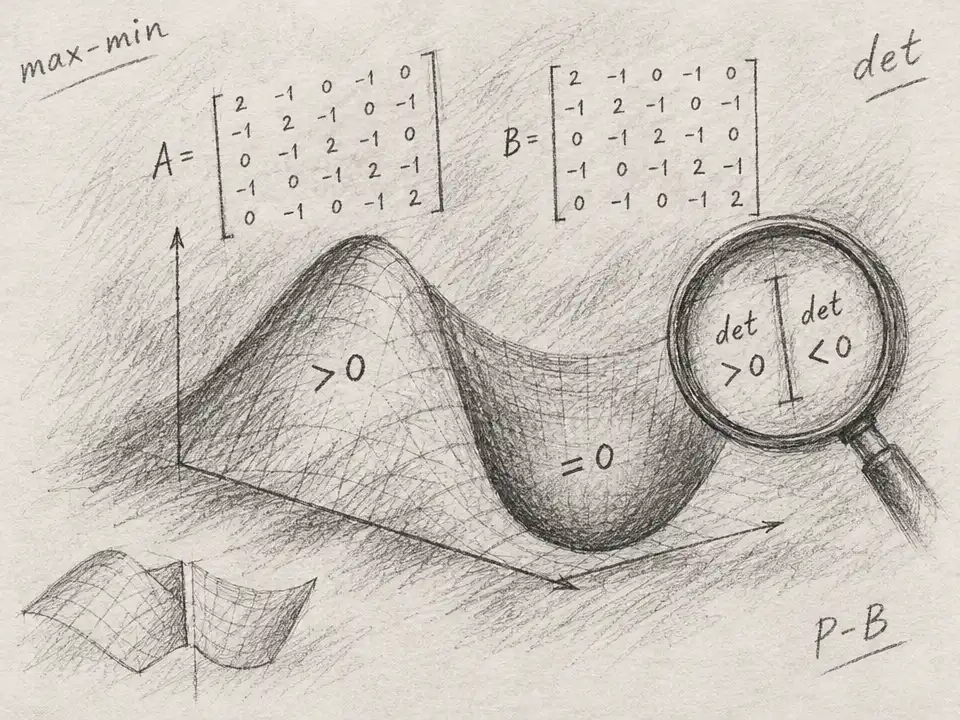
The hard part is making the trap close. A determinant built from the series’ tails has rational coefficients, but its denominator can grow rapidly. Sun’s proof estimates that growth by tracking how often different prime numbers divide the ingredients. It then balances this arithmetic bookkeeping against how small the determinant becomes as a parameter, called B, increases. The claimed balance leaves a small negative margin, enough to force the impossible whole number.
Wachs approached that balance as an audit. For the algebraic steps, he used exact rational arithmetic: fractions stay fractions, and divisibility is checked without floating-point approximations. Only when evaluating the determinant at the actual constant does the computation use high-precision numerical methods, with an explicit bound on rounding error. The paper provides scripts and outputs, including checks across eighteen parameter values from B equals 20 to B equals 119.
One early snag was real but not decisive. Wachs found that a rank argument in Sun’s printed proof uses one series tail where its own recurrence requires the next tail. Correcting the index appears to repair that argument; Wachs also checked the rank claim exactly across 44 small parameter pairs. So the central question was not simply whether the proof had a typo. It was whether its main estimate survived a closer accounting.
Here the numbers did not line up. At the tested values, Wachs found that the quantity being bounded had a lower bound between about 1.49 and 1.79 times B squared. Sun’s derivation claims it is eventually no greater than a negative amount of roughly 0.00966 times B squared, apart from smaller-order terms. Finite tests alone cannot refute a claim about what happens for all sufficiently large B. But they can tell an investigator where to look for a missing term.
The trail led to the prime 2. In Sun’s construction, a large factorial contributes powers of two to the determinant’s real size. Wachs derives an exact contribution from those powers that grows like B squared, with a coefficient of about 1.386. His objection is that the displayed asymptotic accounting does not show this contribution, or an offsetting term, in a way that supports the claimed margin.
There is an important complication: Sun’s paper does address the prime 2. It says that the relevant denominator contribution from that prime is zero, while its remaining effect has been included in a constant derived from the odd primes. Wachs argues that the paper does not show how that constant accounts for the exact term he identifies. In other words, the dispute is not “the prime was overlooked” versus “the prime was included.” It is whether the written derivation demonstrates that the inclusion works.
That distinction is why the computation matters. It does not settle an infinite problem by checking a handful of cases. Instead, the exact checks test parts of the proposed bookkeeping, while an identity in Wachs’s analysis isolates a term that must be reconciled in the broader argument. The audit also finds that the paper’s own bound for the denominator holds in the tested cases and is nearly sharp, pointing attention toward the later asymptotic estimate rather than that earlier step.
For now, the result is narrower than either a proof of irrationality or a proof that the constant is rational. In the September 2026 preprints, Sun’s claim remains unestablished according to Wachs’s critique; the underlying question remains open. What the exchange offers is a close-up of mathematical discovery: a bold argument turns an infinite decimal into a finite integer that should not exist, and exact computation follows the factors, prime by prime, to see whether the contradiction has really been earned.
The next step is not to calculate more digits of Catalan’s constant. It is to make the proof’s competing ledgers agree—or find a new route around them. Sometimes, in mathematics, the decisive clue is not a mysterious new number. It is the factor of two that refuses to disappear.