A sensor trace arrives without punctuation. It may be a phone measuring someone walking, a machine bearing vibrating, or an EEG recording the brain’s electrical activity. To classify it, an AI typically has to turn that flowing signal into a label. But if the answer matters, a label alone leaves a hard question: what did the system notice, and should anyone trust its answer when the signal looks unfamiliar?
A new approach called ConceptTime tries to build those questions into the classification process. Its key clue is not simply the shape of a signal. It is the moment a model’s prediction fails.
First, a forecasting model learns from unlabeled signals. At each instant, it predicts a probability distribution for what should happen next. When the next measurement lands far from that expectation—especially when the model was confident—the system registers “predictive surprise.” Imagine a familiar rhythm suddenly breaking: the important feature is not just the new beat, but that it arrived where the model expected something else.
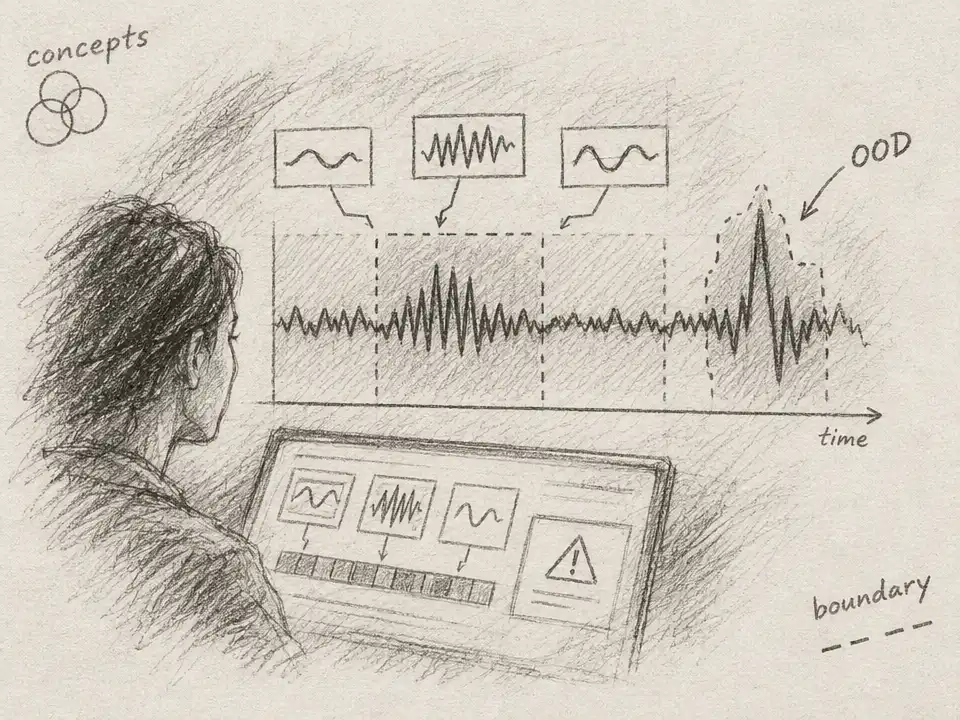
That surprise helps the system decide where one segment ends and another begins. Instead of slicing every recording into identical pieces, ConceptTime searches for a set number of boundaries while keeping the segments within chosen length limits. It then describes each segment using simple summaries of what the model expected, how the actual signal differed, and how the surprise unfolded over time.
Here is the twist: those descriptions help create the categories the classifier will use. Segments with similar predictive signatures are grouped around prototype patterns—learned “concepts” in the researchers’ terminology. A small classifier then makes its decision using the sequence of concepts, rather than the raw signal alone. The concepts do not arrive with plain-English labels. People can inspect representative signal segments to see what they capture, but interpreting their meaning remains a human task.
The same prototypes offer a second, potentially useful signal. If a new segment sits far from every learned concept, the system can treat it as poorly described by its vocabulary. That is different from asking whether the classifier feels confident: a classifier might confidently assign a familiar label to a pattern it has never really learned to represent. ConceptTime’s prototype distance instead asks whether the input fits the patterns the system knows.
In tests across 17 public benchmarks, the researchers report competitive classification performance and stronger results than the interpretable comparison methods they evaluated. On a benchmark that distinguishes seizure from non-seizure EEG recordings, ConceptTime reached 97.91% accuracy when trained with 1% of the available labels. In one phone-sensor activity test, predictive summaries performed far better than conventional descriptions of raw signal shape on the same segments: 87.7% accuracy compared with 42.7%.
The striking point is that two segments can look different yet behave similarly relative to the model’s expectations—or look alike while differing in context. A flat trace after a quiet stretch may be routine; the same flatness after a spike may be surprising. By encoding that context, the researchers’ method tries to make its concepts reflect how signals behave, not just what a waveform resembles.
There is an important qualification to the headline result: “1% of labels” does not mean the system learned from only 1% of the recordings. The forecasting model and concept vocabulary can use unlabeled signal data; the 1% figure refers to the labels available to train the classifier. That distinction matters in settings where collecting expert labels is costly but raw sensor data are plentiful.
The method also has a price. Researchers must choose the vocabulary size in advance, and the learned patterns do not explain themselves. The approach may save labeling effort, but people still need to decide what a prototype means and whether that meaning is useful in a real application. In a test of artificial noise and shuffled signals, the built-in fidelity score was good at flagging altered examples. But when the researchers tested shifts among real machine operating conditions, its average ability to distinguish unfamiliar from familiar conditions was modest: the area-under-curve score was 0.666. At a setting designed to catch 95% of unfamiliar examples, it also incorrectly flagged familiar ones 71.9% of the time.
So the frontier is not an AI that can safely diagnose a person or monitor every machine without supervision. It is a classifier with a more visible route from signal to decision—and a possible reason to say, “This pattern does not fit what I know.” If that route can be made reliable across new devices, populations, and operating conditions, it could help humans review the right cases instead of trusting a confidence score alone. For now, ConceptTime is a promising research design, not a ready-made safety net: its concepts need interpretation, and its willingness to defer still needs stronger tests outside familiar benchmarks.