A DNA motif is a short pattern of letters that can help a protein find the right place to bind on a strand of DNA. These tiny signals matter: transcription factors use them to regulate genes. But a motif can be hard to spot. The same pattern may appear with small variations, and the surrounding DNA can be noisy. A computer can search thousands of sequences and still get stuck asking the wrong question.
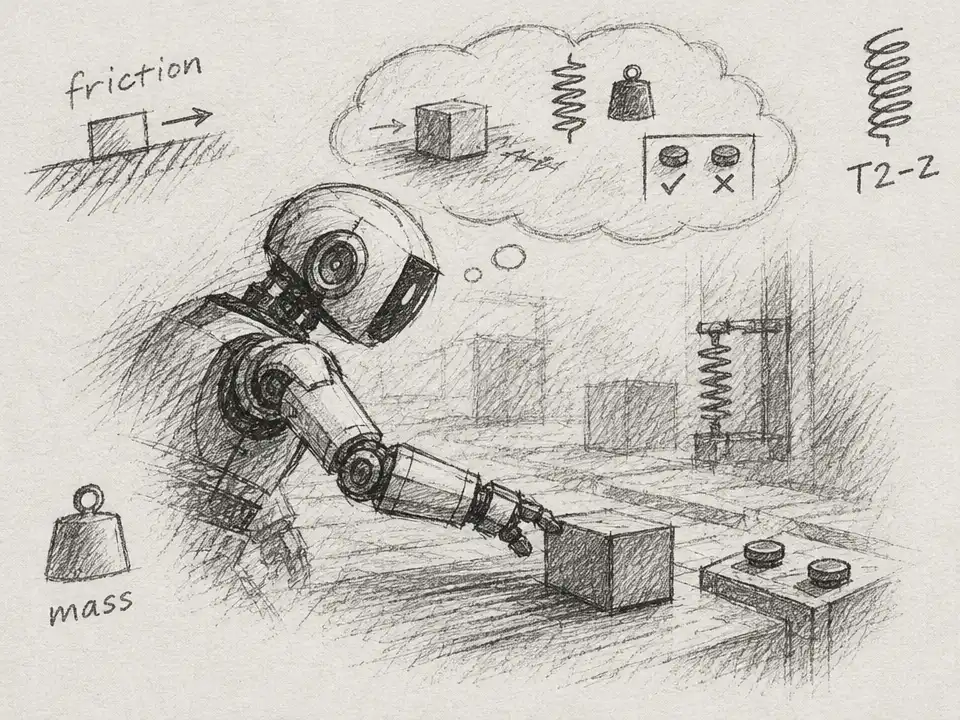
In an August 2026 arXiv preprint, researcher Travis Smith describes a system designed to get past that kind of impasse by borrowing an idea from the philosophy of science. The system’s name, The Little Scientist, is a hint. Its AI agent was asked to form a hypothesis, predict what a change would do, test its code, and compare the result with its prediction. When progress stalled, a second agent—named Kuhn after philosopher Thomas Kuhn—was meant to challenge the approach itself.
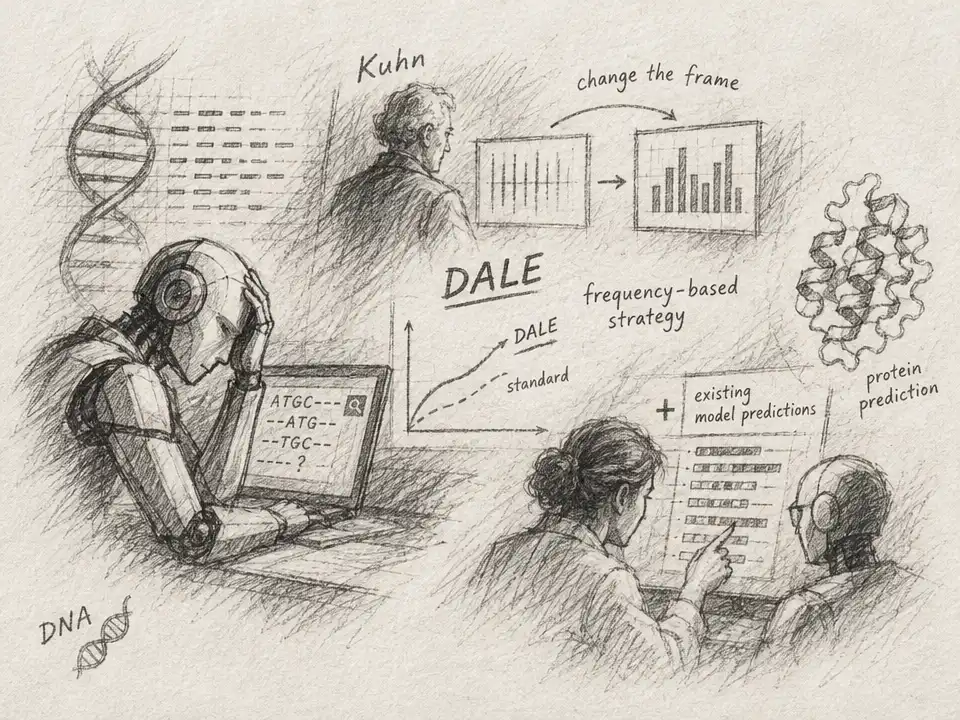
Kuhn argued that science advances not only through steady improvements within an accepted framework, but also through shifts in the framework scientists use to understand a problem. Smith’s system turns that broad idea into a practical prompt: don’t just tweak the current method; question the assumption underneath it. That philosophical detour led to a different way to search DNA.
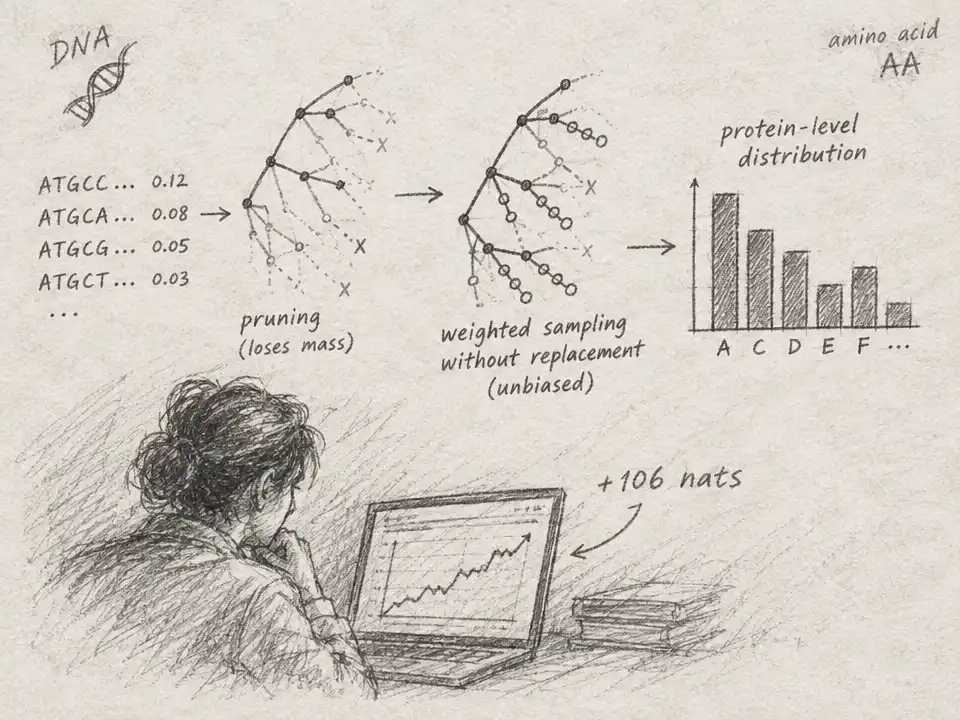
The system’s first attempts at finding DNA motifs had plateaued. The turning point was a switch from probability-based modeling to counting short DNA strings, called k-mers. The new approach, which became the DALE algorithm, looked for strings that appeared repeatedly across DNA sequences, then refined promising candidates. The key change was not simply trying more code edits. It was changing what the search treated as a useful clue.
To test DALE, the researcher used data from ENCODE: sequences associated with 132 transcription factors in a human cell line. For each dataset, the search focused on a 100-base-pair window centered on a location where DNA was enriched around a transcription factor. The system had to identify a motif that could help distinguish those sequences from a comparison set. In this test, the comparison sequences were made by shuffling the originals while preserving how often neighboring DNA letters appeared.
DALE scored a mean AUROC of 0.842, compared with 0.803 for STREME, an established motif-finding tool. AUROC measures how well a method separates two groups—in this case, sequences containing a transcription-factor binding signal and comparison sequences. DALE also took 0.30 seconds per transcription factor, against STREME’s 3.26 seconds: about 11 times faster in this benchmark.
The researchers also tested against more realistic comparison sequences drawn from genomic DNA, which contains natural patterns absent from shuffled sequences. On a 53-factor subset where the tools could be compared, DALE reached 0.891 AUROC versus STREME’s 0.863, while taking 0.3 seconds per factor instead of 4.4 seconds. Those are strong results for the particular datasets and tests—not proof that one algorithm will win on every kind of DNA or biological question.
There is a revealing wrinkle in how the team got there. At one stage, the AI received only an overall score, not diagnostics showing which transcription-factor cases it handled badly. It could see that a version had failed, but not where or why. The paper reports that, without these case-by-case clues, the search stalled; after diagnostics were restored, the agent could make targeted changes and test specific explanations. In other words, the useful scientific-method ingredient was not just asking the system to make hypotheses. It needed evidence detailed enough to tell one hypothesis from another.
The Kuhn agent supplied the larger reframe: count recurring letter patterns instead of staying with the earlier probability-based direction. The Scientist agent then made most of the subsequent refinements. That division resembles a familiar rhythm in research: someone questions the frame, then a long sequence of experiments works out what the new frame can do. It also makes the crossover concrete. An idea about how scientific fields change was repurposed as a strategy for steering computational biology.
A second case study, predicting the effects of protein mutations, adds a human-AI twist. The system eventually developed a way to combine predictions from existing protein models. But the largest jump in performance followed a human researcher’s decision to provide predictions from five existing models as input data. The agent worked out how to combine them; it did not conjure those useful inputs from nowhere. The study presents the process as collaboration, with a person supplying context and data while the system tests candidate strategies.
There are important limits. The results come from computational benchmarks, not experiments in living cells or organisms, and DALE’s biological plausibility checks were not uniformly better on every measure. For example, it matched more transcription factors to at least one known motif in a reference database, but STREME did better on one strict top-match criterion. The study also changed several parts of its research setup over time, so it cannot isolate exactly how much the Kuhn agent alone contributed to the final gains.
Still, the experiment suggests a useful lesson for automated discovery: an AI search can benefit from more than a score and a bigger pile of candidate code. It may need a structured record of what failed, a disciplined cycle of prediction and testing, and an occasional invitation to question its starting assumptions. In this case, a theory about scientific revolutions did not solve biology by itself. It helped an AI change direction—and gave the resulting ideas a benchmark against which to prove their worth.