A research idea can be far from anything already published and still follow the same well-worn path. That distinction sounds subtle until you test it—and it changes what “creative” means when scientists ask artificial intelligence to help invent the next big question.
In a new study, researchers put language models’ scientific imagination on a map. They compared 524,308 AI-generated hypotheses with 26.9 million published papers, spanning 1,325 research topics in six natural-science fields. The surprise was not that the models produced ideas that looked unusual. By one measure, they often did. The surprise was that unusual-looking ideas rarely pointed in genuinely new directions.
The team began with an apparent contradiction. Some studies have found that people reviewing AI-generated research ideas rate them as highly novel. Other work suggests that AI-generated research clusters around familiar themes. The researchers suspected both observations could be true because “novelty” can mean two different things: how far an idea is from existing papers, and whether it moves beyond the conceptual routes a field already travels.
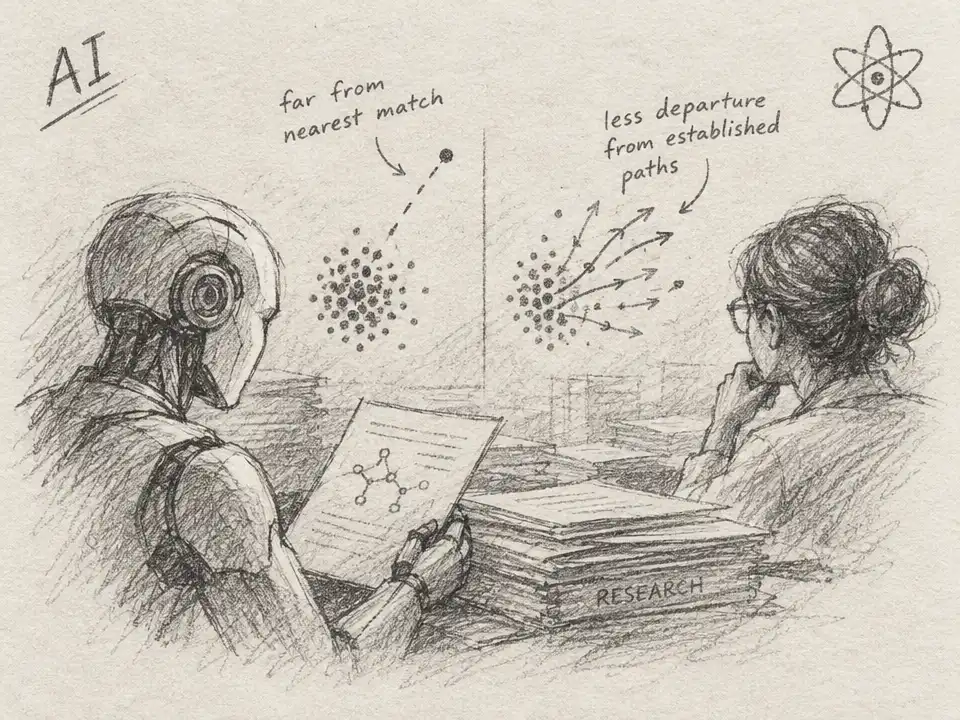
To test that distinction, they turned papers into points in a shared conceptual space. A scientific-paper embedding model placed titles and abstracts according to how their ideas related to one another. Imagine a landscape shaped by a field’s published work. One measure asks how far a proposed idea sits from its nearest existing paper. Another asks how far it lies from the field’s overall center. The researchers’ third measure, called the orthogonal novelty score, estimates how much of an idea falls outside the conceptual directions already represented in that field’s literature.
That last measure is not a machine that can certify a revolutionary discovery. It is a way to compare patterns in text. Still, across the study, it revealed a consistent split. AI-generated hypotheses were often farther from their nearest published neighbor than human-authored papers were from theirs. But the median AI hypothesis scored 15–23% lower on the measure of departure from established research directions. In random comparisons within a topic, a published paper had the higher score 72–82% of the time.
In other words, the models could move away from a familiar paper without leaving the broader neighborhood of familiar thinking. Their proposals might fill gaps between existing ideas or take a longer route through a field, rather than open a road into a different conceptual landscape. The pattern appeared across all eight models and all six research fields the team examined. Depending on the model, it showed up in 86–97% of the 1,325 topics.
Then came the obvious challenge: perhaps the models simply needed better instructions or more literature to read. The researchers varied the number of papers supplied as context, from 5 to 100. The directional-novelty gap barely budged. They also tried choosing papers from the fringes of a topic rather than from its center. That did push AI-generated ideas farther out: with the farthest-out papers as context, the proposals sat 11–12% farther from the topic’s center and 16% farther from their nearest published paper than real papers did. Yet the new-direction measure still did not catch up.
Nor did the familiar trick of telling a model to be “wild.” The researchers built a five-turn exchange between an idea generator and an AI judge. The judge critiqued each batch and suggested what the next batch should change. They also gave the generator or judge either a conservative or a wild persona. The wild judge did push proposals farther from nearby published papers. But asking for wild ideas did not make the proposals score higher on directional novelty; wild-generated proposals even scored lower than conservative-generated ones in the direct comparison reported by the authors.
That is the study’s most striking reversal: instructions that made ideas look more distant did not make them more direction-changing. A proposal can sound bold, combine distant-sounding terms, or sit well away from a paper on the map, yet still use the field’s established conceptual ingredients. Distance and direction, the results suggest, are not interchangeable badges of originality.
Why might that happen? The authors offer a possible explanation, not a demonstrated mechanism. Language models learn from existing literature, which may make them effective at moving through the conceptual territory that literature contains. But truly new turns in science are rare in the record; the models may have fewer examples from which to learn how such turns are made. The study’s failure to close the gap by adding more context or changing prompts is consistent with that possibility, but does not prove it.
The limits matter. The researchers evaluated titles and abstracts in an embedding space, not experiments that tested whether each hypothesis was sound, useful, or capable of launching a new field. A high or low orthogonal novelty score is not a verdict on whether an idea is truly original. The comparison also covers language-model-based systems and the particular prompts and workflows tested, not every kind of scientific AI.
So the finding is not that AI cannot help with discovery. The models may be useful for extending a research program: generating possibilities within a field, exploring links, or helping human researchers work through many candidate questions. The sharper caution is about who sets the destination. If a system is good at extending roads but less reliable at choosing a new direction, a steady stream of unusual-sounding proposals may still leave science traveling familiar routes. The unexpected result is that going farther from the nearest idea is not the same as going somewhere new.