Imagine standing beside a microscope while a tiny living construct moves through a dish. Before it, a brief electrical stimulus. Afterward, its motion changes. Now imagine asking a computer, in plain English, to make it speed up or slow down—and having the computer consult old lab videos to suggest what to do.
That last step is the twist in a new study connecting two fields that rarely share a control panel: language-based artificial intelligence and experimental biology. Researchers trained a system to translate instructions into electrical-stimulation durations for xenobots, synthetic multicellular constructs with no nervous system. But the system did not test its suggestions on living xenobots. It learned from a fixed archive of earlier experiments and selected among interventions already recorded there.
That distinction matters. The achievement is not a living machine obeying a new command. It is a computer learning to search biological records for a past intervention whose outcome best matches a request—and doing so without collecting fresh experimental data for training.
The raw material was a collection of videos showing xenobots before, during, and after electrical stimulation. The researchers tracked each construct’s position to build a picture of its movement. That was less straightforward than it sounds: stimulus-induced bubbles, reflections, and debris could fool a tracker. The team used several complementary detection strategies to follow the xenobot and reject false positives.
Each recorded trial supplied two things: the duration of the electrical stimulus and the construct’s tracked path before and after it. The researchers retained 101 usable batches from 149 tracked trials. Each batch came from a different xenobot, so the archive represented distinct biological replicates rather than repeated tests on the same construct.
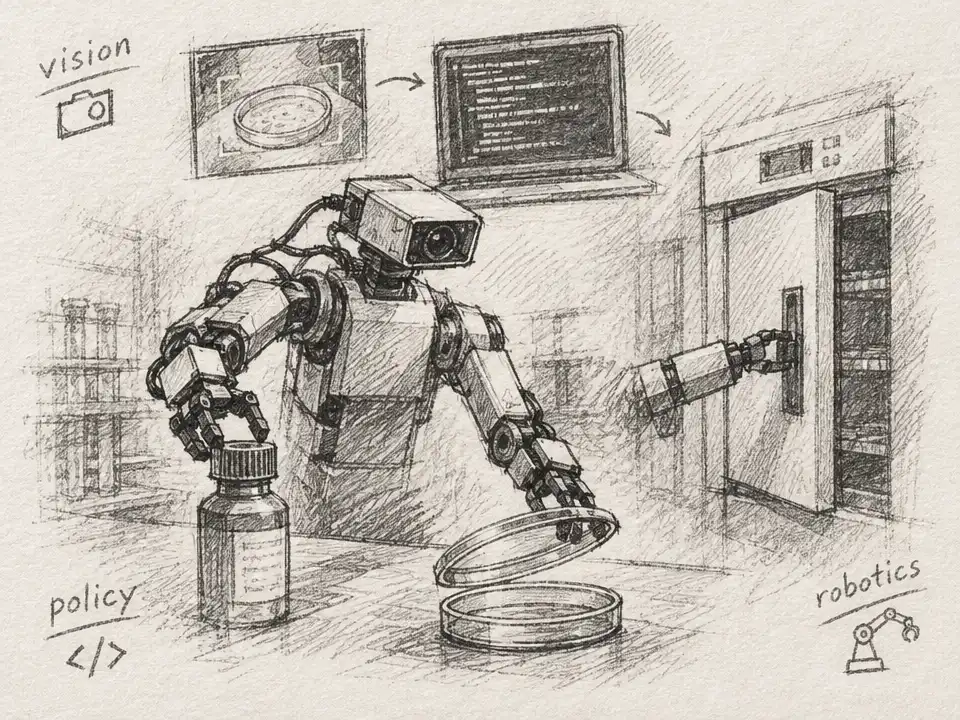
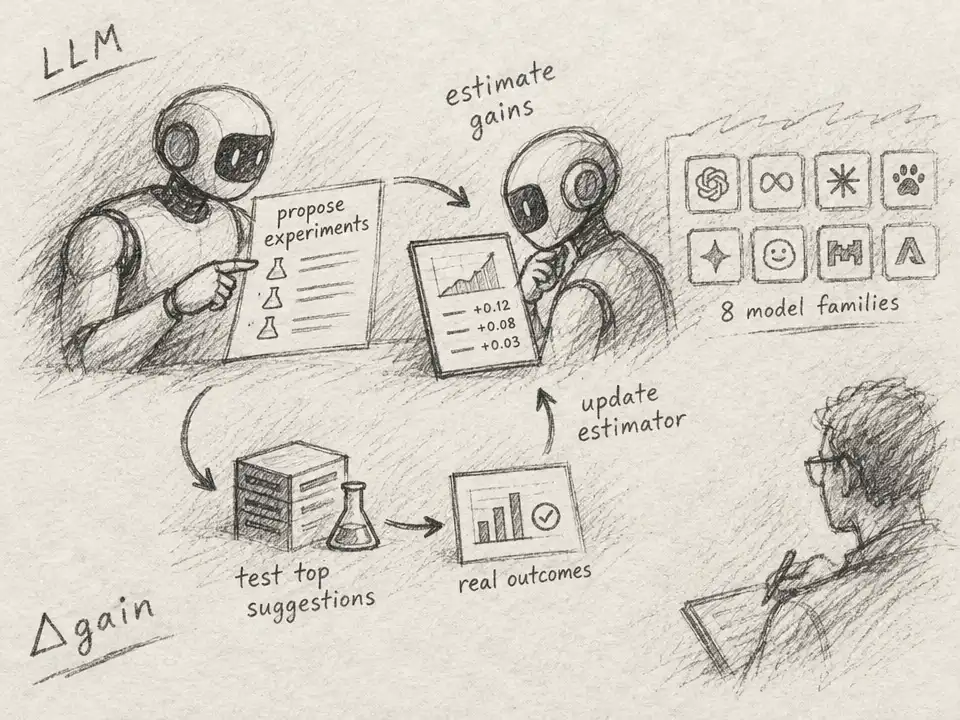
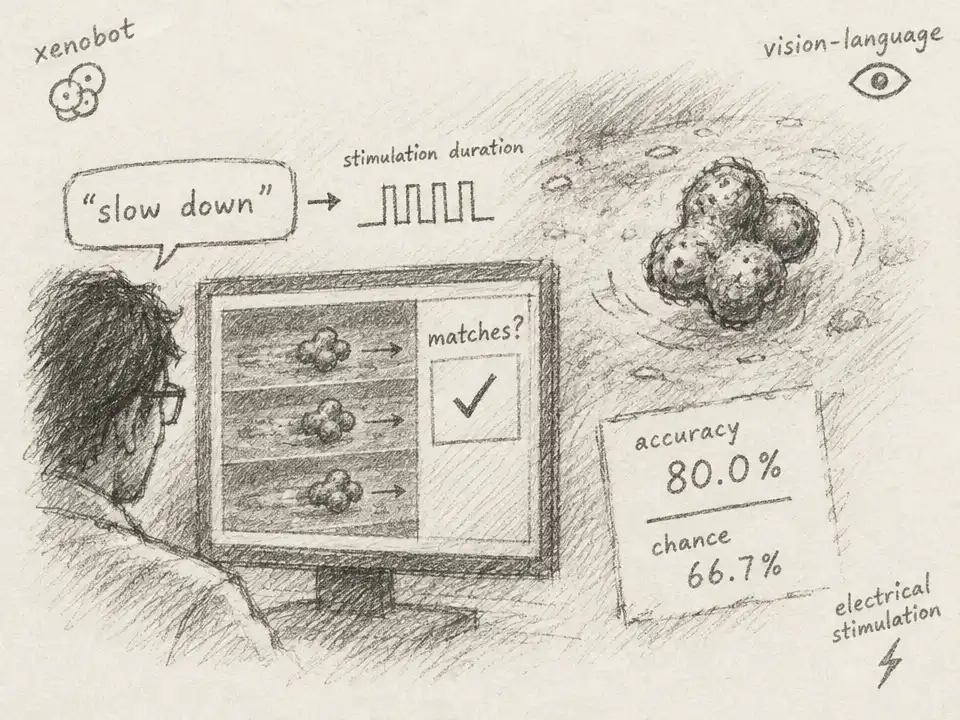
The bridge from video to language began with a vision-language model. Given a written prompt—such as “get the bot to slow down”—and a recorded trajectory, the model judged how well that motion fit the instruction. It saw the paths themselves, not a precomputed speed score. The researchers wanted to test whether a language-and-vision system could interpret the recorded behavior, rather than simply compare a sentence with a number.
Those judgments became training signals. A smaller network received an embedding of the prompt and predicted a stimulation duration. The predicted duration was then matched to the nearest duration in the archive. In effect, the system learned a map between words and an existing shelf of experimental outcomes: for this kind of request, which recorded intervention points to a suitable recorded result?
Testing that map required separating both the instructions and the experimental records used to build it. The key test held out new prompts and new archive data at the same time. On this combined holdout, the system reached 80.0% accuracy against a 66.7% chance baseline. The baseline was higher than half because two of the three prompt categories—“stop” and “slow down”—were both scored as requests to reduce motion.
The researchers also checked whether the vision-language model was a trustworthy judge. Its ratings agreed with independently determined behavior labels 97% of the time, with a correlation of 0.843. The disagreements fell close to the boundary between speeding up and slowing down: each was within ±0.02 px/s of a zero change in velocity. That makes the judge’s misses less like obvious misreadings and more like genuinely ambiguous cases.
One comparison showed why the archive’s shape mattered. The team replaced the language-and-vision model’s prompt-specific reward with a simpler rule: give every “faster” prompt one fixed duration and every “slower” prompt another. The network fit its training data about as well under this rule. Yet on the combined holdout, accuracy fell to 59.1%, below the 66.7% chance baseline. A duration that looked useful among training examples could land in a misleading part of the held-out archive.
So the language model’s contribution was not merely recognizing “faster” and “slower.” Its judgments helped preserve information about which durations, among the recorded options, matched the prompts. The distinction is subtle but central: learning a label can be easy while choosing an intervention that still points to the right outcome in unfamiliar data is harder.
The paper offers a vivid demonstration of how old experiments might do new work. A recorded xenobot that slowed after a 131.0 s stimulus can help anchor what “slow down” means to the system; another recorded case links “speed up” to a 74.0 s stimulus, with measured motion changing from 1.17 px/s before stimulation to 1.81 px/s afterward. These are examples retrieved from the archive, not fresh outcomes produced by following the model’s advice.
That boundary also defines the study’s limits. It considered one intervention parameter, a relatively small archive, and broad behavior categories. The researchers combined “stop” and “slow down” for the main classification because the available data could not reliably separate them as three distinct behaviors. And because the system retrieves an archived match, it has not shown that it can invent a new intervention or combine past examples in a novel way.
The decisive next test would be prospective: ask for an outcome, let the system choose a duration, apply that stimulus to a previously unseen xenobot, and see whether the result matches the instruction. Until then, the system is a language-guided index to lab history—not a proven controller of living systems.
Still, the crossover is intriguing. In ordinary software, a text prompt can describe a task while code carries it out. Biology has no ready-made dictionary linking words to interventions, and every new experiment costs time and effort. This study suggests one possible way to start building that dictionary: let an AI judge old experimental outcomes, then teach a smaller model to connect those judgments to human requests. The living system stays in the archive for now. But the archive has begun to answer back.