A tiny word can act like a handrail. In “the book that the professor wrote,” that helps signal how the sentence is unfolding. Take it away—“the book the professor wrote”—and the sentence is still grammatical, but the reader has to do a little more work to track its structure.
Now imagine a writing system that keeps choosing the shorter version—not because it is clearer, but because it has learned that fewer words are better. A new study suggests that pressure to compress information may help explain why some AI-generated language feels oddly dense. Its findings raise a practical question for the next generation of AI: Can a system learn to pack more into each sentence without making its words harder for people to follow?
The researchers examined text from 14 language models, including chat, coding, and essay outputs. They looked for features that psycholinguistic research has linked to human processing difficulty: uncommon word combinations, long stretches between related words, noun-heavy compounds, and constructions that omit optional words. They also counted cases where an inanimate thing takes an action-like verb, as in a sentence where a dataset “knows” something.
These are not errors. English allows all of them. The question is whether models use them more often than people do—and whether a preference for compact wording might help explain the pattern.
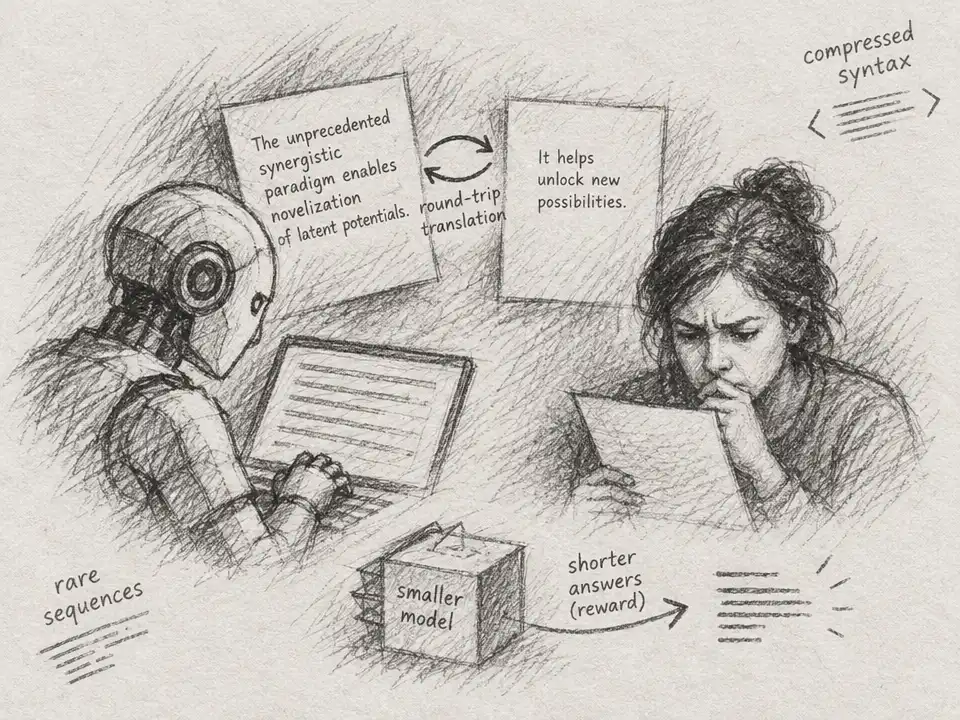
To separate a model’s choice of wording from the meaning it was trying to express, the team used a kind of linguistic detour. They translated model-generated sentences into Japanese and back into English, creating a second version that was intended to preserve the meaning while changing the phrasing. The researchers then compared the two versions. If a feature became less common in the round-trip translation, that suggested the model had favored it over another available way to say roughly the same thing.
Across most of the frontier and near-frontier models, original outputs had more unusual word pairs and higher scores on a measure of how surprising word sequences were than their translated counterparts. The models also tended to favor several constructions associated with greater processing demands. The pattern was generally stronger in chat and coding than in one-shot essays. And it was not identical across models: the Llama models and some Olmo versions showed smaller changes, while one newer Claude version scored lower on nearly every difficulty-linked measure than its predecessor.
That comparison matters. The results do not describe a fixed, unavoidable “AI dialect.” They show differences among systems and settings—and offer a hint that model language can shift in more human-friendly directions.
But the translation comparison has limits. A machine translation can alter wording for reasons beyond a model’s original preference, and the study did not ask people to read passages and measure how difficult they found them. Instead, it measured features that previous research associates with processing difficulty. The paper therefore identifies a possible source of friction, not proof that readers stumbled over these particular outputs.
To explore one possible cause, the researchers ran a smaller, controlled experiment. They started with Qwen2.5-1.5B-Instruct and trained it to turn structured event descriptions into English sentences. The training rewarded correct, properly formatted answers—and imposed a penalty for using more tokens. The task allowed different grammatical forms to express the same event, such as including or omitting the word that.
The model learned to prefer the shorter option. In the condition without a penalty for straying from its original word choices, it selected the brief form in more than 98 percent of cases for two trained “that” alternations whenever a length penalty was applied. That preference also carried over to some related constructions not directly targeted during training. Farther transfer was more limited: without the constraint that kept the model closer to its original behavior, the effect appeared in only one of four additional types of alternation tested.
The result is a proof of concept, not a demonstration that all modern AI systems became harder to understand because they were rewarded for brevity. The experiment involved a small model and a narrow sentence-generation task. Still, it shows how a simple scoring rule can tip a system toward a grammatical shortcut—even when the researchers never explicitly tell it to drop optional words.
That points to a quiet tradeoff. In tasks where the answer can be checked mechanically, correctness may be easy to reward while clarity is harder to measure. If a system gets credit for solving a problem but not for helping a person follow its solution, the two goals can pull apart. The authors suggest that pressure to save tokens may encourage language that is efficient for solving tasks but less accommodating to human readers. They present that as a hypothesis about broader training, not a cause established by their model comparisons.
The possible payoff is real: compact communication can matter when systems work through long, costly exchanges or handle technical tasks. But the price could be paid by the people expected to review, question, or oversee their work. A sentence can remain perfectly grammatical while becoming less natural to process. And when monitoring matters, a correct answer that is difficult to follow may be less useful than it first appears.
There is a path forward. Training can reward effective communication alongside correctness and brevity. The differences between model versions in this study suggest that language preferences are not set in stone, though the paper does not test a specific remedy. The next frontier is not simply getting AI to say more with fewer words. It is finding out what those words are for—and making sure that people can still follow them.