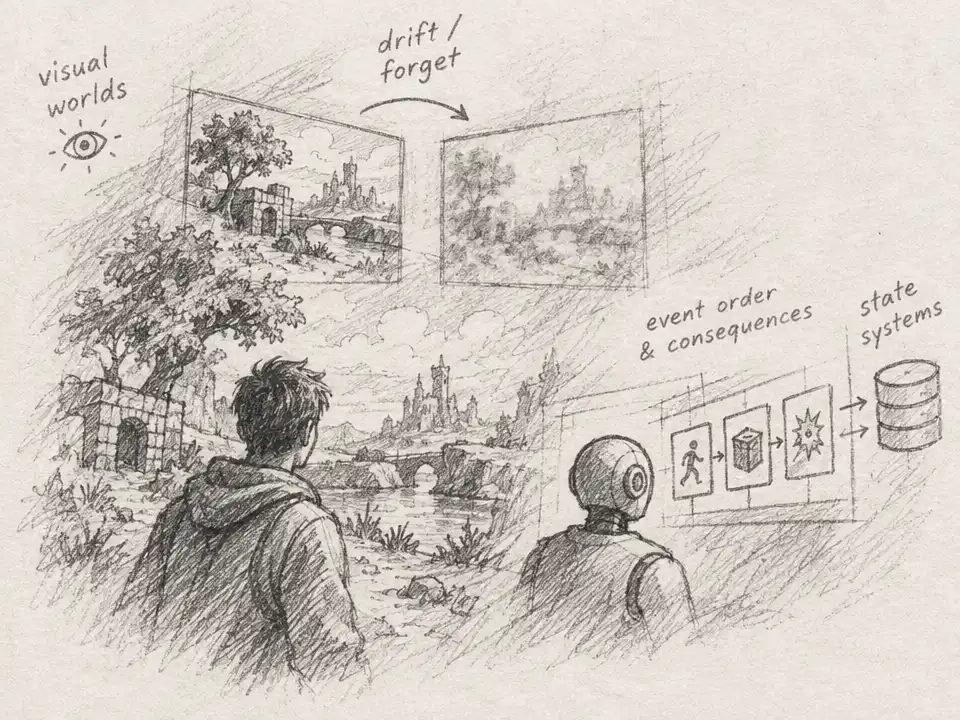
Imagine stepping into an AI-generated town at dusk. A bicycle leans against a café wall. You walk around the block and come back. The bicycle is gone; the café door is open, though you never touched it. The scene may still look lovely. But the place has lost its past.
That gap—between making a convincing image and maintaining a world that stays coherent—is the next frontier for interactive AI. A world has to do more than respond to a button press. It must preserve what happened, keep causes and consequences in order, and remember details when you return. Two recent arXiv preprints test that challenge from different directions: one studies interactive video worlds, the other language-model agents that update an explicit world state.
WorldRoamBench puts viewers inside generated environments and asks them to keep moving. Its test suite spans more than a thousand cases in natural, urban, and indoor scenes, with first- and third-person views and continuous interaction lasting 10 to 60 seconds. The researchers evaluated 12 interactive world models across action following, visual quality, physical plausibility, and memory. These are not long-term deployments; they are structured tests of what happens when a model must sustain an experience beyond a short clip.
The results separate abilities that can look interchangeable in a polished demo. A system may respond to movement yet fail to preserve a scene. Across models, memory scores dropped by an average of 37% between the benchmark’s short and long horizons. Action-following scores were much steadier, falling by an average of 3.6%. One model could trace a strong path through a scene and still score poorly on remembering it. A world can keep moving while quietly rewriting what came before.
The benchmark also reveals why a single score can mislead. A model might ignore a command briefly, then overcorrect; the final path could look close to the intended one even though the moment-to-moment experience was wrong. Or a model might stop at a wall, behaving more plausibly than a test’s straight-ahead route expects. The researchers therefore separated command-following from physical behavior rather than treating them as the same skill. Their approach to memory also tried to account for a basic confound: a model that fails to return to the same viewpoint may seem to have forgotten the scenery, even when it simply arrived somewhere else.
A second study, World Agent, asks a different question: can a language model keep an already-defined world running? Here the world is represented by explicit data and rules, not by a stream of generated images. The model receives a narrative in stages and uses tools to update the world’s state. To succeed, it must record the relevant events and preserve their dependencies, timing, and overlap. A final state that looks right is not enough if the events that should have led to it were skipped or put in the wrong order.
Across eight models, World Agent found that performance weakened as the benchmark removed more of the world’s prebuilt structure. Causal relationships were the weakest component for every model at the hardest level. In a separate prediction task, models were more reliable when they could receive feedback after each action than when they had to forecast a long sequence unaided. At a 48-unit lookahead, the average score was about 0.15. That is a benchmark result, not a prediction about 48 minutes or hours: the study’s units belong to its simulated systems.
Together, the studies suggest a useful design principle for future virtual worlds: give the system something sturdier than its latest picture to remember. An explicit record of objects, events, and changes could help keep visual generation tied to a persistent state. That is a possibility suggested by the contrast between the papers, not a system either study built or tested. If the idea works, it could make interactive environments feel less like sequences of attractive scenes and more like places where actions have durable consequences.
Such places might eventually support richer games, creative exploration, or training scenarios in which returning to a location matters. But neither benchmark demonstrates that these systems are ready for real-world training or dependable simulation. WorldRoamBench tests journeys of at most a minute, uses a limited set of scenes and mostly navigation commands, and relies partly on estimated camera motion and automated judgments. World Agent’s maintenance scores also involve a language-model judge; the authors make judgments reviewable, but note that reviewability does not guarantee correctness.
The price of the next frontier, then, is not simply sharper images or longer videos. It is continuity—and the difficult business of measuring it. A virtual world must remember what changed, distinguish a real cause from a plausible-looking coincidence, and keep its rules intact when nobody is watching. Until those abilities hold up over longer, less controlled encounters, the most convincing AI world may still be a set that gets rebuilt between visits.