A handoff can hinge on a moment too small to notice: the instant a person has the object securely enough for a robot to open its gripper. Release too soon, and the object may fall. Wait too long, and the person may tug awkwardly—or give up. A force sensor can register a touch or a pull, but those signals do not always reveal whether someone has a firm hold.
One reason is that the same force can mean different things. A person might pull upward to take a mug, but a light touch from below can also push upward. A robot that releases whenever it detects a familiar force may mistake contact for control. Rules built around one expected gesture can also falter when people hold objects differently.
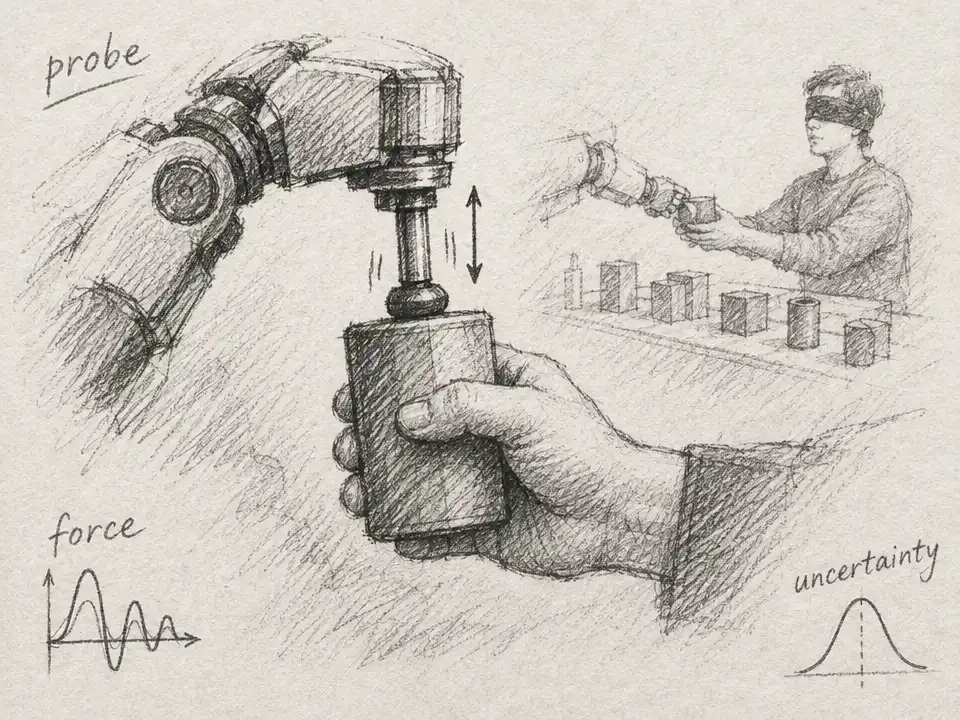
In a paper posted May 6, 2026, researchers Linfeng Li, Lin Shao and David Hsu propose a different tactic: rather than simply watch and wait, have the robot make a small, deliberate movement and measure how the person responds. The motion is not a tug-of-war. It is a probe—an attempt to create the evidence that a passive sensor cannot get from a still object.
The key is to ask whether the person resists movement in both directions. A fingertip brushing an object may oppose a nudge one way but offer little resistance the other. A stable grasp is more likely to push back either way. To test that distinction, the robot uses a force-torque sensor mounted at its wrist to estimate the forces between the person and the object. The researchers’ model focuses on the vertical component: how the person’s force changes when the robot tries to move up or down.
That relationship is represented as two straight-line responses, one for each direction of motion, with uncertainty attached to both. The model updates as new motion-and-force measurements arrive. If the robot has only moved one way, it cannot confidently infer what would happen in the untested direction. That uncertainty matters: a weak response in the measured direction might fit either a light touch or a firm grasp. A probe in the other direction can help separate them.
The robot does not choose its motion at random. Its controller estimates which small movement would most reduce uncertainty, while accounting for the arm’s movement limits. Every 0.1 seconds, it considers 11 possible vertical targets within ±2 cm of its current position. It predicts what each choice would reveal over the next 0.25 seconds, then selects the most informative feasible option. The contact model updates at 200 Hz, and a separate grasp check runs at 50 Hz.
Less uncertainty is not, by itself, enough to authorize release. The researchers define a firm grasp in practical terms: the person should be able to support at least half the object’s weight and produce a pair of small opposing forces. Their check asks whether those target forces remain possible even after accounting for uncertainty in the estimated motion-force relationship. In the study, the model had to meet that test at a 99% confidence level before the robot let go.
To see how this approach worked with people, the team tested a Franka Research 3 robot arm fitted with a parallel gripper and force-torque sensor. An overhead depth camera helped locate the participant’s hand. Twelve participants tried handoffs with a range of 30 rigid objects, including objects of different shapes and weights. They were blindfolded so they would not be able to compensate visually for a robot’s release mistakes, though the setup could still guide a hand back into the robot’s working area.
Each participant tried three release methods. One opened the gripper when the measured interaction force passed a threshold of 1 Newton. Another relied on changes in the object’s apparent load, an approach that can effectively ask a person to lift upward to signal readiness. The third was the researchers’ active-probing method. Success meant that the person had a firm grasp at the moment the robot released the object. Three independent experts, unaware of which method had been used, judged the trials from video.
The probing method achieved a 97.5% success rate, compared with 67.5% for the force-threshold method and 65.0% for the weight-based method. The simpler rules failed in opposite ways: one often released soon after first contact, while the other could let go too early with light objects or keep holding heavier ones after the participant had grasped them. The active method was more reliable in this test, but some participants felt it took too long to check. Survey scores for workload and usability were broadly comparable across methods.
The results do not yet show how the method would perform in every kind of handoff. The experiment covered rigid objects, and the model relied on force sensing rather than combining force with vision or spoken cues. Because it focused on vertical motion, a strong sideways push could also be mistaken for a sign of resistance. The researchers note that the probing can prolong a handoff, a real tradeoff when a robot must be both careful and quick.
Still, the central move is simple and useful beyond this particular grip: when a signal is ambiguous, a machine can make a controlled change and observe what follows. The robot does not have to guess what a single tug means. It can test how the object responds, track what remains uncertain, and wait until the evidence supports letting go.