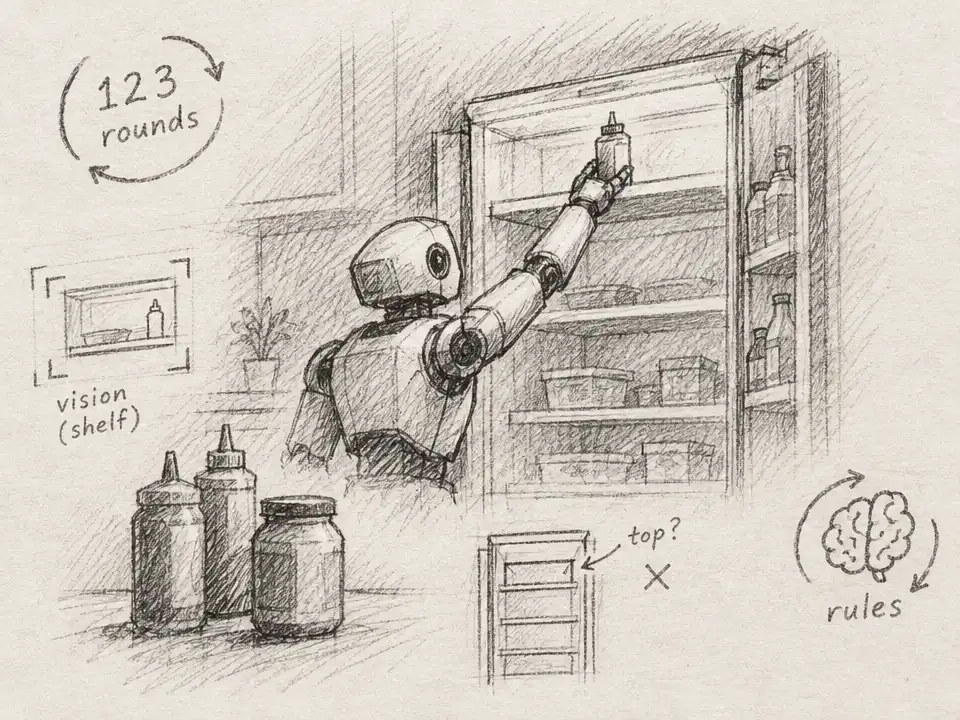
A book lies partly trapped beside a box. To free it, a robot may need to nudge it sideways, find a grip, and lift without knocking it to the floor. The tricky part is not simply moving a gripper. It is knowing where the book’s edges are, what lies on the far side, and which touch might actually help.
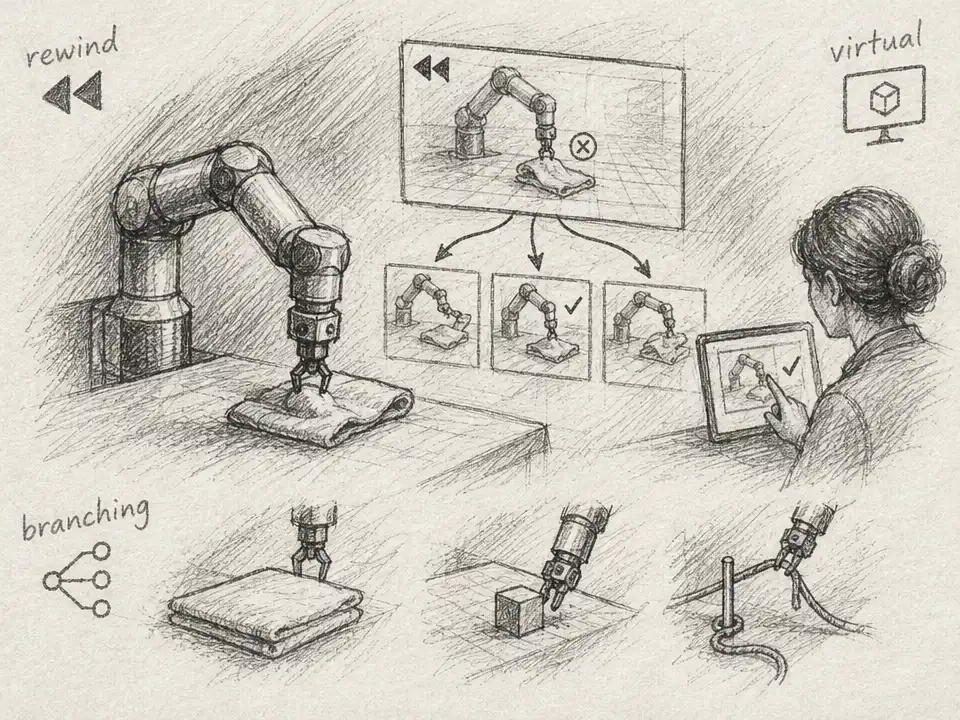
A new system called ZeroBot tries a striking shortcut: let the robot look at an object once, build a virtual version, and practice there before making contact in the real world. In tests, the robot learned a range of object-handling tasks from scratch in minutes—without demonstrations, a pre-trained robot policy, or a catalog model of the object. The longer-term possibility is a machine that can adapt to new things without waiting for a person to teach it each move. The catch is that its toy world must be a good enough stand-in for the real one.
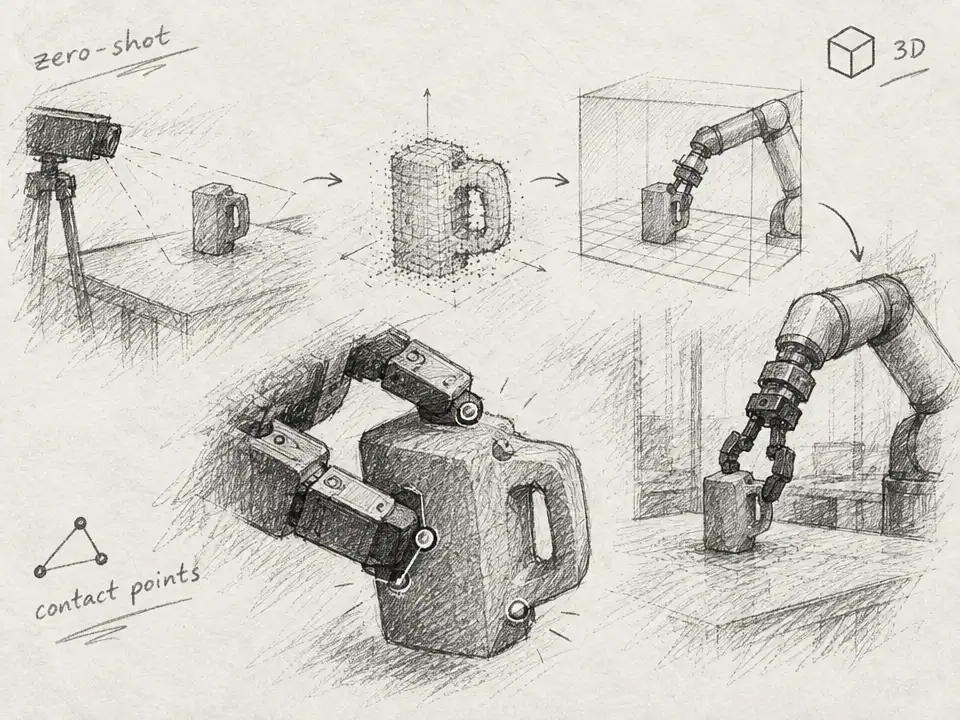
ZeroBot begins with an RGB-D image: a color picture paired with depth information. In the researchers’ setup, a person clicks on the object to identify it. An image-to-3D model then uses the visible view to generate a complete mesh, including surfaces hidden from the camera. The system uses depth data to set the mesh’s real-world scale. Its mesh-generation step runs in about 10 seconds on a desktop graphics card.
That unseen geometry matters. A robot pushing a bowl from the far side needs a useful model of that side, even if the camera never saw it. A handle partly hidden behind a tumbler may still be the only place to grasp. Rather than ask the robot to learn every movement directly from camera pixels, ZeroBot tracks the object’s position and orientation and trains a policy—a rule for choosing actions—using those estimated states.
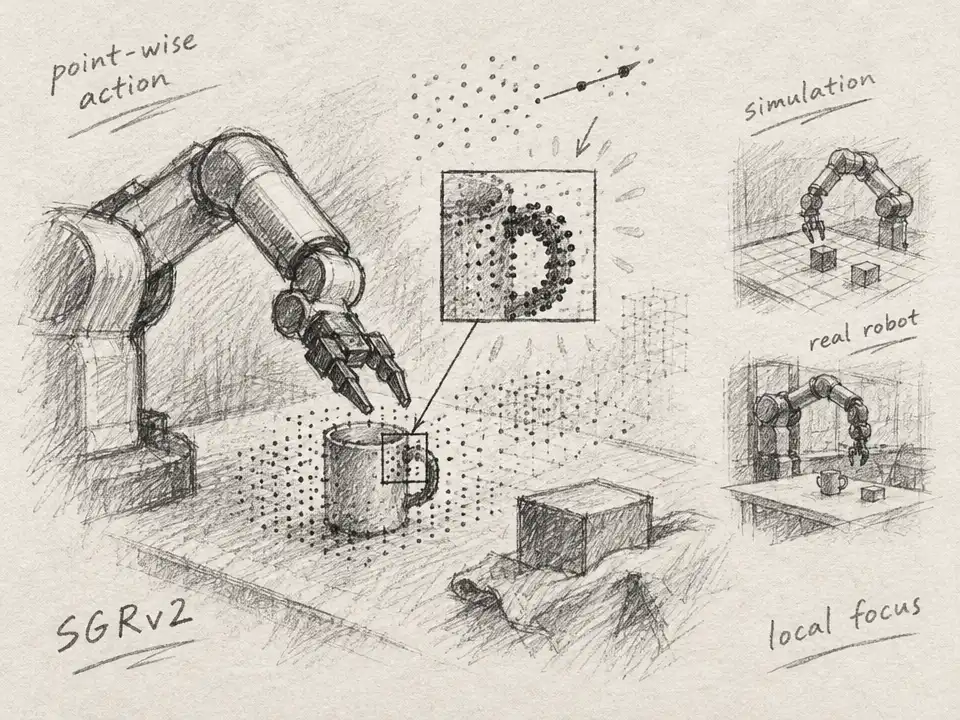
Next comes the virtual practice. The researchers place the generated object mesh in a physics simulation and train a robot arm using reinforcement learning. The important twist is where the robot starts practicing. Instead of spending much of its training time moving through empty space, ZeroBot samples possible gripper positions on the object’s surface. A learned value function scores these candidate contacts according to how promising they appear for reaching the goal. The robot can then focus its practice on touches that might move the object toward the target.
Imagine trying to slide that bowl toward yourself. Randomly waving a gripper around the tabletop is a slow way to discover that pushing the bowl’s far rim might work. ZeroBot’s contact-focused action space helps it explore such interactions directly. In simulation, the researchers trained 256 parallel agents, each practicing in its own environment. When the policy moved to the physical robot, the system used the learned value function to choose a promising contact, planned a route to it, and then executed its learned actions.
The tests were more varied than a simple pick-and-place demonstration. A seven-degree-of-freedom Franka research arm attempted six real-world tasks, including sliding a bowl, rolling a can up a ramp, pulling a bottle from a cluttered shelf, and nudging a book into position before grasping it. In the book task, simply gripping the object did not count as success: the robot had to lift its center of mass. For each task and method, the researchers ran 10 end-to-end trials, generating a mesh and training a policy anew each time.
Across the six tasks, ZeroBot reported an 87% success rate and an average training time of 119 seconds. It outperformed comparison methods that used an incomplete mesh reconstructed from the visible depth data or retrieved a similar object model from a database. The comparisons point to the value of generating a model for the particular object in front of the robot: a familiar bottle may have a close match in a catalog, but a less common tumbler may not.
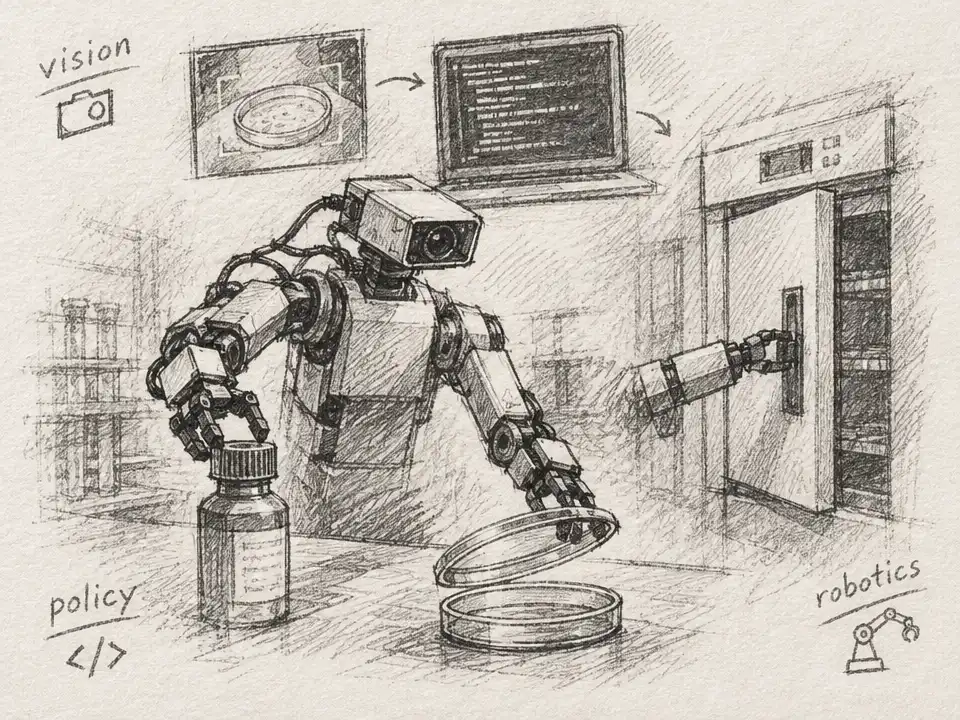
The result does not mean the robot has learned general housework, or that it can handle any object after one glance. The experiments mostly involved a single rigid object, and the input view needed to show it clearly. The system also assumed a static background. For its articulated-object demonstration—a robot opening a microwave door—the researchers supplied information about the joint and door segmentation rather than having the system discover those details itself. In simulation, they set a constant mass across objects instead of inferring each object’s true physical properties.
Those simplifications expose the price of speed. A generated shape can look convincing and still be wrong where a precise contact depends on a small feature. And geometry alone does not tell a robot exactly how heavy an object is or how slippery its surface may be. ZeroBot’s authors identify image-to-3D precision as a limitation; automatically inferring physical properties and articulation is left for future work.
The microwave test offers a glimpse of the tradeoff. A generated mesh took 23 seconds to create and supported an 80% success rate. A manually scanned reference mesh performed better, but creating it took 443 seconds, including an allowance of 290 seconds for scanning. In this case, the quicker, more autonomous route gave up some performance to save time and human effort.
That exchange may matter most in places where objects change faster than a robot can be programmed for them: a workbench, a stockroom, or a home. ZeroBot’s contribution is not that it knows every object in advance. It is a method for turning one view into a practice environment, then steering learning toward the moments that matter: contact. For now, the trick works within carefully stated limits. The frontier is whether better models of shape, mass, friction, and moving parts can let that small virtual rehearsal hold up in a messier world.