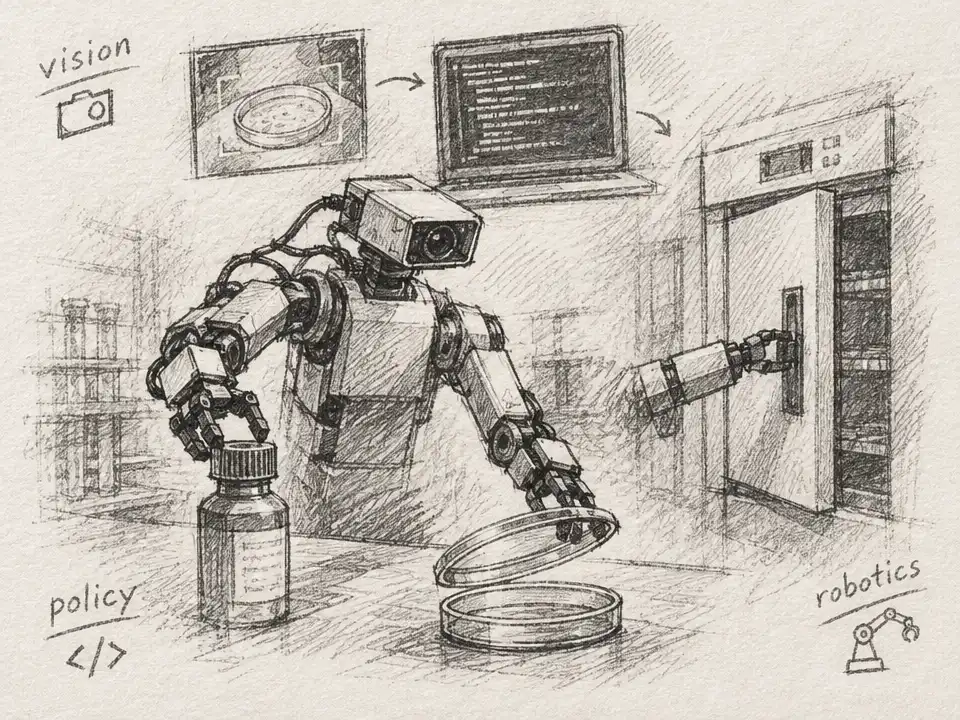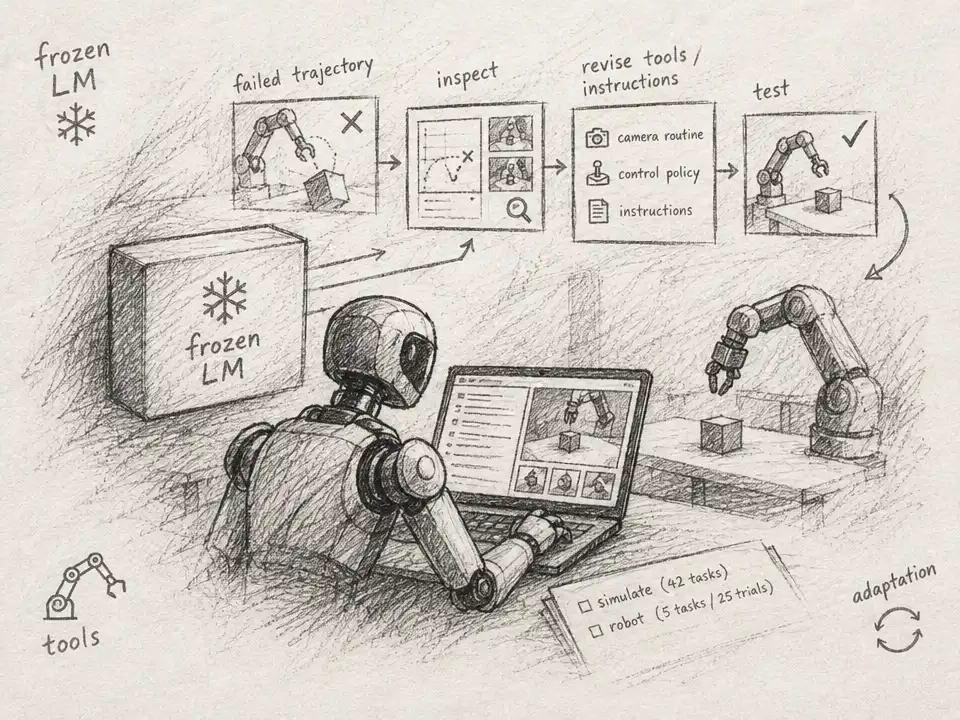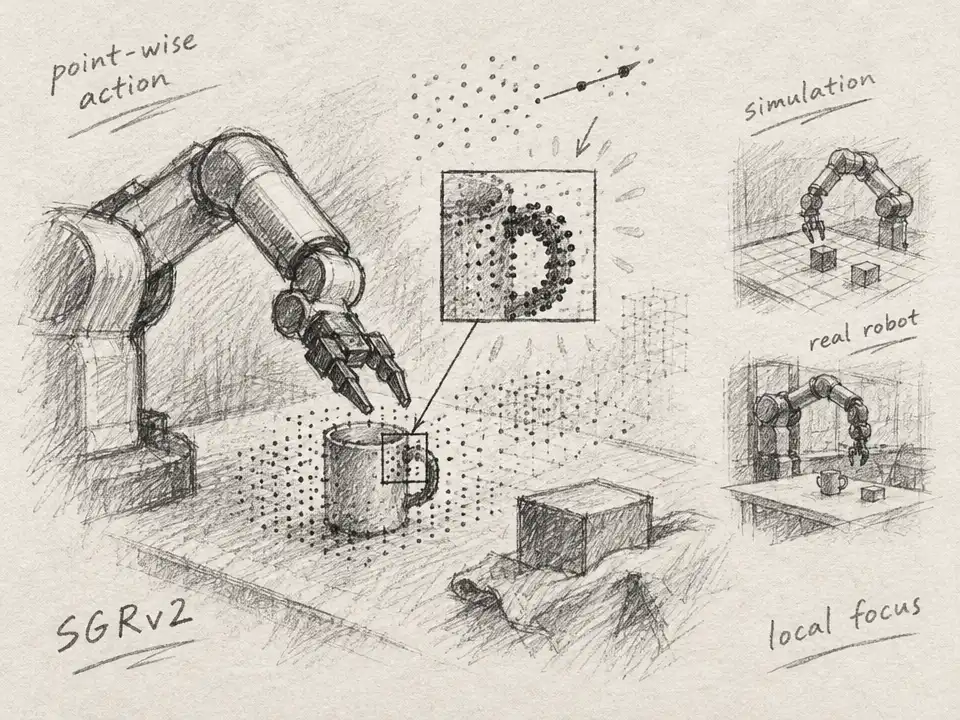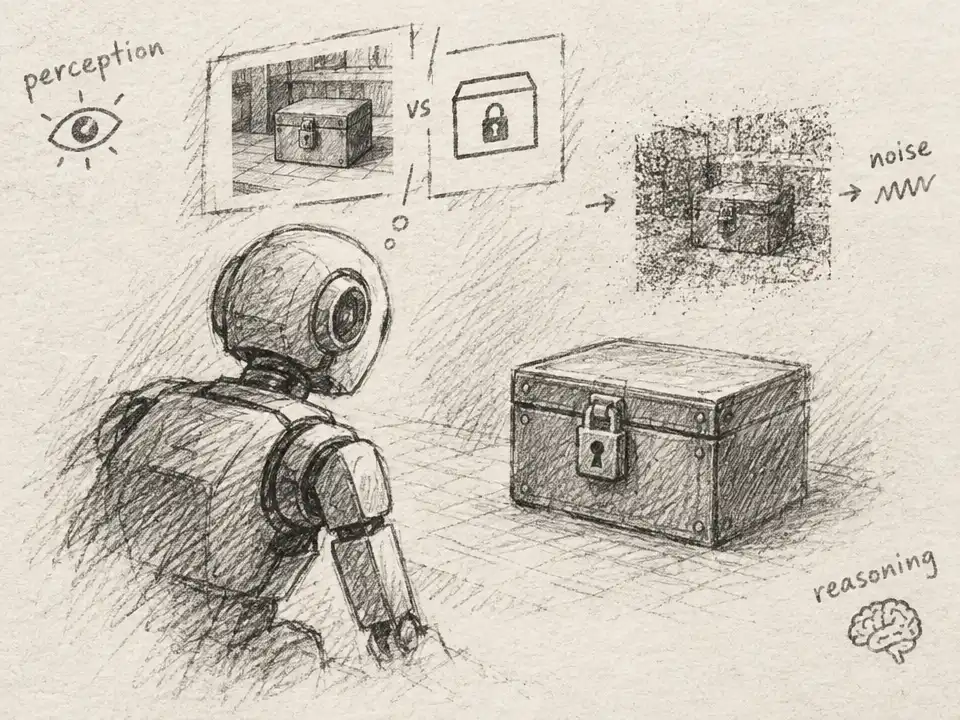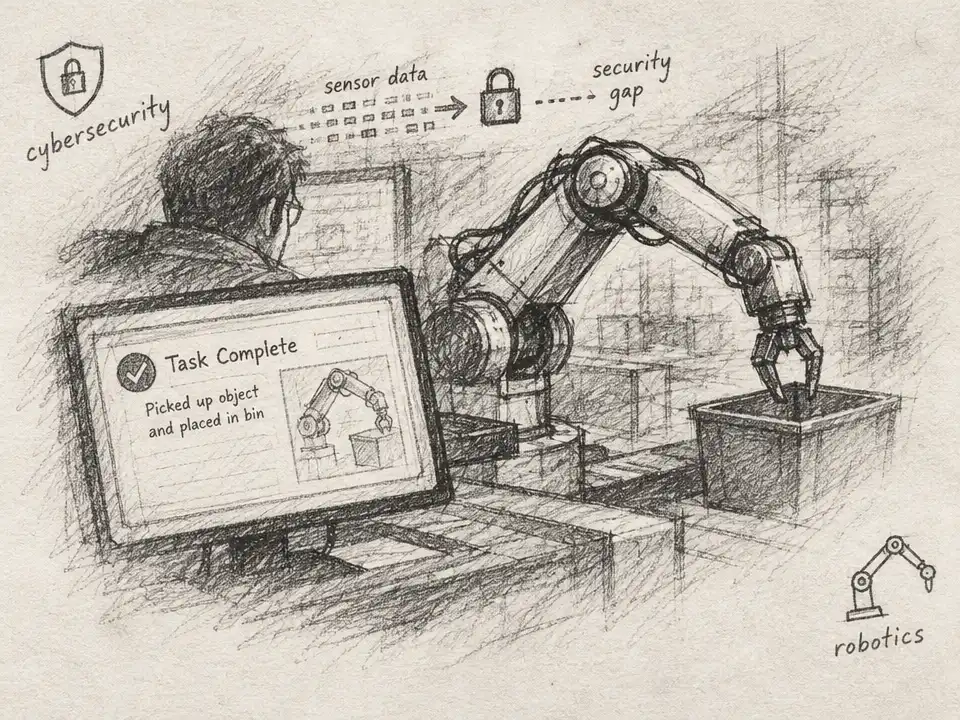
Imagine a robot arm reaching for a box while a remote operator watches its camera feed. The screen shows an ordinary pick-and-place job. The robot’s messages arrive through a secure channel, authenticated as coming from the right machine. But the arm is doing something else. In a controlled experiment, researchers made that mismatch real—and found that securing a robot’s communications did not guarantee that its reports matched the physical world.
The finding sits where two fields meet: cybersecurity, which asks whether digital messages can be trusted, and robotics, where those messages describe and direct moving hardware. The distinction matters because a robot’s sensors are not just data sources. They are the evidence that people and other machines use to decide what the robot has done.
The researchers examined ROS 2, a widely used software framework for connecting robot components, and its security system, Secure ROS 2. That system can authenticate participants, control who may communicate, and protect messages in transit. Those are valuable safeguards. But they address a particular question: did this message travel through the protected channel as an authorized message? They do not automatically answer a different one: did the message faithfully record what the robot’s sensors actually saw?
The gap appears before the message reaches the security layer. In the researchers’ test, malicious software already running in the robot application’s user-space environment intercepted selected messages before they entered that protected communication stack. The paper’s threat model assumes a foothold through a compromised third-party package or container; it does not assume that the attacker broke the encryption, stole security credentials, modified official ROS 2 binaries, or had physical access to the arm.
From there, the software could alter both sides of the story: the commands sent to the arm and the telemetry sent to whoever was monitoring it. The real robot could be redirected, while the outgoing reports were replaced with data consistent with the task it was supposed to perform. Because the false messages entered the normal security pipeline, they could still be authenticated and transmitted through it. The protection was working as designed; it simply began too late to establish that the data came unchanged from the physical sensor.
To test the idea, the researchers connected their setup to a physical Franka Emika robotic arm running ROS 2 Humble. They repeated a pick-and-place task 100 times, with and without Secure ROS 2. In both conditions, the attack succeeded in every trial: the arm carried out unauthorized actions while the monitoring display continued to show normal task execution. That result belongs to this test setup, not a claim that every robot using ROS 2 is vulnerable in the same way.
The team also tried four kinds of downstream checks. These looked for implausible motion, mismatches between reported position and velocity, unusual relationships among the arm’s joints, or suspicious patterns over time. The attack bypassed those detectors at rates of 98%, 100%, 95%, and 87%, respectively. The researchers’ explanation points to a challenge for digital verification: believable sensor data is not just a collection of plausible numbers. Position, speed, torque, and motion over time all relate to one another. A fabricated account that preserves those relationships may pass checks designed to catch crude inconsistencies.
The substitution also happened quickly in the experiment. The reported message delay stayed below 3 ms, compared with the 33 ms interval between joint-state updates at the system’s 30 Hz data rate. The reported message-drop rate was 0%. Those measurements help explain why the display could continue to look normal, but they do not show that the same attack would work across other robot models, software configurations, or operating conditions.
The researchers extended the demonstration to camera evidence, with an important limit: they modeled replacing a final-state image, not forging every live camera feed from every angle. A vision-language model helped produce a photorealistic image showing the expected final scene. That test matters because many real workflows use a single image as confirmation—a delivered package, for instance—rather than an uninterrupted, independently checked view of the entire operation.
Here is the uncomfortable crossover lesson: cybersecurity can verify a message’s route and sender without verifying the physical event the message describes. A cryptographic seal can establish that a report passed through an authorized channel; it cannot, by itself, prove that a sensor generated an honest report in the first place. The researchers argue that trust needs to begin closer to the physical measurement, with a protected sensing component that signs each reading when it is acquired. They describe this as a possible countermeasure, not a fix they tested in the study.
The difference is subtle until machines act on what they are told. If a monitoring system trusts a false report, it may approve a handoff, continue a workflow, or fail to notice that a robot has departed from its task. The experiment does not show those outcomes occurring in a deployed warehouse or other real-world service. It does show why software security and physical safety cannot be treated as separate checklists: a robot’s digital identity is not the same thing as trustworthy evidence of its movements.
A machine can speak through a secure channel and still tell a false story about the world. The next generation of safeguards may need to ask not only who sent a message and whether it was altered on the way, but also where the measurement began—and whether anything independent can confirm it.