Imagine laying 36 years of computer science on a table—not as code, but as millions of research papers, each leaving a trace of what scientists chose to investigate. One might expect the map to grow more varied as the field grows. Instead, a new study finds a puzzle: the breakthroughs that opened fresh territory also drew researchers toward the same crowded center.
The researchers assembled 7,180,635 computer-science papers, 73,089 peer reviews and records for more than 3.7 million scientists. Their question was not whether AI systems were getting more capable. It was whether the research community building them was spreading out to explore more possibilities—or concentrating its attention on fewer.
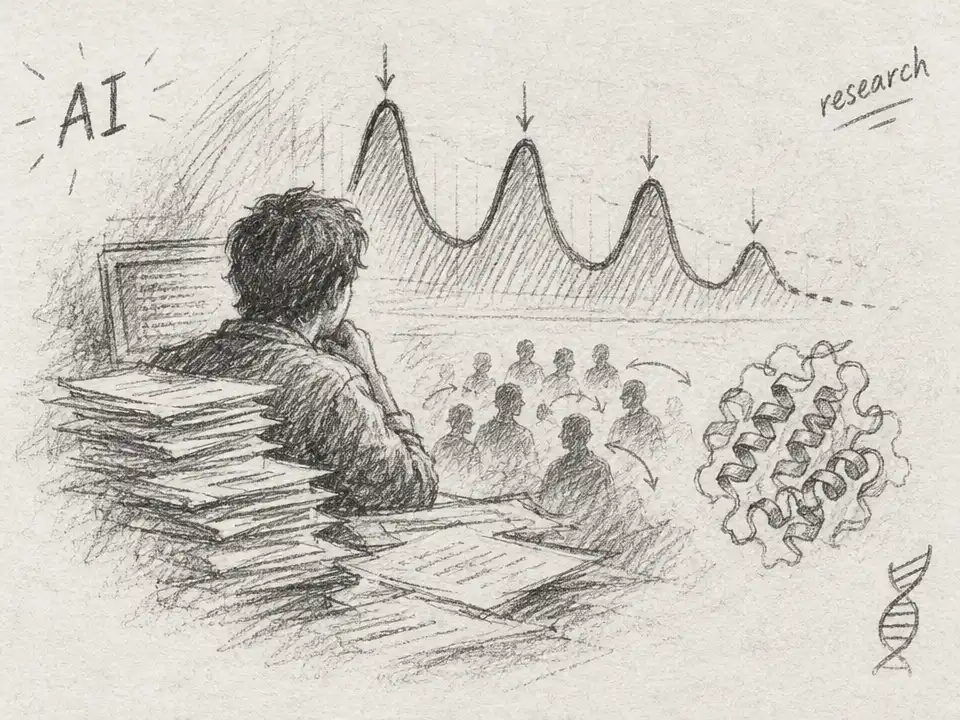
The surprise was not that breakthroughs brought a burst of activity. They did. After landmark advances such as AlexNet and the Transformer, the researchers saw new research ideas appear more rapidly. But the bursts were followed by downturns. And across successive technological waves, the decline in the pool of actively explored ideas became steeper.
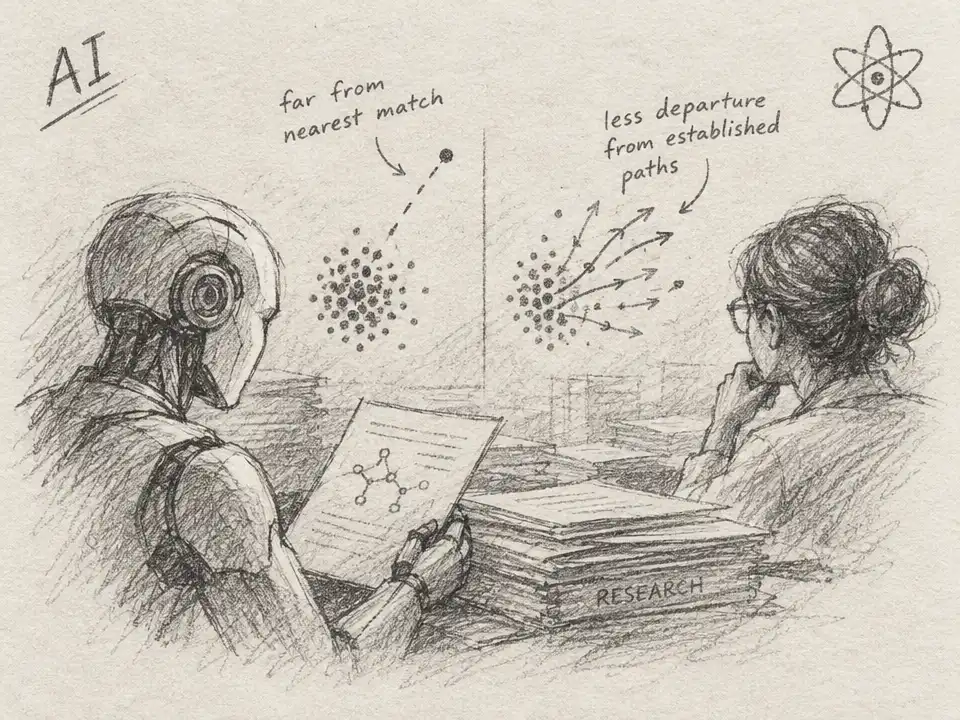
That turns a familiar story about innovation inside out. A breakthrough is usually pictured as opening doors. In this account, it does that—and then pulls a crowd through some doors while leaving others less visited. The winning approach gains researchers and papers, but the field may lose some of the intellectual variety that could help produce a different kind of advance later.
To look for this pattern, the team needed a way to track ideas across millions of abstracts. They used recurring nouns as a rough stand-in: a term counted as a stable idea when it appeared in at least 10 papers in two consecutive years. If it then disappeared from that stable status for three years, the researchers counted it as dead, though it could later return. They repeated the analysis with different language-processing methods and found similar patterns.
It is an unusual measuring stick. A noun is not an idea in the rich, human sense: two papers can use the same word to mean different things, while a genuinely new concept might arrive under familiar vocabulary. The measure is better understood as a way to trace the topics that research repeatedly names, not as a census of every original thought. The study also measured concentration in the keywords and citations papers attracted.
One clear shift begins in 2017, the year the Transformer architecture appeared. The inequality of attention across research keywords rose: the study’s Gini measure moved from 0.26 to 0.33 over the next eight years. Meanwhile, AI’s share of computer-science papers increased from 40% to more than 55% between 2017 and 2025. Systems research and theory contracted as shares of the field.
The people behind those papers were moving, too. Of 918,862 recorded shifts in researchers’ main subfield, 53.81% ended in AI. The researchers found that the likelihood of moving into AI peaked among scientists at an estimated academic age of 31.8 and at the 82nd percentile of prior publication output. In other words, the strongest migration signal came not from newcomers or the most established researchers, but from people with some experience and standing who still had room to change direction.
Peer review offered another sign of strain. Across the reviews they examined, reviewers’ reported confidence fell from 3.9 to 2.9 on a venue-normalized scale from 0 to 5. That does not show that the papers themselves got worse. The authors suggest that a fast-growing field can make it harder to match a submission with reviewers who know its particular methods and questions. The data show declining confidence; the explanation remains an interpretation.
The researchers then looked at the sequence of breakthroughs. AlexNet, in 2012, helped usher in modern deep learning; the Transformer followed in 2017; the large-language-model wave expanded after 2022. Each disruption coincided with a rise in new research vocabulary and then a retreat. The pool of active ideas seemed to swell and sag like an ecosystem after a disturbance, with the post-Transformer drop more severe than the one after AlexNet.
But the newest wave is also the hardest to judge. The paper’s research record ends in 2025, leaving only a few years of data after the 2022 surge. The authors note that this window is too short for a definitive conclusion about large language models. Their analysis suggests that the latest cycle may be bending toward decline unusually early; it does not establish that AI research has run out of ideas, or that the pattern will continue.
A comparison with structural biology adds an intriguing clue. The researchers report a similar cycle around cryo-electron microscopy and AlphaFold: advances were associated with new activity, followed by a narrowing or decline in some measures of active ideas. That echo suggests the pattern may not belong exclusively to AI. Still, it comes from the same broad approach to measuring ideas, and it cannot prove that a breakthrough itself caused the later change.
The paper also tests a possible institutional feedback loop using a computer simulation. In reciprocal-review systems, researchers who submit more papers take on more reviewing. In the model, that gives prolific researchers greater influence over which work gets accepted; if reviewers favor topics like their own, the accepted research cluster tightens. The result held across the model’s tests, but the authors describe it as an illustrative mechanism, not evidence that reciprocal review has already caused real-world intellectual narrowing.
The deeper implication is a tension between scale and variety. More researchers, papers and compute can make a field larger without making its search broader. A powerful new approach can raise the ceiling on what a community can explore while also steering more people toward the same methods, problems and incentives. The study does not tell us which neglected line of research will matter next. Indeed, the authors argue that predicting the next breakthrough is not currently possible.
That uncertainty is the point. If no one can reliably identify the next productive idea in advance, a field may need to protect room for work that looks peripheral while a dominant method is winning. The unexpected result is not that breakthroughs stop progress. It is that their success may help narrow the paths available for progress to take—and that a field’s next leap could depend on keeping some of those less-traveled paths open.