Imagine a car that unlocks when your phone is nearby. The radio link can be strong, the phone can be only a few feet away—and still, the distance estimate can change when you turn the device. That mismatch matters for Bluetooth’s newer Channel Sounding feature, designed to measure distance between nearby devices. A recent study suggests that one overlooked variable is not just what stands between the radios, but how they are angled.
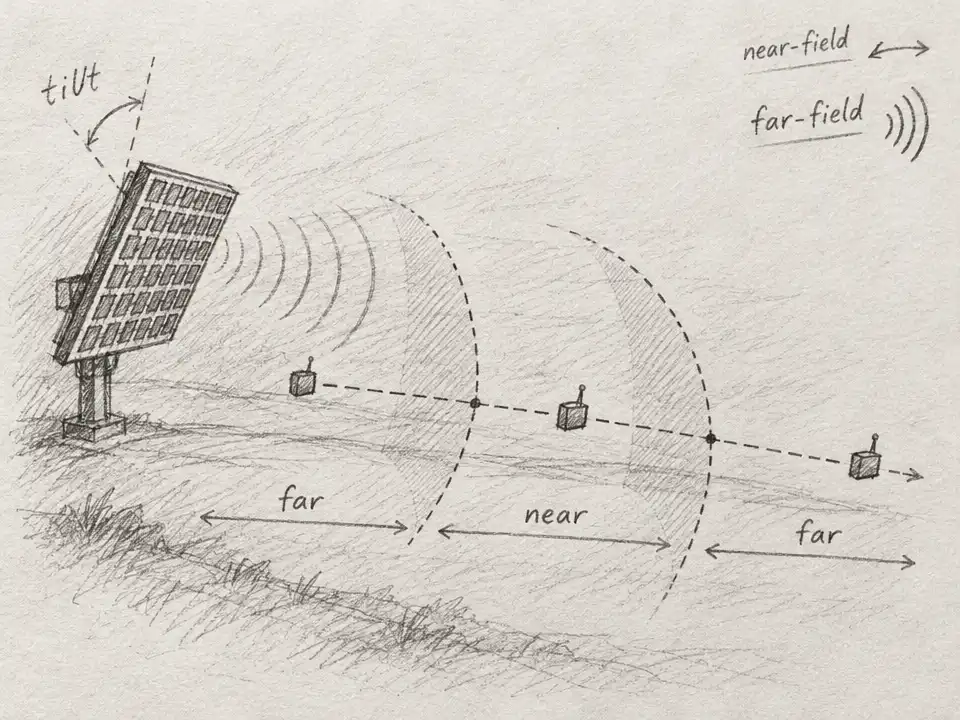
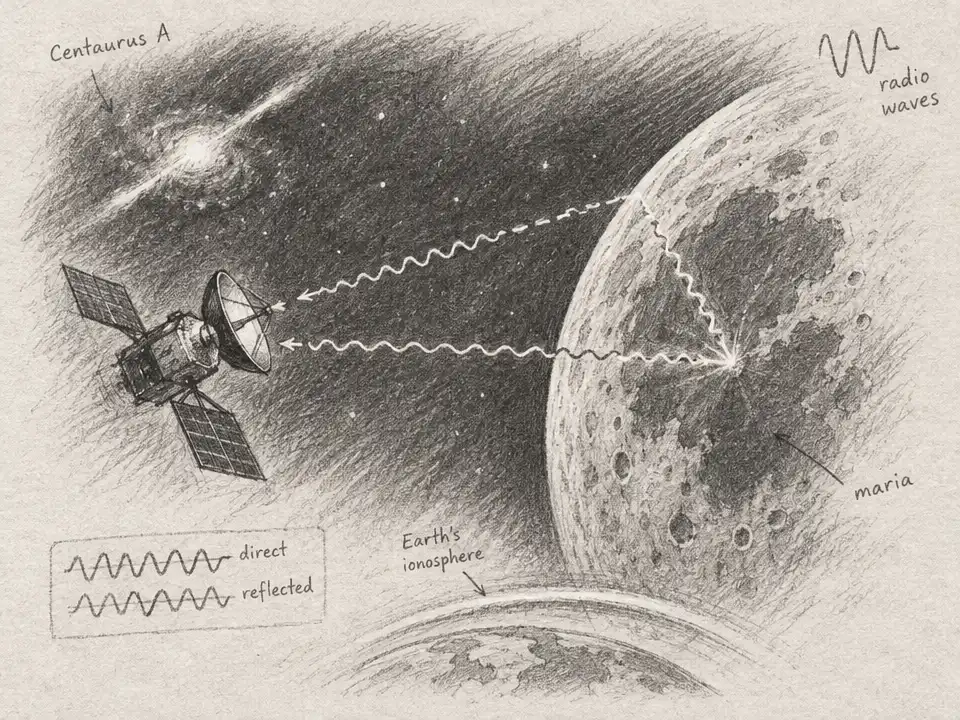
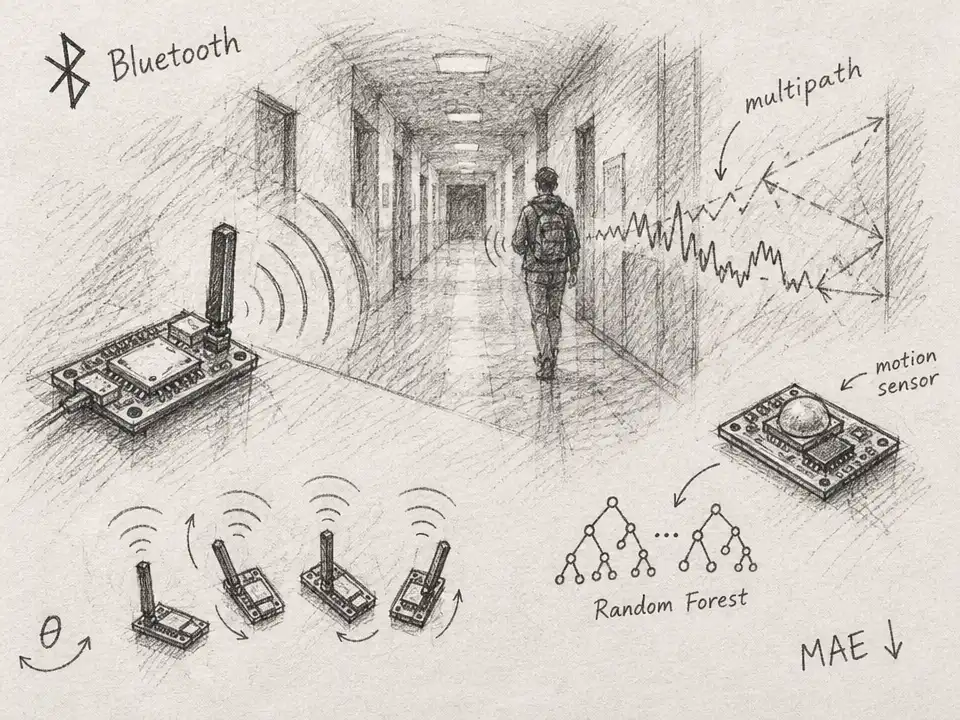
Channel Sounding estimates distance in two ways. One compares the changing phase of signals exchanged across Bluetooth channels; the other measures how long a signal takes to make a round trip. Neither method gets a perfectly clean path through a room. Signals bounce off walls and objects, creating echoes called multipath. And the antenna’s radiation pattern—the directions in which it sends and receives radio energy—changes when the device rotates. That can weaken the direct signal and leave the echoes with more influence.
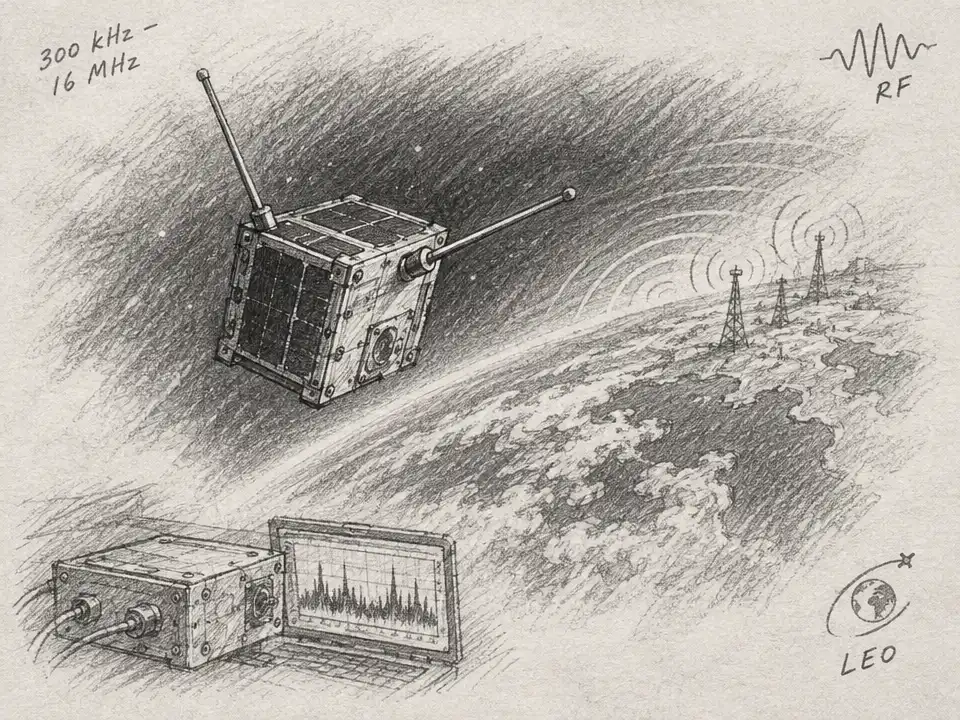
To measure the effect, Mihir Bapat and Santosh Nagaraj tested two commercial development boards. One transmitted the measurements; the other acted as a reflector. The transmitting board also recorded readings from its six-axis motion sensor, which measures acceleration and rotation. The researchers set the boards at nine distances, from 1 ft (0.30 m) to 30 ft (9.14 m), and tested nine orientations, including face-up, face-down, tilted toward the reflector, and turned onto an edge. They collected 44,576 measurements across 81 sessions in an indoor corridor.
The clearest warning appeared at close range. With the boards 2 ft apart, the mean absolute error—a measure of the typical size of the mistake—was 9.3 cm when the transmitter tilted 30 degrees toward the reflector. Turn it onto its left edge, and the error rose to 44.6 cm. That is nearly a fivefold difference at the same distance, under the same general test conditions. At 3 ft, rolling the board onto that edge again produced high error.
Distance itself remained a major challenge. Across all the measurements, the mean absolute error was 164.17 cm, with larger errors at longer distances driving much of that result. At 1 to 3 ft, errors ranged from 19.70 to 39.15 cm; beyond 5 ft, they ranged from 195 to 266 cm. So the orientation effect is not a magic explanation for every bad reading. It is one factor in a measurement problem that also grows harder as signals travel farther through an echo-filled indoor space.
The researchers’ explanation begins with the test board’s antennas, which are designed to radiate most strongly when the board lies flat. Rolling it changes how the antennas align with the reflector. The direct signal weakens, while reflected signals become relatively more important. The researchers also found that roll orientations produced a combined mean absolute error of 165.0 cm, compared with 140.9 cm for pitch orientations. The difference fits the antenna layout of this particular board; it is not a universal rule that rolling any Bluetooth device will always cause more error than tilting it.
Could the device notice its own pose and compensate? The team trained a Random Forest model, a machine-learning method that combines many decision trees, using the motion sensor’s readings alongside the ranging data. The important test was whether it could handle an orientation missing from its training examples. In a leave-one-orientation-out evaluation, the researchers trained on eight orientations and tested on the ninth, repeating the process for all nine. The model reduced mean absolute error by 74.6% on average, with improvements ranging from 61.5% to 83.7% for the held-out orientations.
That figure needs a careful reading. It means the model reduced the typical error relative to the uncorrected measurements in this cross-validation test; it does not mean every estimate became accurate to within a particular number of centimeters. And the model’s average reduction was 16.1% when the test instead withheld one of the nine distances. That gap suggests the correction learned more about orientation than about the broader ways distance changes radio propagation.
The authors also show why a seemingly impressive result can mislead. A random split of the data suggested a 96.9% error reduction, but consecutive readings at the same distance and orientation were so similar that near-duplicates could land in both the training and test sets. The team treated that result as unreliable and emphasized tests that held out entire orientations or distances. It is a useful reminder: a model’s score matters less than whether the test resembles the unfamiliar conditions it will meet outside the lab.
The possible payoff is practical. If a device already contains a motion sensor, using its readings to correct a Bluetooth distance estimate might require little additional hardware. That could help proximity systems work more consistently when a phone is in a pocket, turned in a hand, or mounted at an angle. But this study is a first step, not a ready-made fix for phones, cars, or access-control systems. It used one board design in one corridor, kept the reflector flat, and did not test varied rooms, obstacles, or moving users. The next frontier is finding out whether the correction survives all that variety—and whether a sensor that knows how a device is tilted can help a radio tell how far away its partner really is.