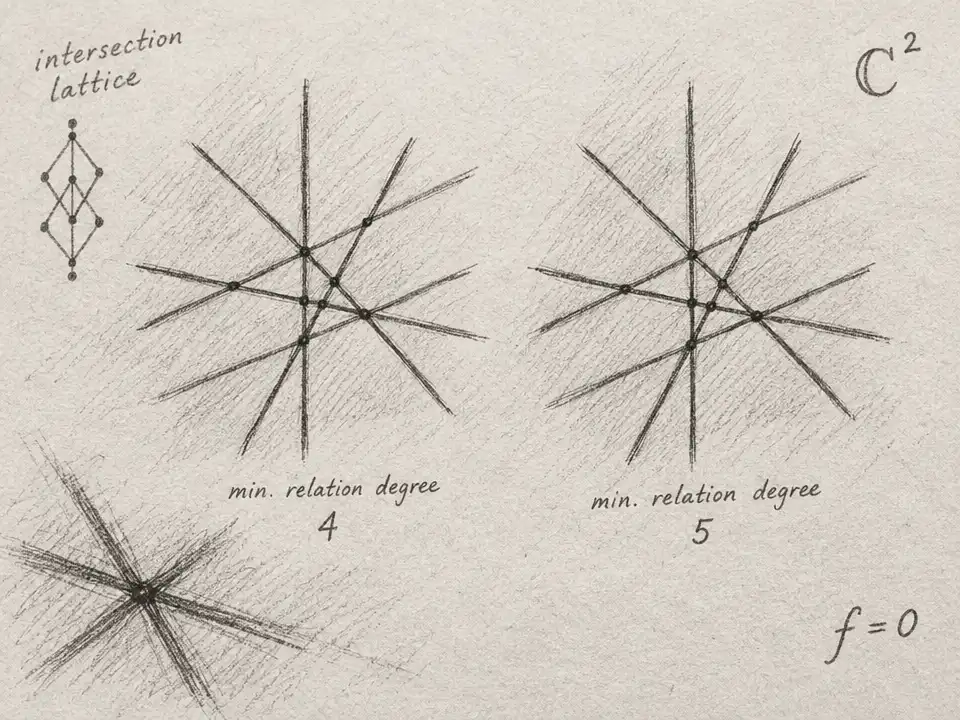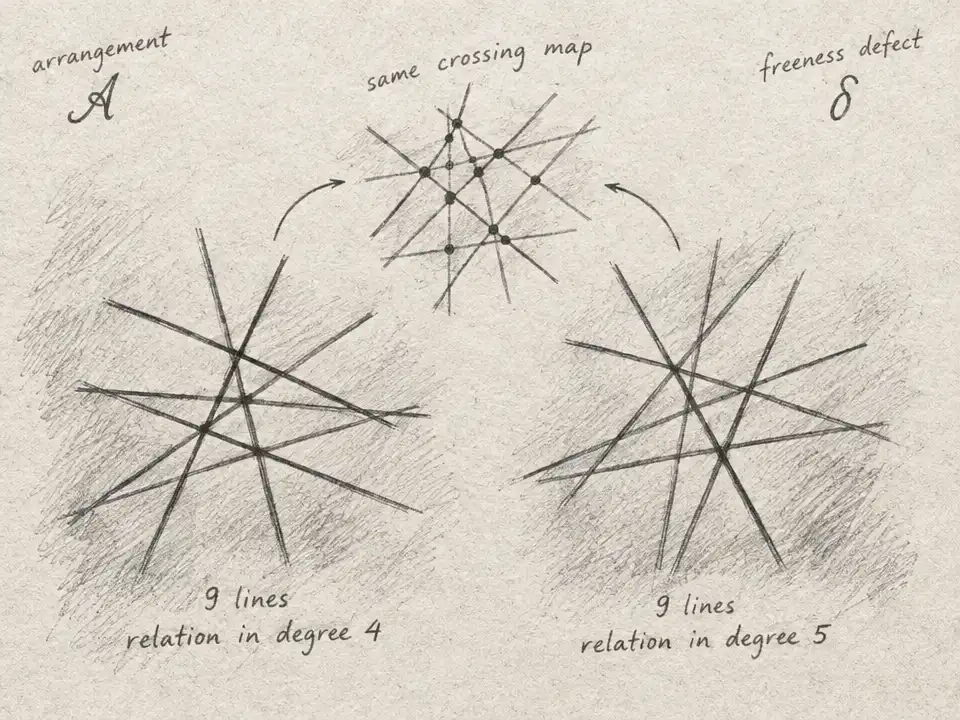
Imagine two drawings made from nine straight lines. In each drawing, every pair of lines meets, and the crowded spots line up perfectly: the same groups of lines gather at the same kinds of intersections. If you recorded only which lines meet where, the two diagrams would appear to have the same blueprint.
Here is the puzzle: could that blueprint still hide a difference?
Mathematicians Alexandru Dimca and Piotr Pokora built a pair of nine-line arrangements that answers yes. Their lines live in the complex projective plane, a setting where even parallel-looking lines count as meeting at a point. The useful map is not a picture of angles or distances. It is an incidence record: which lines pass through each shared point. The two arrangements have matching records, including nine ordinary crossings, seven points where three lines meet, and one point where four meet.
That seems like a remarkably complete description. Yet the researchers tested a different feature: the simplest algebraic cancellation hidden in each arrangement.
To see what that means, imagine multiplying the equations for all nine lines together to make one polynomial describing the whole arrangement. Differentiate that polynomial in three coordinate directions. A Jacobian relation is a set of polynomial weights that makes a combination of those three derivatives cancel exactly. The researchers ask how low-degree the weights can be. In one arrangement, a nontrivial cancellation first appears at degree four. In the other, it does not appear until degree five.
That one-step gap is the clue that cracks the case. The line-crossing blueprint matches, but this algebraic feature does not. The result supplies a counterexample to a proposed rule that, in a certain range, the lowest degree of such a relation should be fixed by the intersection pattern alone.
Could the mismatch be a bookkeeping error? The paper checks the full incidence structure, not merely the totals of double, triple, and quadruple intersections. The authors also calculate the relevant relations through exact linear algebra. For each degree, they test whether a cancellation exists; the first degree where it does gives the value that differs. This is not a visual impression that one drawing looks more tangled. It is a verified difference in what the defining equations allow.
So the first answer is unsettling: the crossing map does not contain every algebraic fact about the lines. But the investigation has a second turn. What if the researchers have chosen a measure that is unusually sensitive? Perhaps another meaningful measure of the arrangement’s algebraic structure is still determined by the same map.
A separate paper by Dimca and Pokora pursues that question through a related quantity called the freeness defect. In broad terms, it measures a feature of how the arrangement’s algebraic relations fall short of a particularly orderly structure called freeness. The paper asks whether this defect is fixed by the intersection lattice, even when the lowest degree of a Jacobian relation may not be.
The nine-line pair becomes a useful check on this rival explanation. It does not refute the freeness-defect conjecture: both arrangements have the same defect, even though their first Jacobian relations occur at different degrees. The distinction matters. Two arrangements can disagree on one algebraic measurement while agreeing on another. The first counterexample does not make the blueprint useless; it shows that different questions can demand different information.
The newer investigation pushes the second question further. It proves that the freeness defect is determined by the intersection pattern for arrangements of up to twelve lines, and for thirteen-line arrangements except a specific remaining case: those with a point where exactly five lines meet as the highest-multiplicity intersection. The result does not settle every arrangement, and it does not restore the failed claim about the lowest relation degree. Instead, it narrows the territory where the related conjecture could still fail.
How do the authors shrink that territory? One key move is a deletion argument. Under conditions they establish, removing a line from a hypothetical counterexample would produce a smaller counterexample. That lets them carry nonexistence results from one number of lines to the next. For the thirteen-line cases they analyze, they also reduce the possibilities to a finite list of intersection patterns and use computer-assisted classification to show that the remaining candidates cannot be realized over the complex numbers.
There is a pleasing detective-story rhythm to the result. First, matching blueprints seem to imply matching algebra. Then a carefully chosen pair breaks that expectation. Next, a rival explanation—that every useful algebraic measure has failed—also falls away: a related measure survives, at least across nearly all small arrangements examined so far. Each clue sharpens the question rather than ending it.
The lesson is not that a diagram of intersections tells us nothing. It is that a mathematical description can preserve one kind of truth and erase another. A list of crossings may tell you exactly how the lines meet, yet fail to predict the earliest cancellation among the equations that define them. Meanwhile, another measure of algebraic order can still be pinned down by that same list.
So the original puzzle has a careful answer. Yes, two arrangements can be indistinguishable by their intersections and still differ algebraically. But the next question is more precise: which hidden properties are truly encoded by the map, and which require details the map leaves out? For line arrangements, researchers have found one sharp failure and placed tight boundaries around a nearby open problem. The exceptional thirteen-line case remains on the board.