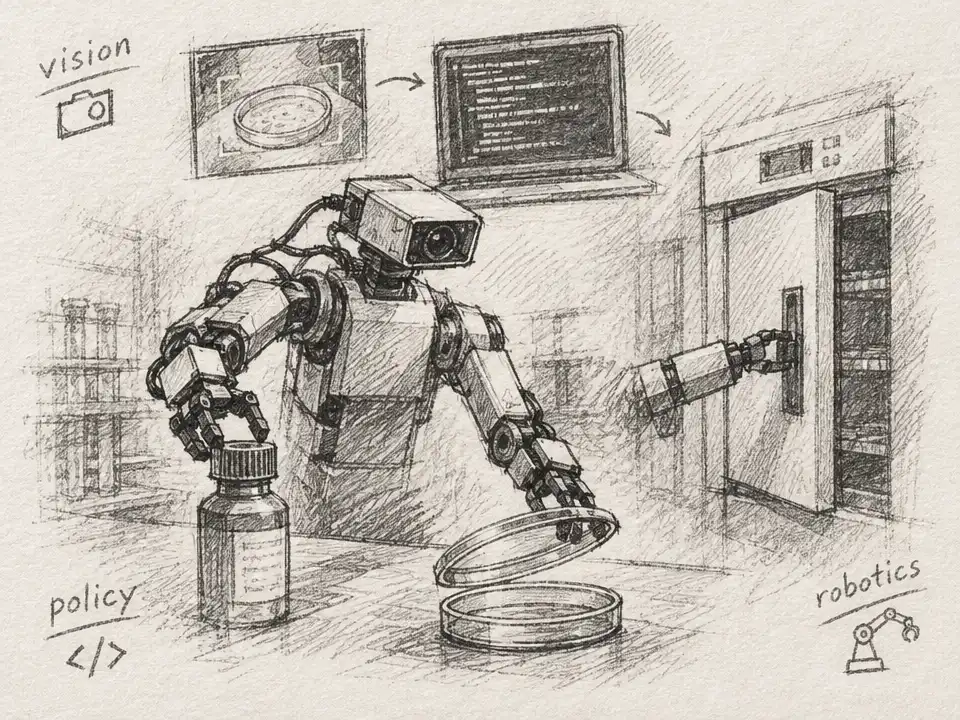
A robot reaches for a white bottle cap. Its jaws close—but the cap is still there, untouched. A camera view suggests the gripper is slightly off. The robot backs away, tries a new angle, and checks what its sensors say after the next attempt. This is not a prewritten routine running blindly. In a recent study, a coding agent inspected the lab and wrote new programs to guide a real robot through the job.
The setting was a biology lab, where everyday research can involve repetitive physical chores: opening containers, handling dishes, or reaching into equipment. Industrial automation can tackle standardized workflows, but individual labs often have different benches, cameras, and tools. A robot trained in one room may falter in another. The researchers behind WetRobo explored a different route: instead of training a new robot policy for every lab, could a coding agent adapt its instructions on site?
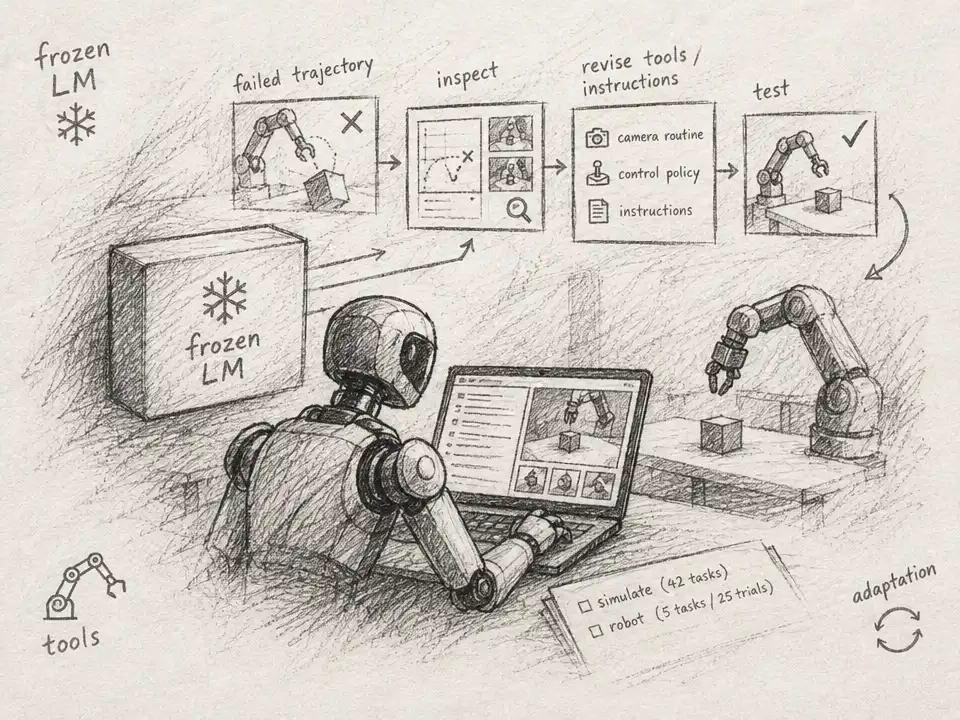
WetRobo is a reproducible kit: a robot arm, cameras, code for controlling the arm, demonstrations of basic tasks, and a file of operating instructions. Researchers gave the agent simple requests in ordinary language, such as “Lift the bottle cap.” The agent could inspect camera images and robot readings, run small tests, and write or revise programs as it went. It could also bring in familiar tools from computer vision and robotics when a task called for them.
That combination is the crossover at the heart of the work. Robot control has often been built around policies learned from demonstrations: show a system what a task looks like, then train it to reproduce the motions. WetRobo instead treated programming as a flexible way to build a controller. The agent could use a camera to locate an object, test how a small arm movement changed its position in the image, and calculate how to correct its approach. It was, in effect, turning observations into a custom procedure for the room it was in.
The experiments involved three small but recognizable lab tasks: lifting a Petri-dish lid, removing a screw cap from a reagent bottle, and opening an incubator door. The robot did not simply succeed on the first try. For the dish lid, the agent tried different ways of locating and grasping the rim, including using image segmentation and depth measurements. It also built a virtual scene to check possible grasps before trying them on the real bench. To tell whether the jaws had actually caught the lid, it compared gripper readings rather than assuming that a close command meant a successful grasp.
The bottle-cap test offered a direct comparison across two laboratories. The rooms differed in lighting, camera arrangement, gripper, and the bottle’s surroundings. The coding agent succeeded at the cap task in both. A vision-language-action policy fine-tuned on demonstrations from Lab X succeeded there but did not transfer to Lab Y. The contrast suggests that adapting a program to local conditions can help where a learned motion pattern does not carry over—at least for this task and these two setups.
In Lab Y, for example, the agent made small movements and watched how the scene shifted in the camera. Those probes helped it estimate the relationship between movements of the arm and shifts in the image, so it could correct its alignment. It also used depth information and measurements from the gripper to judge where the cap was and whether the jaws had a firm hold. When early grasps missed, the agent changed its approach and added a twisting motion before lifting. The important discovery was not a clever single maneuver; it was the process of measuring, revising, and encoding what worked.
The incubator task showed the same pattern—and its limits. In one laboratory, the agent gradually improved its alignment with the recessed handle, added checks for a secure grip, and used depth measurements to estimate the door’s angle. A short test pull helped confirm that the robot had hold of the handle before it continued. The task was completed in Lab X, but the attempt in Lab Y stopped when camera-based alignment was unreliable. So the paper does not show a robot that can handle any lab task in any room. It shows a system that can adapt, sometimes succeed, and also recognize when a step is not safe to continue.
That caution matters because the method has real costs and remains an early demonstration. Reaching the first successful bottle-cap grasp took 1 h 02 min in Lab X and 48 min 43 s in Lab Y. The study reports token use of 41.4 M and 23.0 M for those trials. The researchers also tested one coding agent and one model; the results came from individual adaptation trials, not many independent repetitions. The tasks were basic manipulations, not full biological protocols, and lifting a dish lid is not the same as carrying the dish securely.
Still, the experiment points toward a different model for laboratory automation. Instead of expecting every lab to train a robot from scratch, researchers might share a common kit and let software adapt its control code to local equipment. Programs and operating rules learned in one setting could then inform another, though how reliably that knowledge transfers remains an open question. WetRobo’s most interesting move is to make the robot’s instructions editable: not just a machine that repeats a skill, but a machine whose skill can be rebuilt around what it sees. For now, that is a promising tool for lab work—not a substitute for the people who design and supervise the experiments.