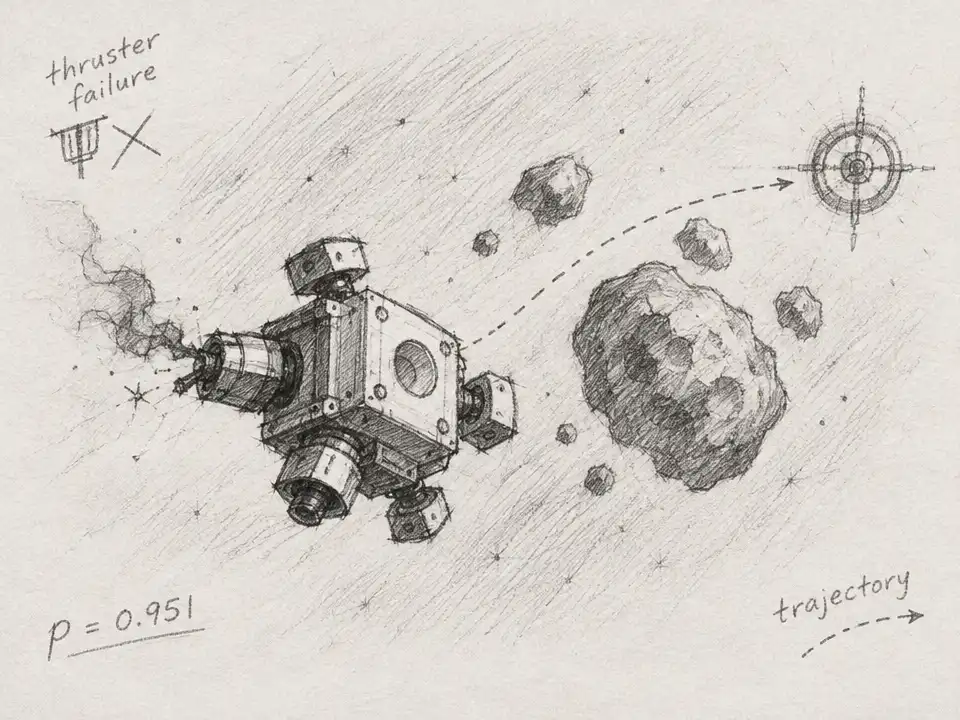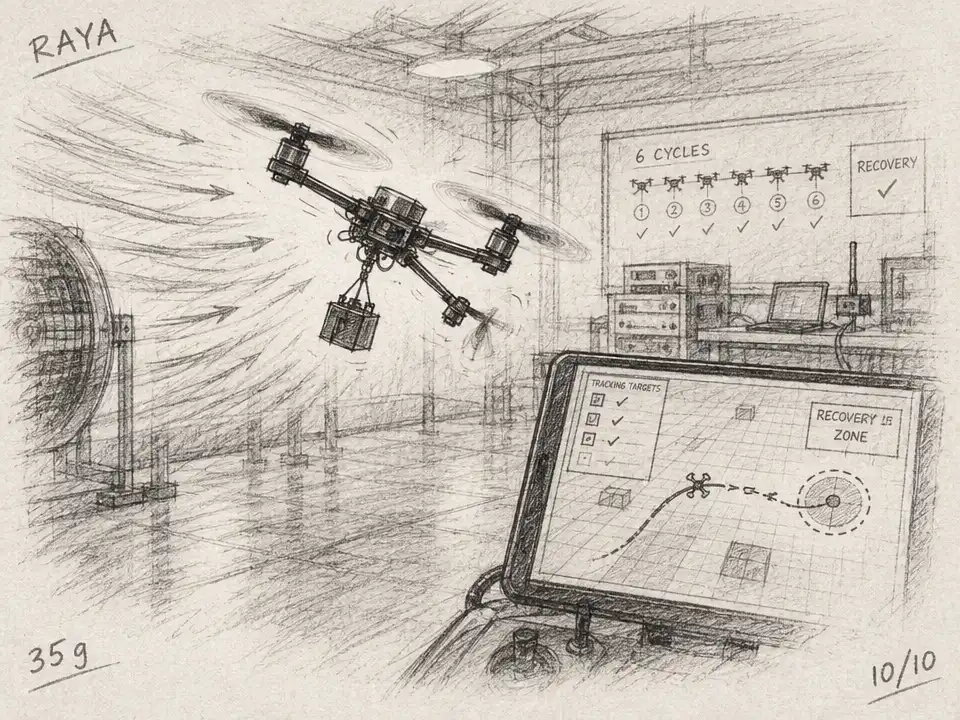
A 35g quadrotor traces a figure eight while two fans push it off course. In one test, the researchers add a 3 g attachment. In another, one motor quietly loses 40% of its command. The drone has a safety system meant to recognize trouble and steer away from failure. Yet the central puzzle is this: how can a controller spot danger and still be unable to save the machine?
The answer seems, at first, as if it should be better prediction. If a controller can see that a crash is coming, surely it can choose a safer move. But a warning is not the same as a way out. A quadrotor has only so much thrust and tilt it can command. If its ordinary flight plan has already spent that control authority, a last-second correction may be impossible.
That distinction separates two kinds of safety system. A common design lets the flight controller choose an action first, then asks a safety filter to inspect and alter it. Think of a driver who sees a skid and yanks the wheel after the tires have run out of grip. The correction may be sensible; the trouble is that it arrives too late to fit the situation.
The researchers tested this idea in RAYA, a control system that estimates how much room remains for recovery. It uses signals available to the controller—such as altitude, tilt, angular rate, and remaining motor authority—to estimate whether the vehicle is drifting toward a state from which recovery will become difficult. Crucially, that estimate is not just a veto applied after an action is picked. It becomes part of the calculation used to choose the action.
The first clue came from a comparison that held the warning signal steady and changed where it entered the process. In quadrotor simulations, ordinary control survived 34.24% of episodes. A post-action filter using the learned warning reached 34.45%, a result the paper describes as statistically indistinguishable from ordinary control. The warning was there, but placing it outside the plan barely helped.
Put that same learned margin inside the controller’s optimization, and survival rose to 37.48%. Add a second ingredient—a scheduler that adjusts which goals matter most as recovery becomes harder—and survival reached 40.83%. The result suggests the mystery is not simply whether the system sees danger. It matters whether the warning can reshape the plan before the remaining options disappear.
That scheduler introduces a second puzzle: what should a robot give up to stay safe? RAYA does not take over and invent a new flight command. Instead, it changes the importance of selected goals while the controller still chooses the action and respects its existing hard limits. For the quadrotor, it can let sideways position and speed tracking yield while giving more weight to keeping the craft level and controlling its rotation. In effect, the drone may briefly accept a less perfect path to preserve the ability to fly at all.
A small ground vehicle offered a useful check on whether the idea was peculiar to drones. In simulations with patches of low grip, ordinary control survived 35.93% of episodes. A post-action learned filter reached 39.43%; using the warning inside the controller reached 40.57%; and adding the scheduler raised survival to 48.73%. Here, changing task priorities contributed more than moving the warning inside the optimization. The best balance depended on the machine and the failure it faced.
The researchers then took the question out of simulation. They ran RAYA on the quadrotor’s onboard microcontroller at 20 Hz, with a 50 ms control deadline. The test missions called for six figure-eight cycles under fan-driven airflow, either with the 3 g attachment or with the 40% motor-command loss. Each of three comparison controllers—ordinary control, a control-barrier safety method, and a learned warning applied after action selection—failed to complete any of its five missions in either condition. RAYA completed all five in each condition.
One of those successes was not a graceful, contact-free flight: under motor loss, the drone touched the floor after 3.286 cycles, recovered, completed the remaining path, and landed under control. Four of the five motor-loss flights finished without contact. That detail matters. The experiment was about recovery and mission completion, not a guarantee that the drone could avoid every bump.
There were other possible explanations for the difference. Perhaps the new system simply had more computing time, or the advantage came from squeezing the algorithm onto a different kind of hardware. The team checked those possibilities: every controller met the deadline, and the post-action learned controller used about 85–86% of it, compared with approximately 89% for RAYA. The RAYA network and a cache supporting its calculations occupied 161 KiB of the microcontroller’s 1 MiB of flash. More computation alone did not explain why one controller recovered and the other did not.
The more telling clue was what happened when the late filter tried to intervene. Its requested correction was infeasible in 93.2% of attempted corrections under the aerodynamic mismatch and 97.9% under motor loss. By then, the plan had often left no admissible input capable of delivering the rescue. The safer controller’s advantage was not that it could break the limits of the hardware. It gave recovery a voice while the plan was being made, and let some tracking goals yield.
There are limits to what these tests establish. The hardware missions were controlled, and the result rests on five flights per controller for each disturbance condition. The researchers also selected which signals predicted lost recovery and which objectives could yield. They identify messier situations, such as contact-rich manipulation and legged locomotion, as important challenges ahead. So the finding is not that a learned warning makes robots safe in general.
It is a more precise answer to the opening puzzle. Seeing danger can be useless if the robot waits until after it has committed to a plan. Recovery depends on intervening while the machine still has room to change course—and sometimes on allowing the mission’s immediate goal to give way to keeping the machine controllable.