Imagine a three-way grid whose pattern looks identical if you swap any two directions. Now try to build that grid from the simplest pieces possible. Must each piece share the grid’s symmetry? For a long time, mathematicians suspected the answer was yes. A new construction makes the puzzle concrete: one perfectly symmetric object can be assembled in 55 unrestricted pieces, but it takes 56 pieces if every piece must be symmetric on its own.
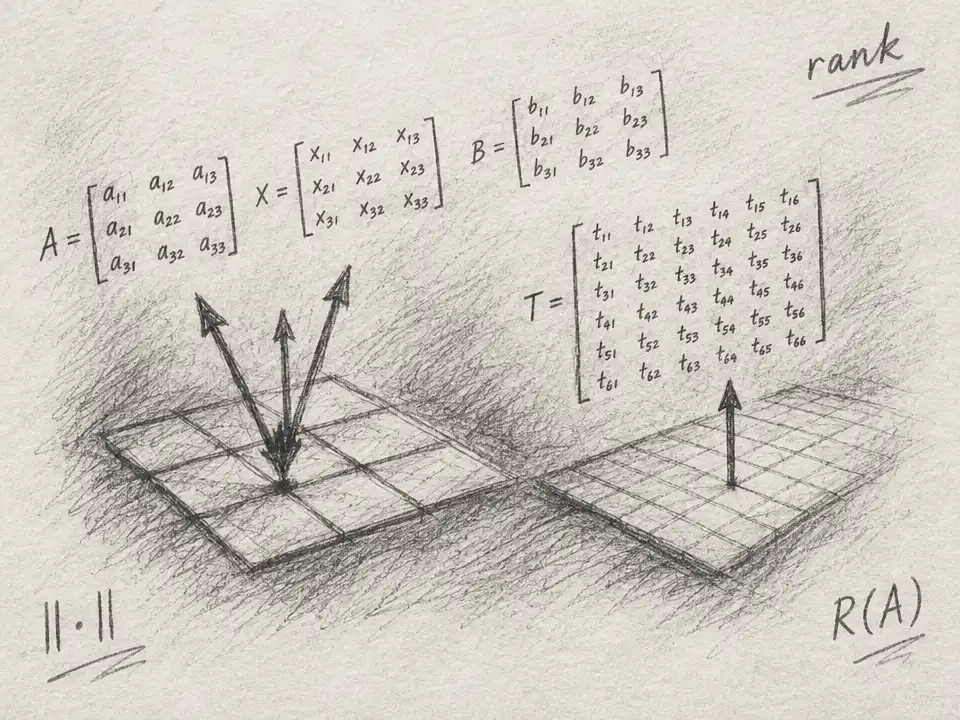
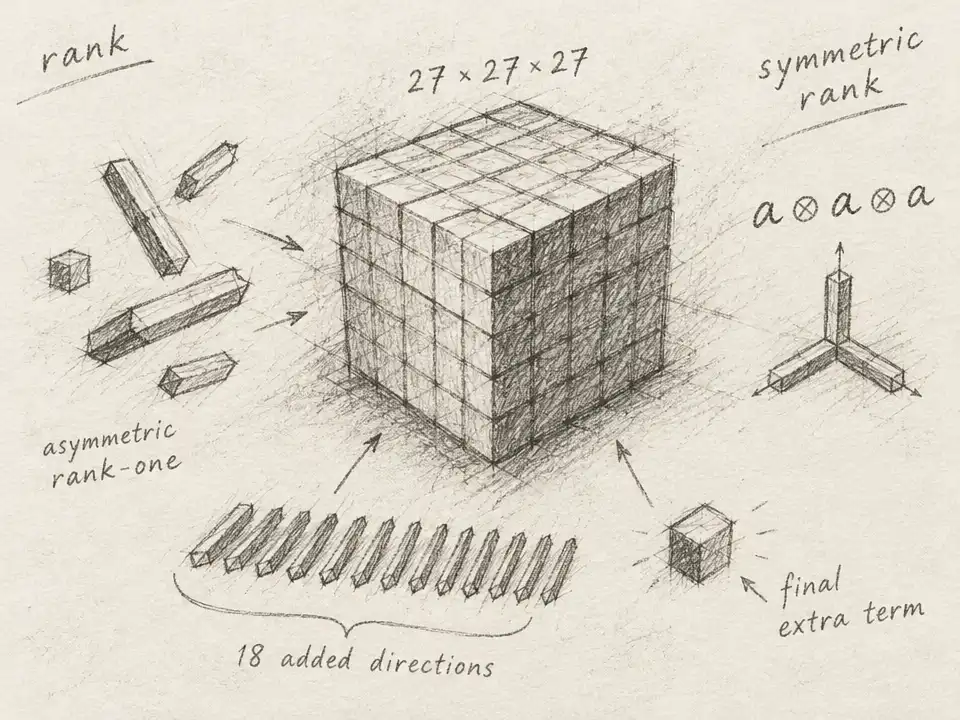
The object is a tensor, a mathematical way to record relationships across several directions. Here it has three directions, each with 27 coordinates. “Symmetric” means that exchanging those directions leaves the tensor unchanged. A rank-one piece is built by choosing a pattern for each direction and combining them. In an unrestricted piece, the three patterns can differ. In a symmetric piece, all three must be the same. Rank counts the fewest pieces needed to build the whole object.
That distinction sounds like it ought to disappear when the finished tensor is symmetric. After all, its three directions are interchangeable. But symmetry of the final result does not require symmetry of every ingredient: lopsided pieces can combine so their imbalances cancel. The real question is whether that freedom can save pieces, or whether any efficient lopsided construction can always be replaced by an equally short symmetric one.
For matrices, which have only two directions, the two kinds of rank agree. For higher-order tensors, the proposed equality became known as Comon’s conjecture. Earlier work had produced counterexamples in other settings, but the cubic case had a special appeal: it asks whether a three-way symmetric object can always be built just as economically from symmetric pieces. In a paper posted to arXiv on September 25, 2026, Benjamin Lovitz gives a sharp answer. His explicitly constructed tensor has ordinary rank 55 and symmetric rank 56, over the rational, real, and complex numbers.
The first clue is the scale. A tensor with 27 coordinates along each of three directions has a daunting number of entries, so searching all possible decompositions directly would be a dead end. Lovitz instead uses a framework called a symmetric adjoin construction. Its trick is to design a smaller, hidden puzzle first, then add new directions in a controlled way. The added structure makes the final object larger without obscuring where the difference in the two ranks comes from.
At the heart of the design are 18 carefully chosen rank-one symmetric matrices. They are arranged in two groups of nine, built from two five-dimensional spaces that share one direction. Together, those overlapping spaces form a nine-dimensional starting space. The construction then adds 18 more directions, bringing the total to 27. This is not just padding: the added directions create a predictable cost in both kinds of decomposition, allowing the researchers to isolate the tiny discrepancy underneath.
Here is the hidden puzzle. The framework reduces the rank question to a carefully chosen affine family of smaller tensors. Think of it as a restricted search area: its members differ in permitted ways, but all retain the essential structure of the original problem. Lovitz arranges for this family to contain a rank-one tensor whose three patterns are not all alike. So the unrestricted version of the remaining puzzle can be solved with one piece.
But the family contains neither zero nor a symmetric rank-one tensor. That rules out the tempting escape route: there is no single perfectly balanced piece hiding in the search area. At the same time, the family does contain a symmetric tensor that can be expressed using two symmetric rank-one pieces. The choice is now exposed. One lopsided piece solves the residual problem if asymmetry is allowed; two symmetric pieces are needed if each ingredient must match the whole’s symmetry.
That one-piece-versus-two-piece contrast is not enough by itself. To settle the puzzle, the proof must show that clever rearrangement cannot produce a shorter symmetric decomposition elsewhere in the construction. This is where the argument becomes a mathematical investigation rather than a suggestive example. Lovitz proves a special case of a conjectured counting rule for the adjoin framework, establishing the needed lower bound. The construction also supplies decompositions that reach the bounds, so the final counts are exact rather than estimates.
In the completed tensor, the 18 added directions contribute a shared overhead of three pieces apiece: 54 pieces in either accounting. The residual asymmetric solution adds one, giving 55. The symmetric solution needs two, giving 56. The rational construction matters, too: the example is not merely a complex-number curiosity. Its entries and matching decompositions can be taken rational, while the proof establishes the same rank gap over the real and complex numbers.
The result answers Comon’s conjecture with the smallest possible difference between the two ranks: one. It does not show how large that gap can become; the paper notes that whether it can exceed one remains open. Nor does it say every symmetric tensor is cheaper to build with lopsided pieces. It settles a narrower, more revealing question: the finished object’s symmetry does not guarantee that its most economical ingredients can share that symmetry. The extra piece is small, but the puzzle it resolves is not.