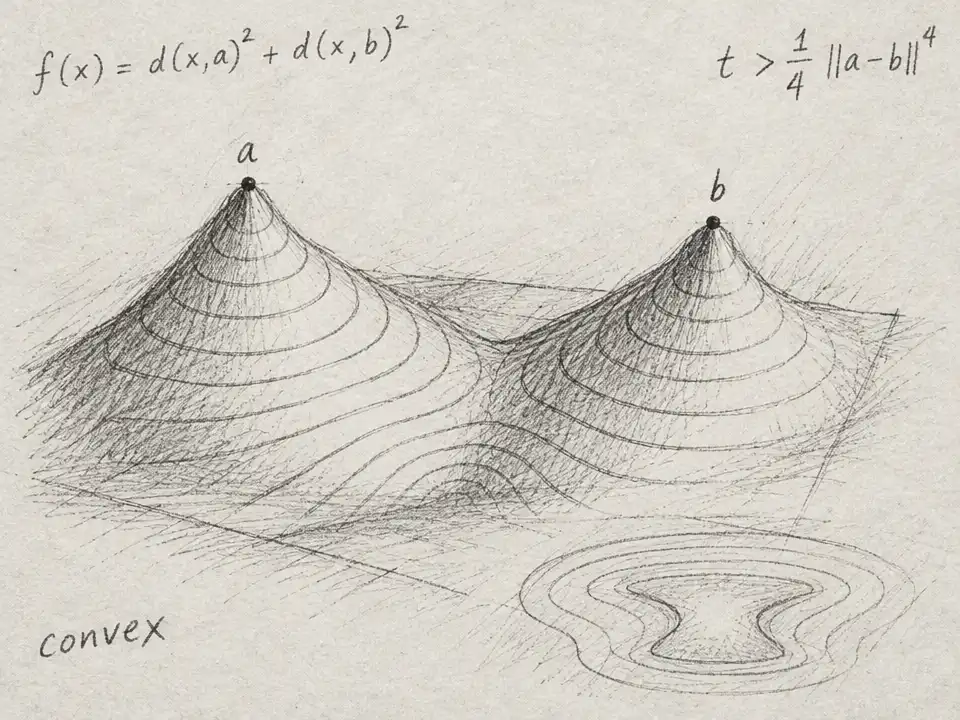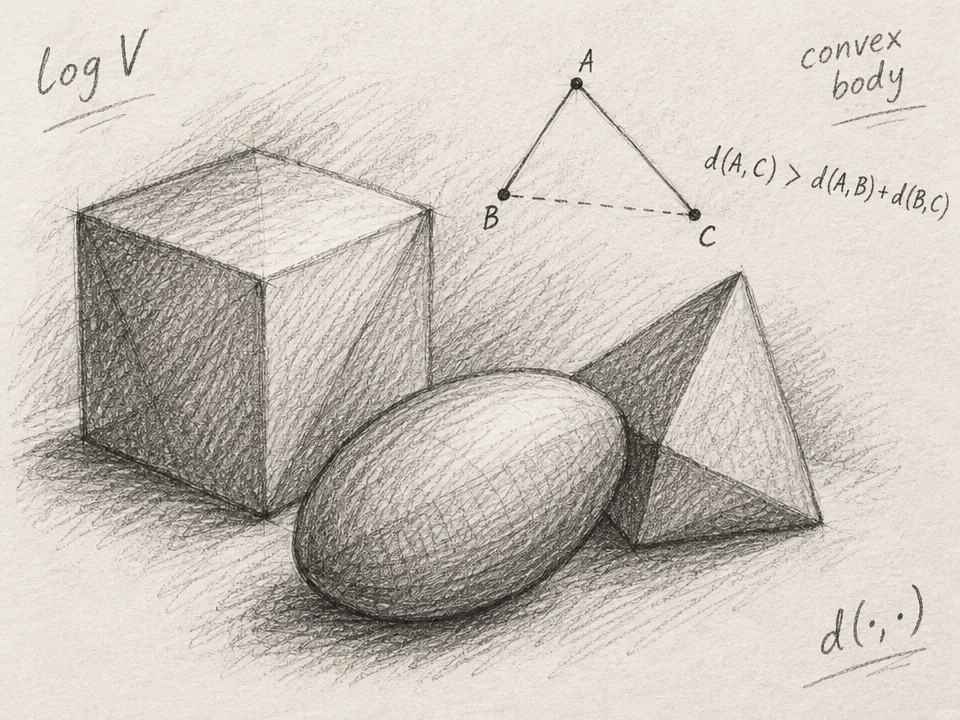
A distance has one simple test that can ruin everything: if you travel from A to B by way of C, the detour should not be shorter than the direct route. Mathematicians call this the triangle inequality. In a 2026 paper, mathematician Suvrit Sra reports a counterexample to a promising way of measuring how different two convex shapes are. The proposed measure clears an initial test—its values are nonnegative—but fails the three-point check.
The idea begins with volume. Take two convex bodies, such as solid shapes with no inward dents, and mix them by adding scaled copies together. The volume of the resulting shape changes in a structured way as the scaling changes. In three dimensions, that change is described by a polynomial of degree three. Researchers hoped the polynomial could do more than track size: perhaps the way its volume changes would define a useful distance between shapes.
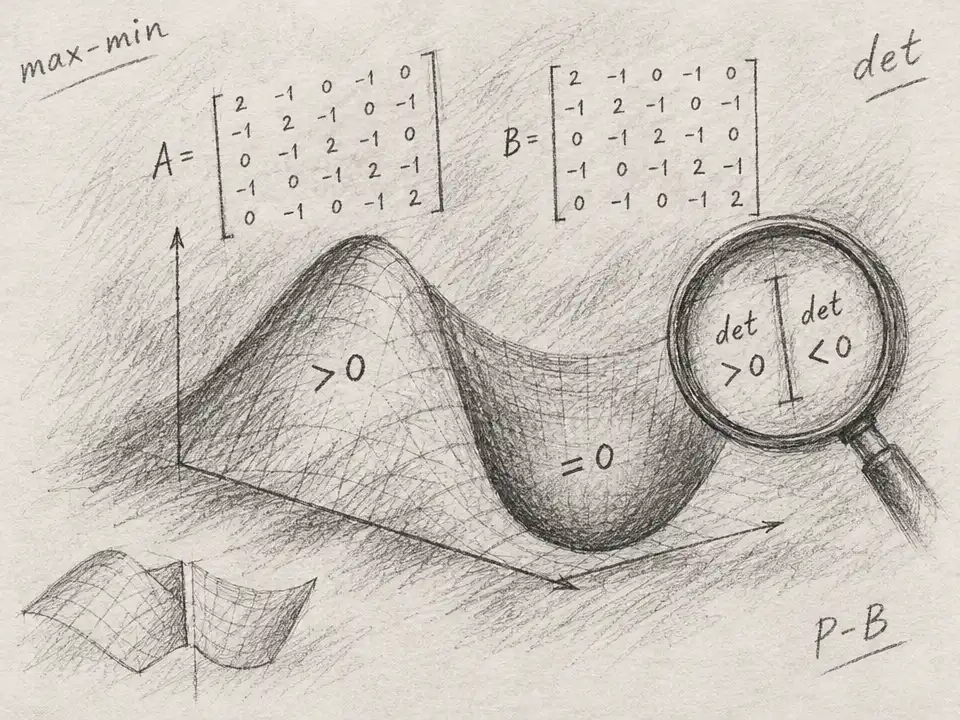
There was a compelling precedent. For positive definite matrices—a mathematical class used to represent, among other things, covariance and geometric information—a related measure built from the determinant behaves like a true distance. The determinant is a close relative of volume: it captures how a transformation stretches space. If a determinant-based comparison has the triangle inequality, it is tempting to expect a volume-based cousin to have it too.
The proposed distance compares the logarithmic volume at the midpoint between two inputs with the average logarithmic volume at the endpoints. Taking the square root of that midpoint gap gives a number for each pair. A broad family of polynomials called Lorentzian guarantees that this gap is nonnegative. The name is technical, not a reference to Einstein’s theory of relativity; here it describes a pattern of algebraic behavior that includes strong forms of log-concavity.
That guarantee seemed like a good start. If a comparison is always nonnegative, symmetric between its two inputs, and zero when an input is compared with itself, it has several features we expect of distance. The remaining question was whether the numbers fit together consistently across three points. Sra’s paper answers no. A particular cubic polynomial satisfies the strict Lorentzian condition, yet three rationally chosen points make the direct comparison larger than the sum of the two comparisons through the middle point.
That algebraic failure does not stay trapped in an abstract example. The paper uses a result in convex geometry to show that the cubic can be realized as the volume polynomial of two actual, full-dimensional convex bodies in three-dimensional space. The three points in the polynomial’s input plane then correspond to different mixtures of those bodies. So the triangle-inequality failure applies to shapes and their volumes, not merely to a formal polynomial.
The authors certify the violation with rational enclosures for the relevant logarithms and square roots, rather than relying on an ordinary floating-point calculation. The result is a strict positive excess: the direct route is longer than the two-step route. One counterexample is enough to defeat the general claim. It does not show that every volume-based comparison fails, or that the measure is useless for other purposes. It shows that the proposed rule cannot be assumed to be a distance for all convex bodies.
Why doesn’t log-concavity prevent the failure? Because it answers a different question. It ensures that, for each pair, the midpoint gap points in the right direction: the comparison is nonnegative. But the triangle inequality compares three separate pairwise gaps. A guarantee about each pair on its own does not ensure that all three agree on a shared geometry. Local consistency is not the same as a global map of how far apart things are.
The paper also draws a boundary around the surprise. In an appendix, Sra proves that a related result does hold for a narrower, stronger class called hyperbolic polynomials. There, the square root of the corresponding gap is a pseudometric—a distance-like measure that may assign zero to distinct inputs. In other words, the hoped-for behavior is not fantasy; it depends on having more structure than the Lorentzian condition alone supplies.
There is another unusual detail in how this particular counterexample emerged. The paper credits GPT-5.6 Pro with finding the candidate in July 2026, while Sra formalized and audited it. The work’s mathematical point rests not on a machine’s suggestion by itself, but on the exact verification and geometric realization that turn a candidate into a counterexample. The surprise is precise: a rule can inherit the positivity of a convexity argument and still fail the basic geometry that a distance demands.
That distinction matters far beyond one formula. Mathematicians often build new tools by extending a successful idea from one setting to a neighboring one. Here, the matrix analogy offered a reasonable expectation, and the convexity property offered real support. Yet the three-point test revealed the missing ingredient. In mathematics, a beautiful resemblance can point toward a theorem—but sometimes the shortest path to understanding it is a counterexample.