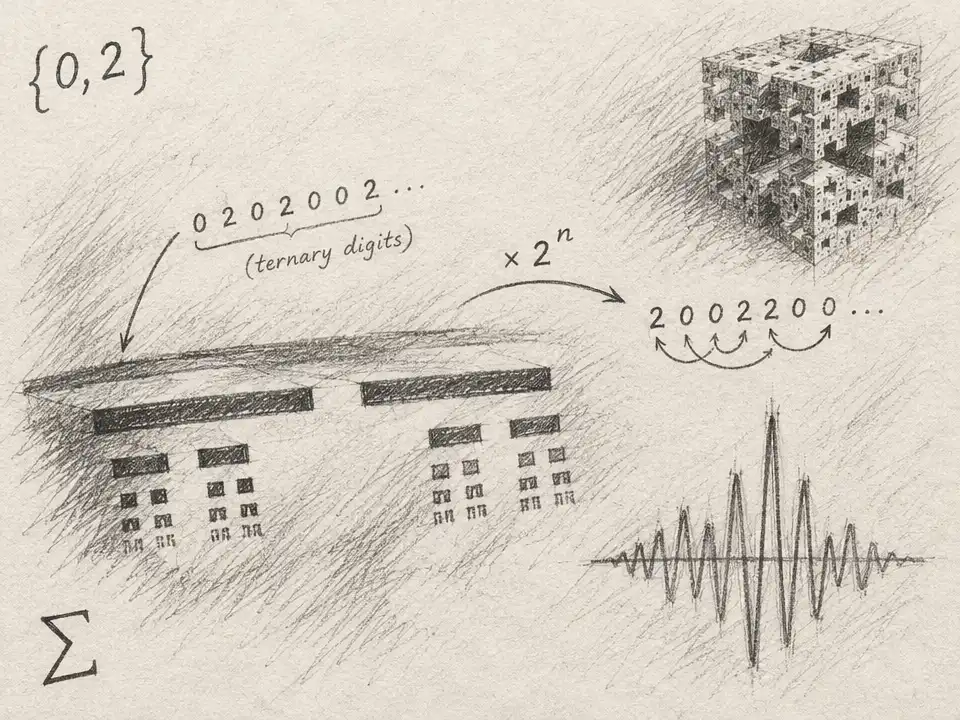
The middle-third Cantor set looks like a number line that has been carefully edited. Remove the middle third of a line segment, then the middle third of every surviving piece, and repeat. What remains is an intricate dust of points whose ternary expansions use only the digits zero and two.
Now try a different kind of search. Take one of those points, double it, double it again, and keep going. Sometimes the result lands close to an integer. In the original number, that means a close encounter with a fraction whose denominator is a power of two. How often should those encounters happen?
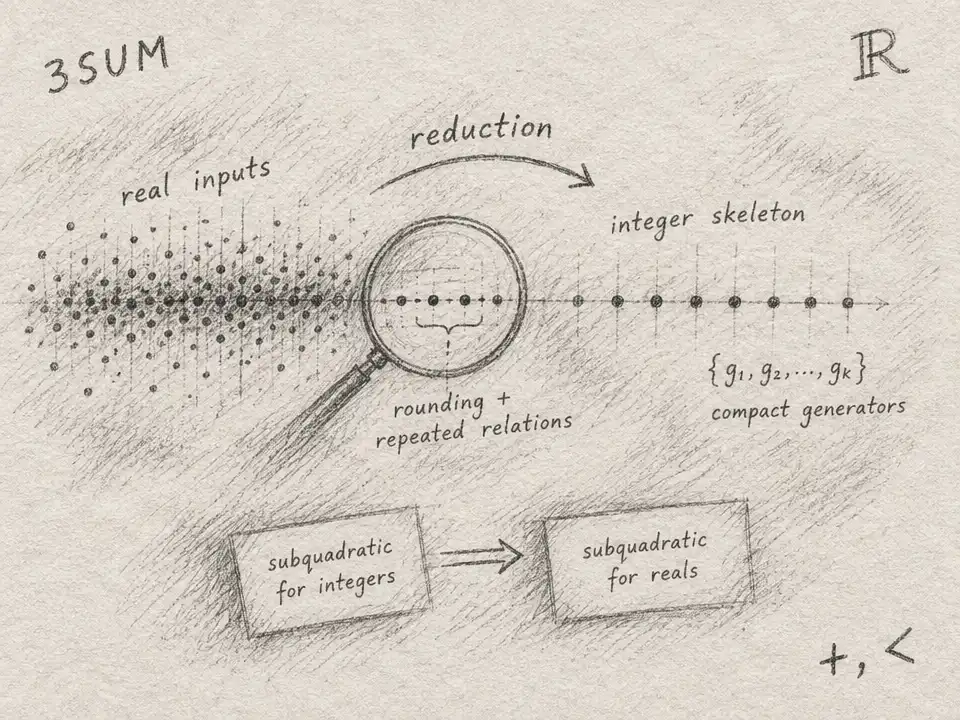
A new paper by Sam Chow and Han Yu answers a conjecture about this question with a technique that makes two incompatible-looking number systems work together. The Cantor set is built in base three; the search for close approaches runs through powers of two. Rather than treating that mismatch as an obstacle, the researchers track how one system keeps rearranging the digits of the other.
The answer is a precise kind of almost-sure law. Choose a non-increasing sequence of tolerances: each step specifies how close a doubled-and-redoubled Cantor point must come to an integer to count as a hit. For almost every point under the natural Cantor measure, there will be infinitely many hits if the tolerances have a divergent sum. If their sum is finite, almost every point has only finitely many. “Almost every” here means all points except a set with zero Cantor measure—not every imaginable point in the set.
That clean dividing line is familiar from classical approximation theory, but it was not automatic for a fractal. The middle-third Cantor set has gaps at every scale, so it is not a smooth, evenly filled background. And the repeated-doubling events are linked: knowing that one hit occurred can affect how likely another one is. The hard part was to show that these dependencies do not overwhelm the overall pattern.
The key is to listen to the measure through its Fourier coefficients. A Fourier coefficient is a way to test how strongly a distribution responds to a particular repeating wave. For the Cantor measure, the coefficients have a product structure that reflects the allowed ternary digits. As a useful rule of thumb, when a frequency’s base-three expansion changes often, the repeated factors tend to shrink its Fourier signal. Many changes mean the fractal measure is less able to keep in step with that wave.
But there is a snag. Frequencies arising in the approximation problem are built from powers of two. Their binary descriptions are unusually simple: multiplying by two mostly shifts digits along. That simplicity does not guarantee that every corresponding ternary expansion changes often at every step. A few awkward exponents might keep the Fourier signal large, and a proof that simply assumed steady decay would miss them.
Chow and Yu’s method makes room for those awkward cases instead of pretending they are not there. They divide stretches of exponents into two groups. An exponent is “qualified” when its associated number has many long runs in base three without digit changes. Those are the dangerous cases: long runs are precisely where the Fourier signal may avoid shrinking. The unqualified cases are easier. Their ternary expansions have plenty of digit changes, so their Fourier contributions decay strongly.
For the qualified cases, the authors look not just at one ternary expansion but at a whole run of nearby powers of two. A long block of zeros, or of the digit two, creates room to inspect earlier digits. As the exponent advances, multiplication by two sends those earlier pieces through different positions modulo powers of three. Because two and three do not share a common power, the pieces cannot all keep repeating the same pattern. The researchers use modular arithmetic to show that, apart from a relatively small exceptional collection, many of these earlier digit blocks must vary.
That is the clever turn: a long stretch with few visible changes becomes a window for finding changes just before it. The proof gathers these local discoveries across many scales. The result is not a promise that every individual Fourier coefficient is tiny. Instead, it establishes enough average decay across a whole range of exponents to control the approximation problem. This distinction matters: a stubborn outlier can survive, but it cannot dominate the long-run average.
From there, the researchers handle the two sides of the dividing line differently. When the tolerances sum to a finite amount, a convergence argument shows that the total measure of the hit events is too small for infinitely many hits to occur for typical points. When the sum diverges, the challenge reverses: there are enough opportunities, but the events could overlap too much. The authors estimate those overlaps, using the Fourier method for nearby exponents and the Cantor measure’s self-similarity to compare events at more separated scales. They first obtain a positive-measure set of points with infinitely many hits, then use the measure’s underlying digit structure to extend the result to almost every point.
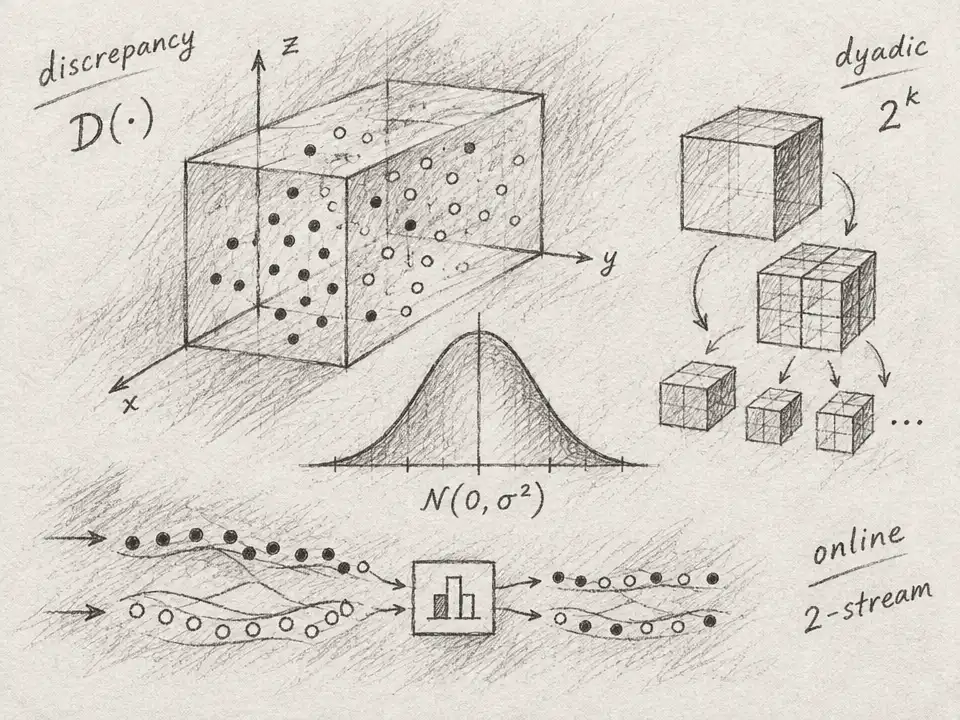
The method reaches beyond the familiar Cantor set. The paper proves a broader version for certain fractals made by allowing selected digits in a prime base, when that base does not divide the multiplier. In higher dimensions, the threshold involves the sum of the tolerances raised to the dimension. The authors also show that the Fourier signals of the standard Cantor measure along successive powers of two decay fast enough for every positive power of those signals to have a finite sum. That result is another sign that the two digit systems resist staying synchronized.
There are limits. The proof currently relies on the digit base being prime, a condition the authors suspect may be stronger than necessary. It also assumes the tolerances decrease; removing that requirement remains open. Those boundaries point to the next tests for the technique: can it survive more complicated digit rules, or a sequence of tolerances that rises and falls?
For now, the result turns a visual mismatch—binary steps chasing ternary dust—into a rigorous counting tool. The Cantor set’s missing digits do not make its points unreachable. They make the chase intricate. By following the patterns that seem to hide from one base inside the other, the researchers show when close encounters are rare and when, for almost every point, they keep coming back.