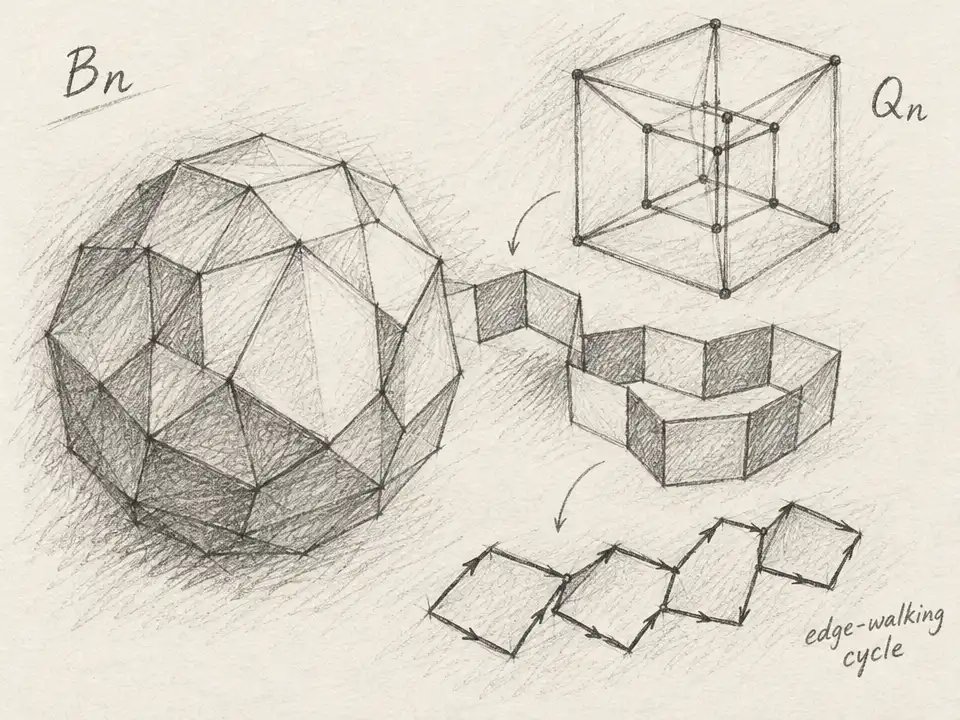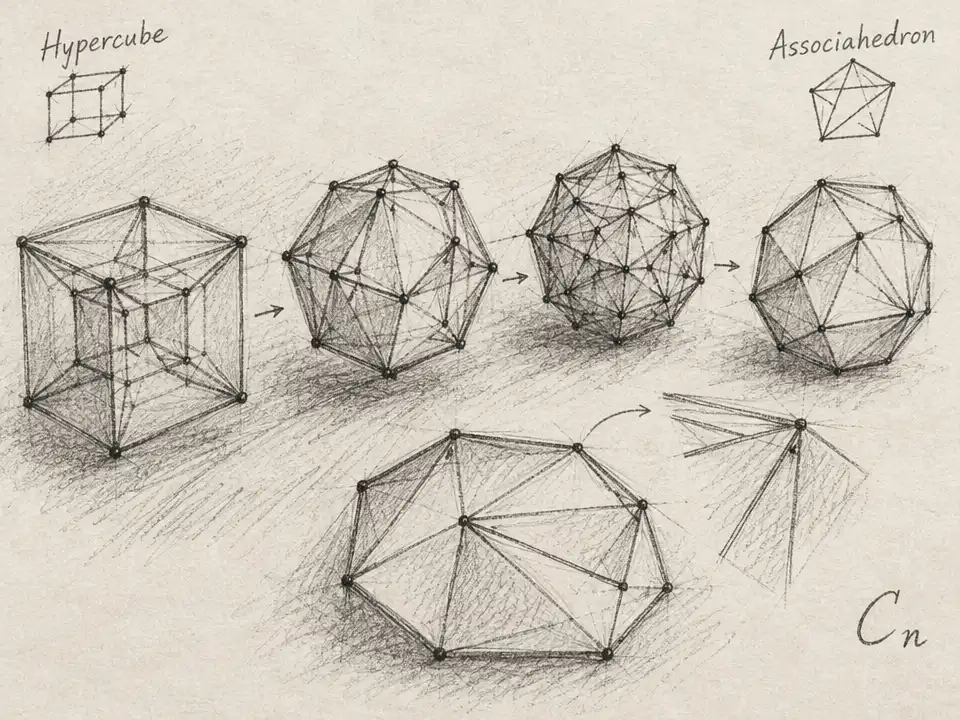
A cube and an associahedron seem to belong to different mathematical worlds. The cube is built from independent yes-or-no choices: for each direction, move one way or the other. The vertices of an associahedron, by contrast, encode ways to divide a polygon into triangles. One is a familiar box; the other is a shape whose structure follows the delicate rules of crossing diagonals.
So what could lie between them? In a paper posted to arXiv on September 29, 2026, Lara Bossinger and Ömer Gürdoğan construct a family of high-dimensional polytopes that starts at the hypercube and ends at the associahedron. The unexpected part is not just that a geometric bridge exists. As the shapes change, their vertex counts pass through a sequence of mathematical neighborhoods, linking powers of two, Pell numbers and Catalan numbers.
The construction has two settings: the dimension, which determines the size of the shape, and a second integer, which controls how much structure is added. To build a shape in dimension n, the researchers combine simple geometric pieces that record runs of consecutive coordinates. The second setting, d, sets the longest run included. At its smallest value, those pieces are just line segments. As the setting rises, more elaborate pieces join the construction.
At the first setting, the result is the ordinary n-dimensional hypercube. At the other extreme, when the setting reaches the dimension, the polytope is equivalent to the associahedron. In between sits a previously studied shape called the pellytope. The name hints at its counting pattern: its vertices are counted by Pell numbers, a sequence generated by a simple rule much like the one for Fibonacci numbers.
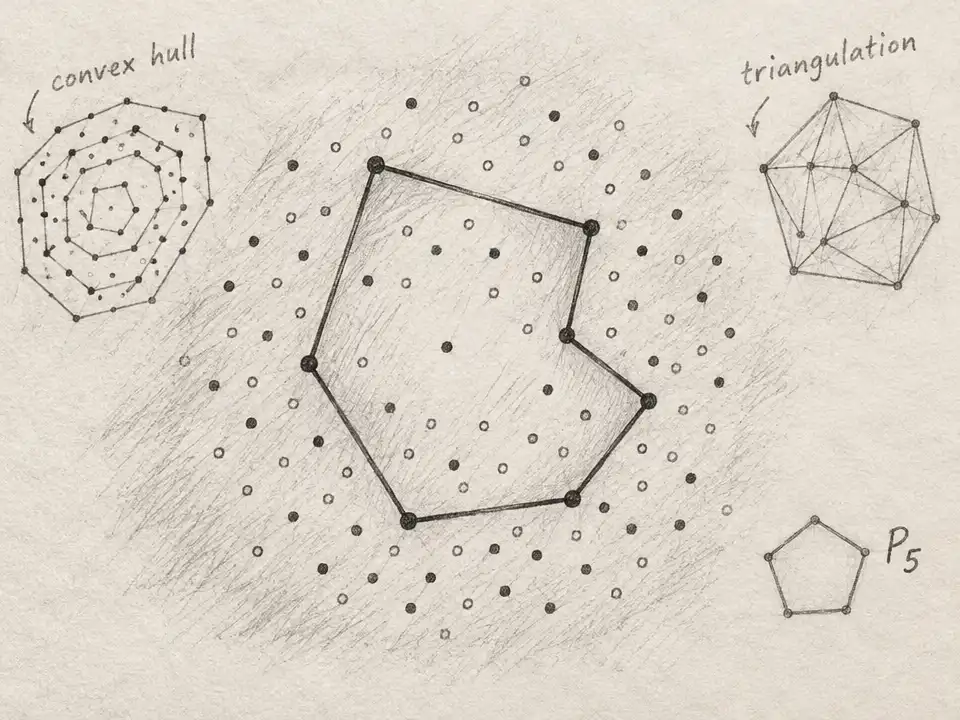
These familiar endpoints could have been joined by an untidy collection of exceptions. Instead, the whole family has a common language: chords drawn inside a polygon. A chord diagram is simply a collection of chords. The researchers define a rule for when two chords can coexist, then show that each maximal collection corresponds to a vertex of the polytope.
The rule is not simply “no crossings.” At the associahedron end, it does reduce to the usual rule: compatible chords do not cross, so maximal collections are polygon triangulations. Earlier in the family, however, certain crossing pairs are allowed, provided they meet a specific condition near the polygon’s outer boundary. The changing rule reshapes which chord diagrams are allowed—and therefore changes the geometry’s vertices.
For a concrete view, take dimension five. The five shapes have 32, 70, 98, 118 and 132 vertices as the setting rises from one to five. The first count is the number of corners of a five-dimensional cube. The last is the number of ways to triangulate an eight-sided polygon, counted by a Catalan number. Between them, the counts climb through forms that are neither simple powers of two nor the final Catalan count.
That middle ground is the surprise. The pellytope’s vertex counts follow Pell numbers; the associahedron’s follow Catalan numbers. Bossinger and Gürdoğan show that the intermediate shapes generate their own related sequences. The counts are not guesses based on a handful of examples: the chord diagrams can be cut into smaller diagrams, and that recursive structure yields a rule for calculating the numbers.
In broad terms, for a fixed setting, each new count depends on twice the previous one plus additional contributions built from Catalan counts and earlier terms. The size of the setting determines how many earlier stages enter that rule. This makes the family more than a visual interpolation: one combinatorial mechanism explains how the familiar counting patterns meet and what happens between them.
There is also a geometric record of each step. The researchers describe how the normal fan—a map of the directions in which each vertex is the shape’s extreme point—is refined as the setting increases. Each refinement, called a star subdivision, inserts a new direction associated with a chord and splits existing regions of the map. In this way, the difference between two successive vertex counts reflects actual changes to the shape’s organizing geometry, not just a new label attached to a sequence.
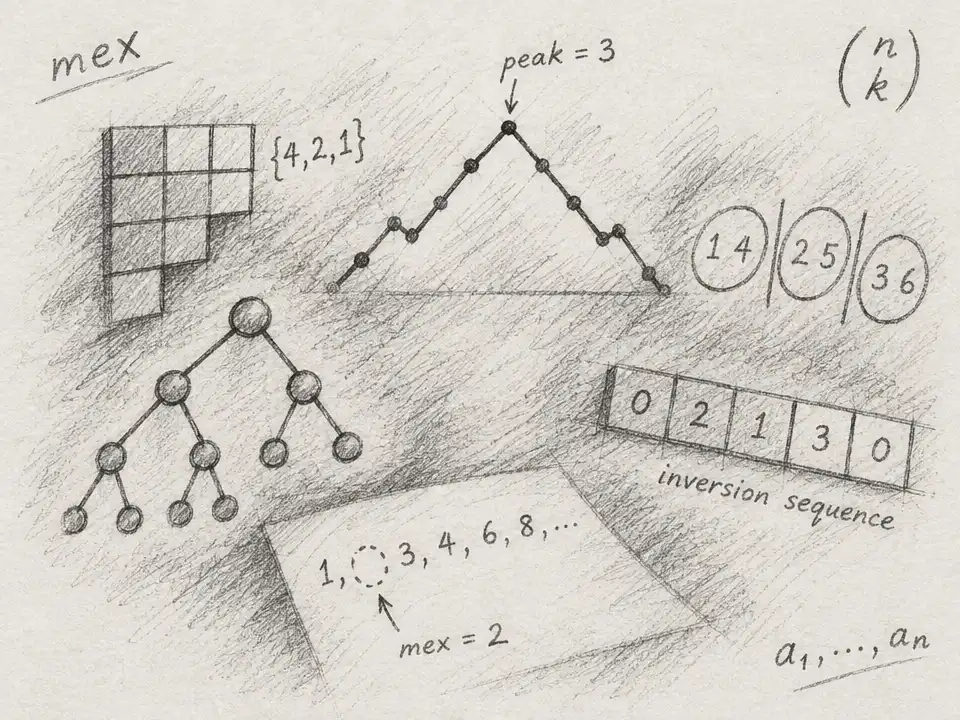
The connection reaches beyond counting. The polytopes sit within broader families built from combinations of simpler shapes, and the paper relates them to Dyck paths, the balanced up-and-down patterns that also appear in Catalan-number problems. The authors further show that every member of their family gives rise to a kind of algebraic space called a binary geometry, an object used in mathematical work on canonical forms and scattering amplitudes. The paper establishes that link; it does not claim a new prediction about particle collisions.
A cube offers a world of independent choices. An associahedron organizes every way to triangulate a polygon. The new family shows that those two worlds are not isolated destinations: a carefully controlled rule for adding and admitting chords connects them, and the in-between shapes carry their own counting logic. What looked like two distinct mathematical landscapes turns out to have a structured route running between them.