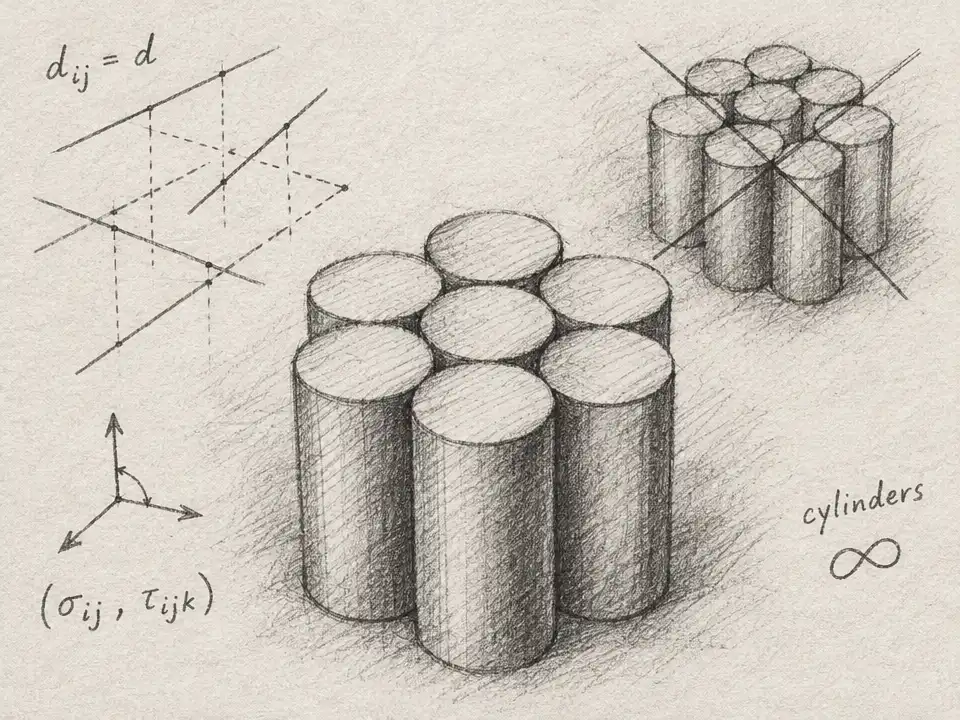
Imagine trying to crowd long, smooth pipes together in empty space. They have no ends, all have the same radius, and every pipe must just touch every other one. How many can fit? Seven is possible. An eighth sounds like it might squeeze through—until you stop looking at the pipes.
A new proof of a question first posed by mathematician John Littlewood in 1968 finds that eight congruent infinite cylinders cannot all touch pairwise. The maximum is seven. The surprising turn is that the cylinders’ curved surfaces are almost a distraction. Their hidden structure is a collection of straight lines.
Each cylinder has a central axis. Two equal-radius cylinders touch exactly when their axes are separated by twice the radius. Scale the whole scene so that distance becomes one, and the puzzle turns into this: Can eight lines in three-dimensional space all be the same distance from one another? The paper proves they cannot.
Lines are thinner than cylinders, but their geometry is harder to see at a glance. Two lines can pass at an angle without meeting; they can sit at a fixed distance, like rails that never cross. With enough lines, the question becomes not how to arrange bulky objects, but how directions and separations can cooperate across space.
The researchers’ next move is a shift from locations to signs. Give each line an orientation, like an arrow pointing along it. For each pair, a sign records a feature of how the two oriented lines relate. For each trio, another sign records the handedness of their three directions—whether they twist one way or the other. The signs aren’t physical labels painted on the lines. They are a compact code for geometric relationships.
That code has to obey rules. Four directions in three dimensions cannot all be independent: one can be expressed as a combination of the other three. The resulting relationship constrains which signs the four lines can carry. Meanwhile, the geometry of those directions supplies triangle inequalities: certain lengths must be smaller than the sum of others. Put the two together, and many seemingly possible patterns of signs become impossible.
Groups of five lines bring another constraint. An identity connecting the directions of five lines rules out further sign combinations. These local tests are important because they let the authors catch a contradiction in a small corner of a proposed eight-line arrangement, without calculating every line’s exact position.
Now zoom all the way out. Eight lines have 28 pairs and 56 trios, giving 84 signs in all. Taken at face value, those signs allow roughly 2 × 1025 assignments—a huge forest of possibilities. But most branches break the local rules quickly. The authors’ computer program checks the constraints as it builds a pattern, abandoning a branch as soon as it becomes impossible.
The computation is not a search through every imaginable arrangement of lines, nor a numerical simulation that tries to nudge cylinders into place. The geometry has already been distilled into exact conditions on signs. The program exhaustively checks the remaining finite possibilities, using symmetries to avoid repeating equivalent cases. Its search visits 1,987,999 nodes and finishes in two seconds on a laptop, according to the paper. No admissible sign pattern survives for eight lines.
This is what makes the result a computer-assisted proof rather than a computer’s guess: mathematical arguments establish that every real arrangement would produce a sign pattern obeying the rules; the exhaustive search then shows that no such pattern exists. The authors describe the program, which is about 500 lines of C++, so the finite check can be inspected and repeated.
The limit had been closing in for years. A construction of seven mutually touching cylinders was known in 2015. Earlier work had reduced upper bounds step by step—from 24, to 18, to 10, and then to nine. The new proof closes the final gap: seven can be done, but eight cannot.
Look back at the imagined pipes and the answer seems physical: space runs out. But the proof finds a subtler barrier. The missing eighth cylinder is excluded by a hidden world of orientations, dependencies, and signs—relationships that remain even after the pipes themselves have vanished from view.