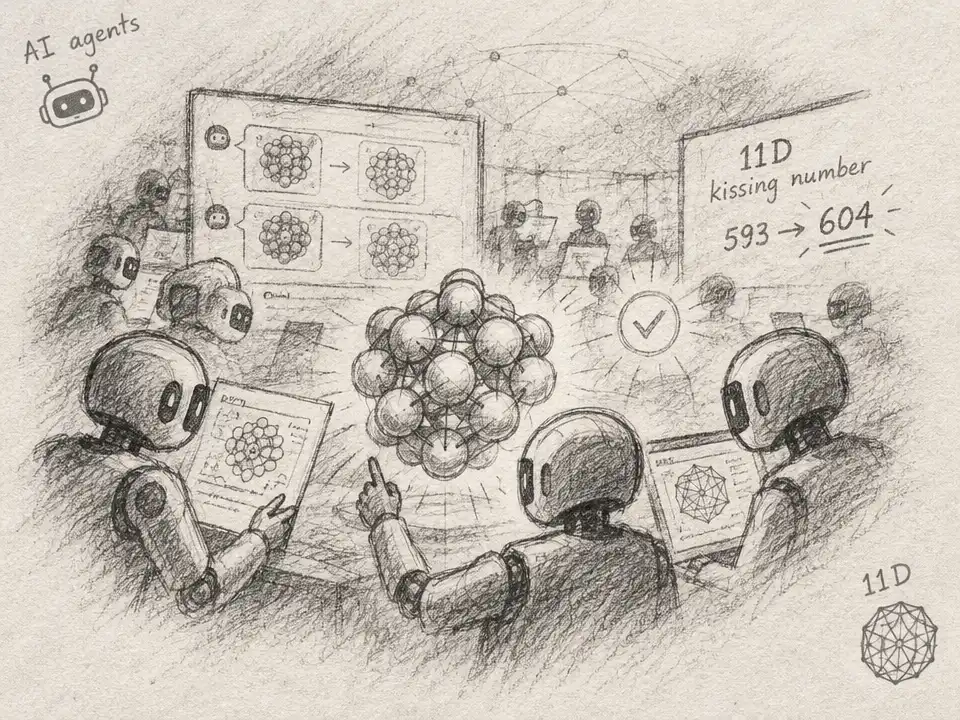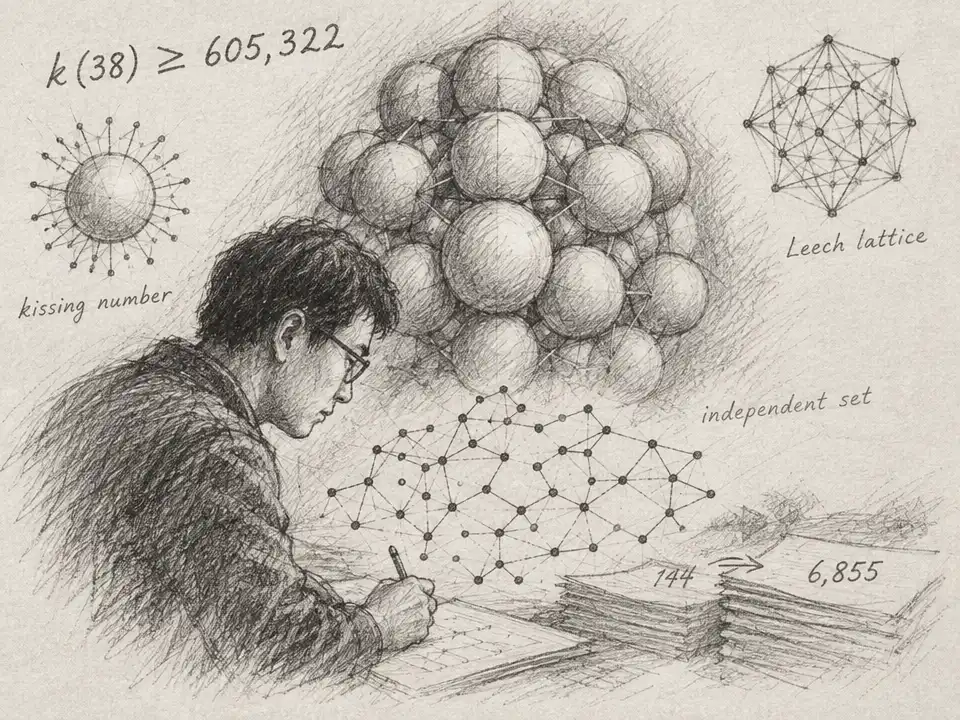
Imagine a ball surrounded by other balls, each pressed against it but never overlapping its neighbors. In a flat room, the arrangement is easy to picture. Now give the room 38 dimensions. How many outer balls can touch the central one? The answer is not known. But a new construction shows that at least 605,322 can fit—and its biggest leap came from a place that had looked empty.
This is the kissing-number problem: find the largest possible crowd of equal balls that can all touch one central ball without bumping into each other. Think of the outer balls as points on a huge, high-dimensional sphere. To keep two balls from overlapping, their directions must stay at least 60 degrees apart. The question is how many such well-spaced directions can be packed around the center.
In most dimensions, nobody knows the exact maximum. The new work by Qihong Lin improves the best known lower bounds in seven dimensions: 32, 33, 34, 35, 37, 38, and 39. A lower bound is a demonstrated crowd size, not a proof that the crowd cannot be larger. The most striking improvement is in 38 dimensions, where the new arrangement raises the previous record from 591,900 points to 605,322.
The construction takes advantage of the Leech lattice, a remarkably orderly structure in 24 dimensions. Picture an immense constellation of points whose spacing follows strict rules. A previous construction used that lattice as part of a larger 38-dimensional arrangement, but left one 24-dimensional slice—the equator—empty. Researchers had already found 144 pairs of opposite lattice directions that could be placed there safely. The natural question was whether that quiet zone was nearly full, or whether it could hold much more.
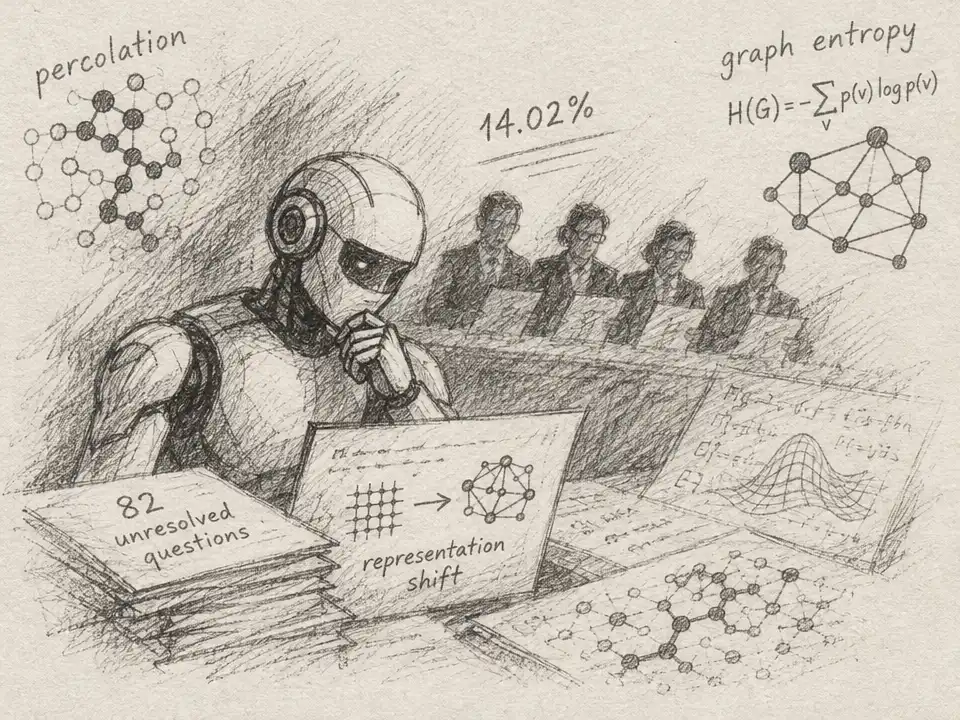
It could. Lin turned the problem into a map of forbidden pairings. Start with 8,386,560 lines from a particular layer of the lattice. In this setting, a line means a pair of opposite directions. Make each line a vertex in a graph, and connect two vertices if adding both would create a pair that comes too close. A usable collection is then an independent set: a group of vertices with no forbidden connection between any two.
The surprising feature was the graph’s degree. Despite containing more than eight million candidate lines, each line conflicts with only 11,178 others. That is a relatively small fraction of the possible neighbors. It does not make the puzzle easy: the choices still interact, and avoiding one conflict can close off other promising options. But it changes the picture. The equator was not a packed wall of nearly incompatible directions. It was a vast search space with room to maneuver.
A computer search found 6,855 mutually compatible lines, far beyond the earlier 144. Each selected line contributes a pair of opposite points to the 38-dimensional arrangement. Those points can be added without spoiling the careful spacing of the existing construction. The resulting arrangement contains 605,322 points. Compared with the previous bound of 591,900, that is 13,422 more potential neighbors around the central ball.
The search did not simply keep adding points one at a time. That strategy can get trapped: a locally good group may block a better arrangement that requires changing many choices together. Lin’s search used local adjustments, then a larger “ruin and recreate” move—remove a chunk of the current set and rebuild it. For the equatorial lines, a randomized greedy start produced a set of 5,291; local search grew it to 6,623 in three minutes, and repeated remove-and-rebuild steps reached 6,855.
That result is not resting on a computer’s claim that it searched well. The search proposes a candidate; the proof comes from checking the candidate itself. The paper’s programs verify the relevant geometric conditions with exact integer arithmetic. For the 38-dimensional arrangement, a separate brute-force check examined 1.83 × 10¹¹ pairs of points and found no violation of the spacing rule. The largest cosine between any two was exactly one-half, the limiting value for balls that touch without overlapping.
There is an important boundary to the claim: 605,322 is a proven minimum number that can fit, not the maximum possible. The authors note that the equatorial search may have substantial room left; each additional compatible line would add two points. So the empty slice has become less a final answer than a new frontier. In a problem where a high-dimensional arrangement resists ordinary visualization, a graph can reveal what a picture cannot: the apparent dead zone was full of possibilities.