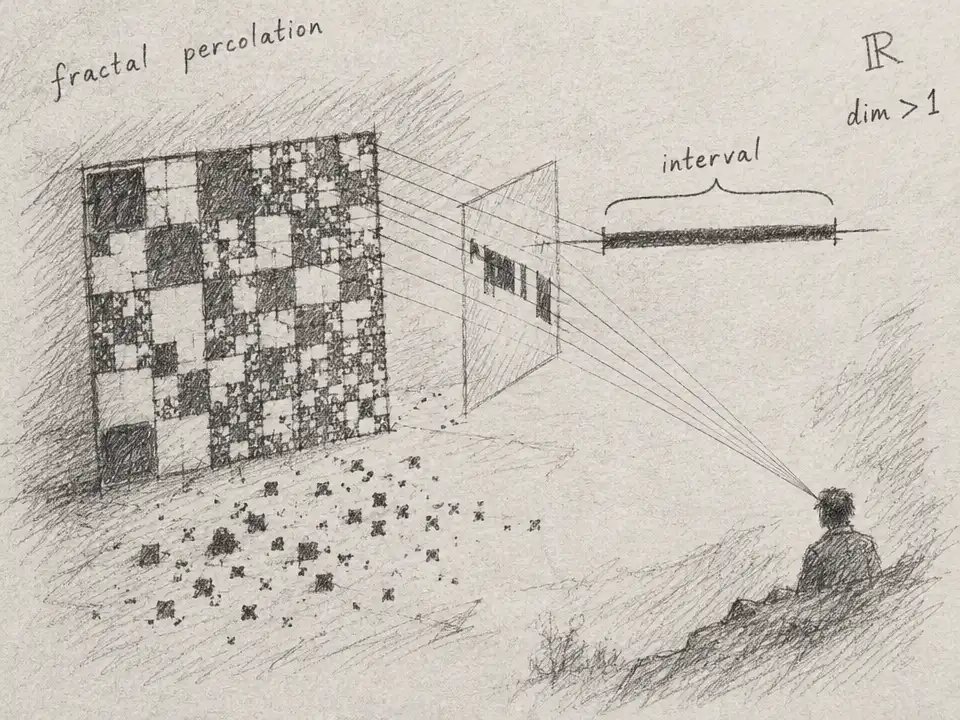
Imagine a shape so full of holes that no two surviving points need be joined by a continuous path. Now shine a mathematical light on it from any angle. The shadow can still contain a complete, unbroken stretch. That is the surprising behavior Michal Rams and Károly Simon proved for a family of randomly built fractals: even a disconnected dust can cast a solid shadow in every direction.
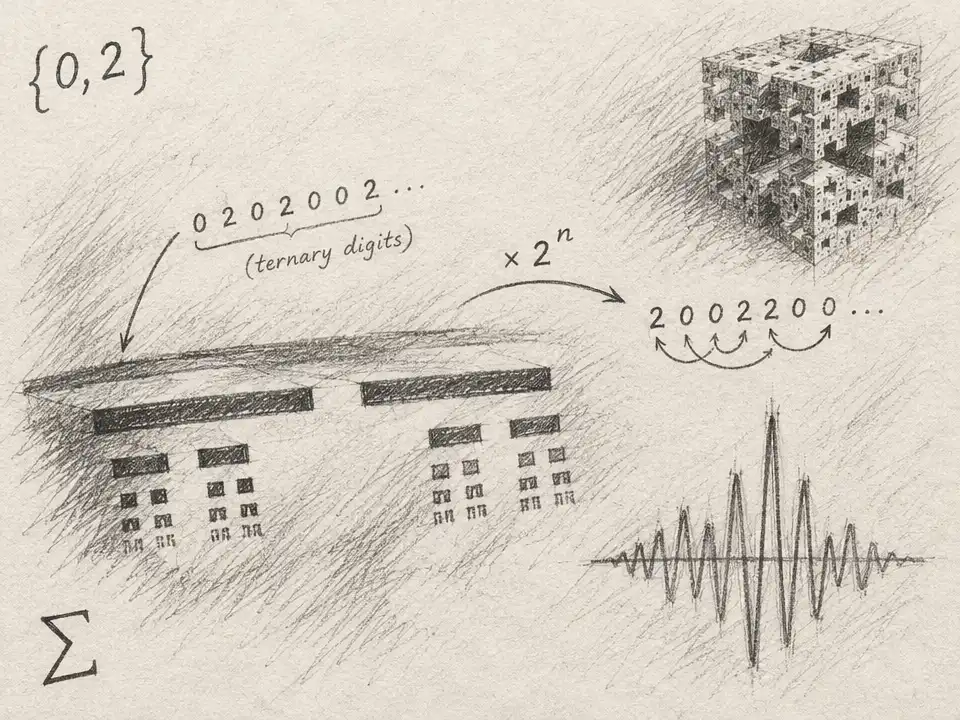
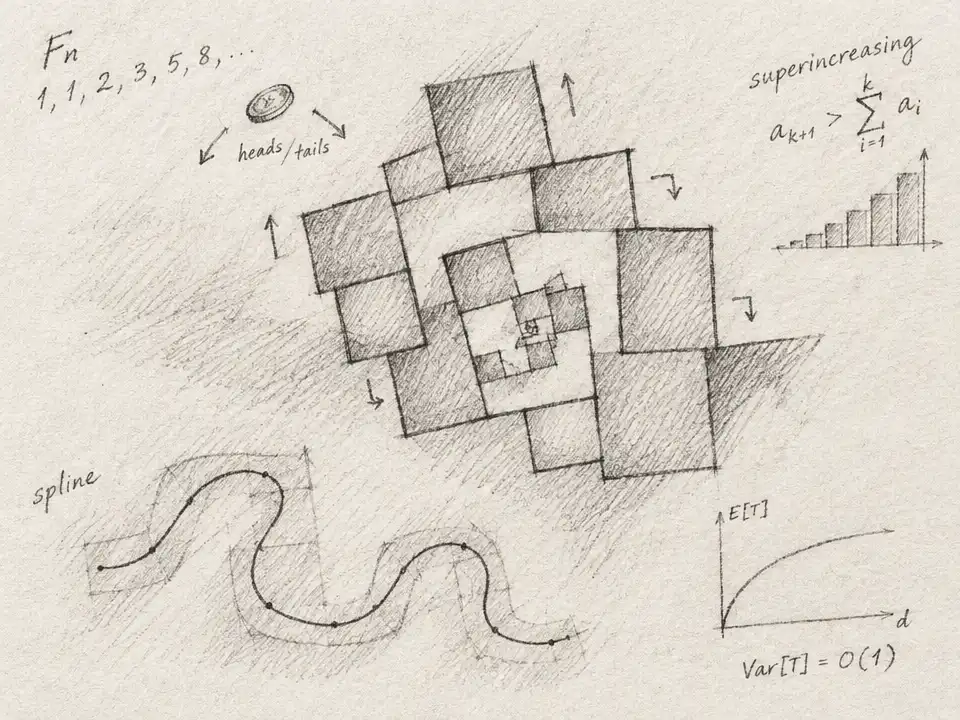
The construction begins with a square. Divide it into a grid of smaller squares, then flip a random coin for each one: keep it or discard it. Repeat the same process inside every square that survives. After infinitely many rounds, the remaining points form a fractal percolation set. Zoom in far enough and the pattern keeps repeating—not as a tidy design, but as a branching record of chance.
Many such sets are sparse and disconnected. Yet sparsity has more than one meaning. The set may have gaps everywhere and still contain enough points, arranged in enough places, to cast a surprisingly rich shadow. In their work, Rams and Simon show that when the set’s dimension exceeds one, its projection onto any line contains an interval. “Contains” matters: the result promises a solid stretch in the shadow, not that the shadow fills the whole line or that the original shape becomes connected.
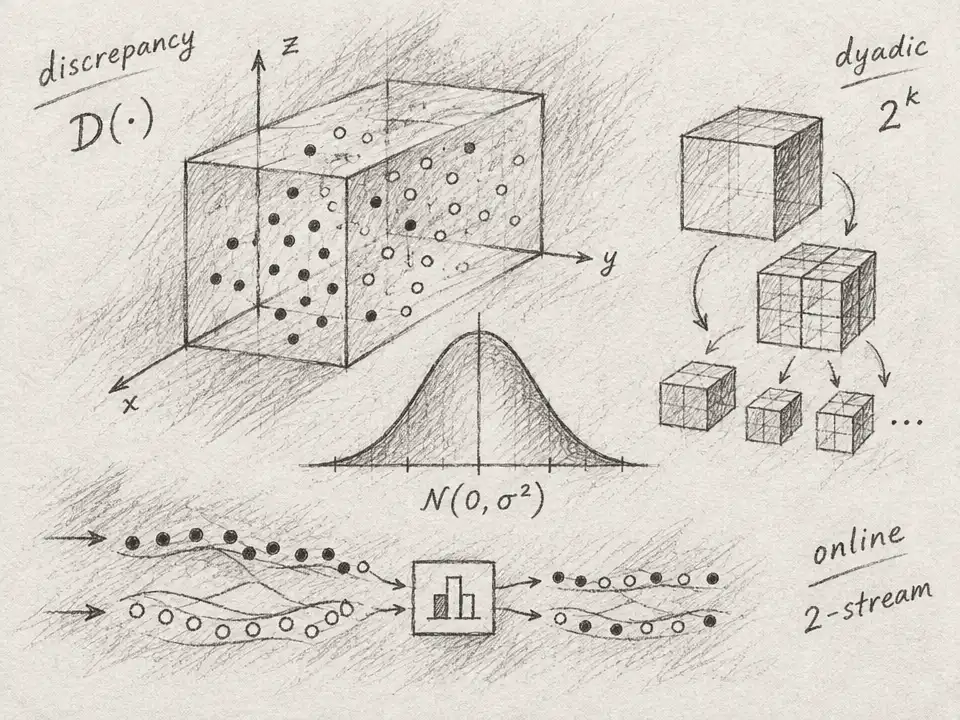
Why should the dividing line be dimension one? A useful clue comes from watching the construction at one scale. Suppose the square is split into an M-by-M grid, and each little square survives with probability p. In a vertical projection, a narrow strip of the target line lines up with a column of small squares. Each surviving square can contribute several children to that column. When the average number of such children is greater than one, the supply tends to grow rather than dwindle as the construction proceeds. That same threshold is where this model’s dimension rises above one.
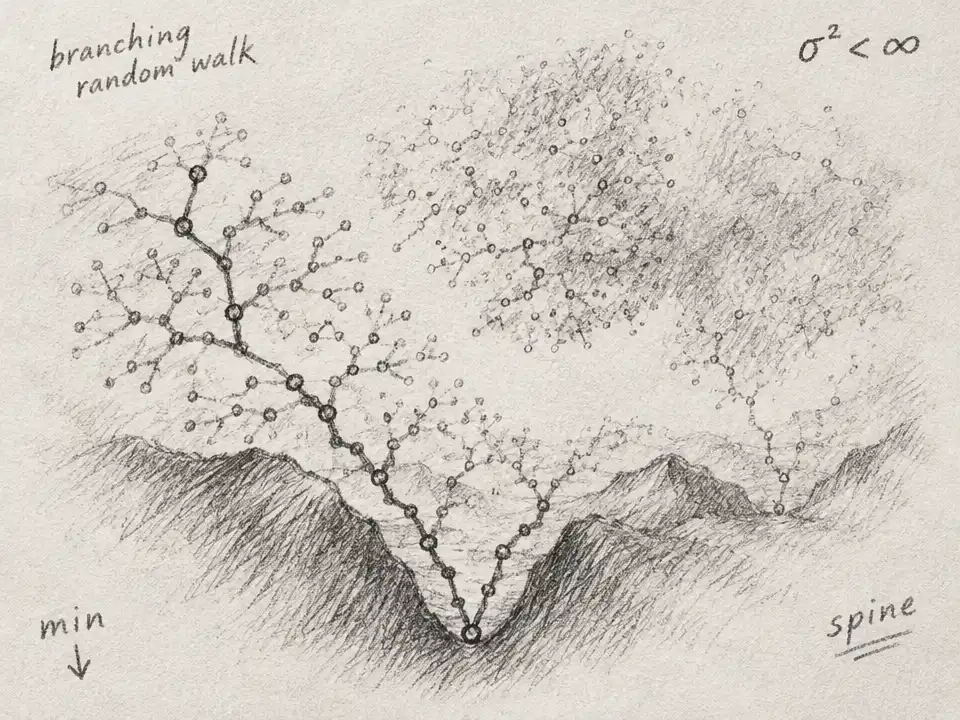
Growth alone does not guarantee an unbroken shadow. A particular strip might miss every surviving square, leaving a gap. And checking one strip is not enough: each finer stage creates many more places where a gap could appear. The proof turns this into a branching-and-counting problem. Instead of following individual points, the researchers track how many surviving squares can reach a small target interval. Independence between the random choices helps: large deviations make a sudden collapse very unlikely when there are many chances to keep the interval covered.
Slanted shadows make the bookkeeping trickier. A line can skim the corner of a square, where its children may not reproduce as reliably as they do in a central part. Rams and Simon handle this by working with buffered intervals and grouping several rounds of the construction together. In effect, they ask whether a safely placed interval can generate enough descendants in the next block of rounds to keep a target interval covered. Once that growth is established, probability bounds help control the increasing number of fine-scale gaps the proof must rule out.
There is another obstacle: proving the result one direction at a time would not automatically prove it for every direction at once. There are infinitely many possible angles, including angles arbitrarily close to one another. The key is robustness. If the shadow contains an interval with a little room to spare, a small change in angle will not instantly break it. The researchers use this stability to handle nearby directions together, then extend the argument across the full range of angles. The result holds almost surely for a nonempty realization of the random set.
The papers go beyond straight-line shadows. Look at the same fractal from any chosen point, and record the directions in which its points appear: that collection of viewing angles contains an interval. Record instead the distances from that point to the fractal, and those distances also contain an interval. The underlying idea is that tiny surviving squares, viewed at a suitably fine scale, can make a curved viewing rule behave almost like a straight projection. Statistical self-similarity lets the researchers repeat their argument inside those smaller squares.
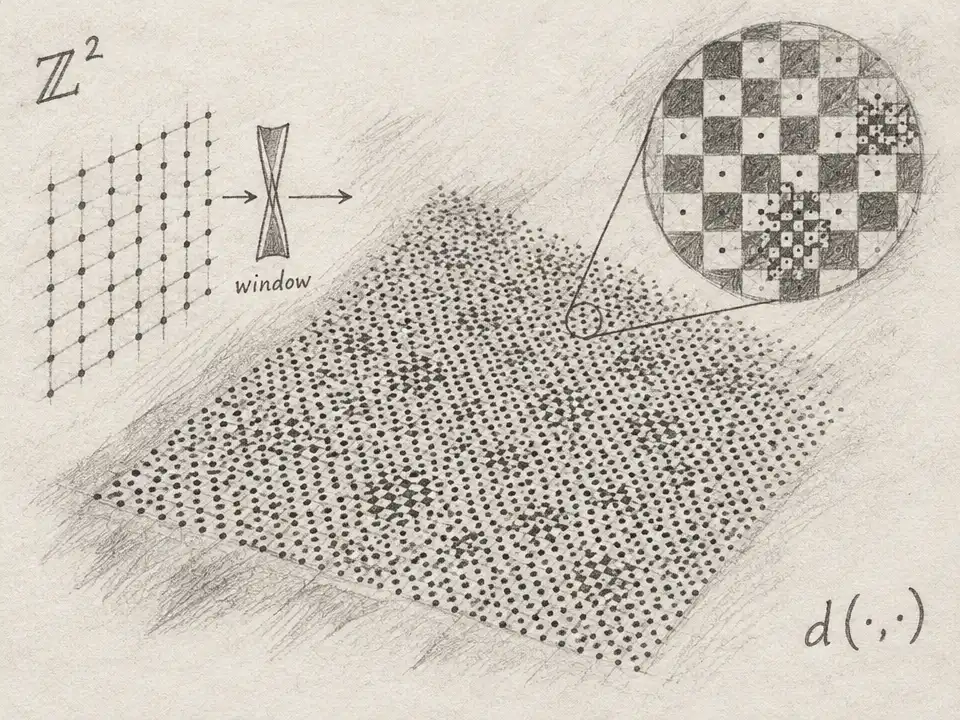
This does not mean the fractal is secretly a solid sheet. Its geometry and the geometry of its shadows are different questions. A projection compresses two dimensions into one, bringing contributions from many scattered locations onto the same line. At the right level of density, those contributions can overlap enough to leave no gaps across an interval—even while the original set remains disconnected.
The result is a reminder that a shape’s holes do not tell the whole story. A random fractal can be a dust when examined point by point, but its one-dimensional views can be unexpectedly continuous. Following the shadows reveals a hidden kind of order: not a path through the object, but enough branching, scale after scale, to bridge every gap in what a viewer can see.