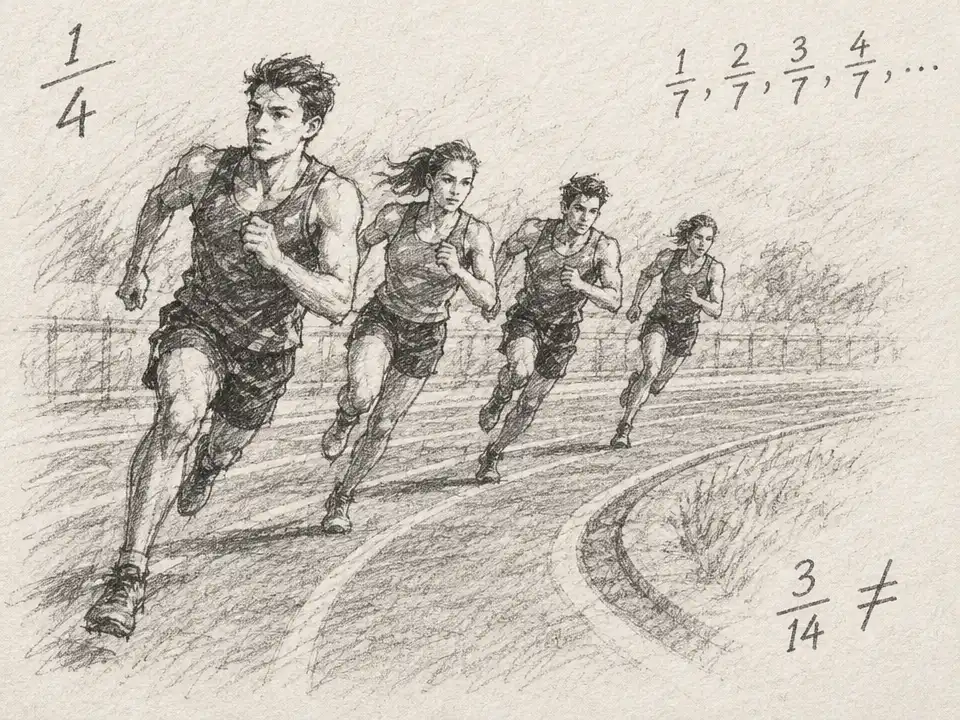
Picture four runners setting off together on a circular track. They move at different whole-number speeds: one might complete a lap once while another makes three circuits, and another fourteen. At any instant, each is somewhere between the starting line and the point where a lap begins again. The puzzle is to find a moment when even the runner closest to the starting line is as far away from it as possible.
That last detail makes the problem more demanding than simply spotting one runner far down the track. The runners must all be away from the start at once. For four runners, a well-known result guarantees that they can each get at least one-fifth of a lap away. But what exact best distances can different speed combinations achieve? The new study answers that question for every four-runner set whose best shared distance is below one-quarter of a lap.
Earlier work had found an orderly-looking ladder of possible distances, but left a finite set of exceptions undecided. The ladder begins one-fifth, two-ninths, five-twenty-seconds, three-thirteenths, seven-thirtieths, and four-seventeenths. The researchers show that the pattern continues—but with a missing rung. Three-fourteenths never occurs. Apart from that absent value, every distance below one-quarter belongs to the predicted sequence.
The answer is not just a list of fractions. The authors identify the speed patterns that produce them. After dividing out any common factor and ignoring the order of the speeds, one family consists of one, two, three, and a positive multiple of four. Another starts with two coprime positive speeds, then adds their sum and a speed made by adding the second speed to that sum again. Specific remainder conditions modulo four determine which members of this second family fall below the quarter-lap mark.
There is also one speed set outside both families: one, three, four, and fourteen. At seven-seventeenths of a lap of time, the four runners’ distances from the starting line are seven-seventeenths, four-seventeenths, six-seventeenths, and four-seventeenths of a lap. That gives the set a best shared distance of four-seventeenths. The value itself is not a new rung—it already appears in the main sequence. What is exceptional is the speed combination that reaches it.
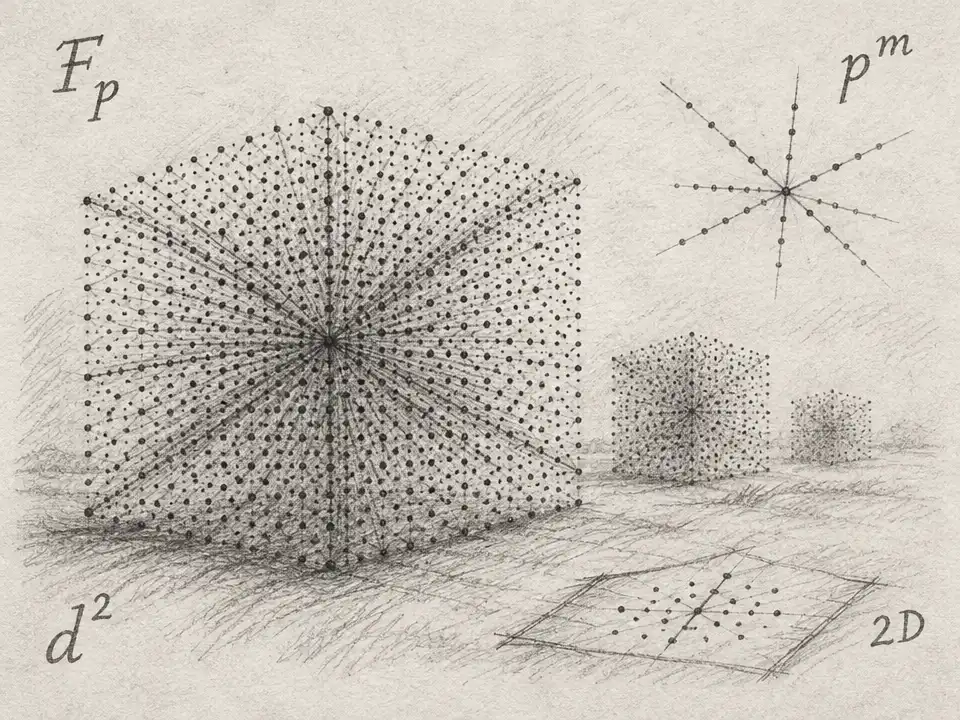
How can a problem involving endlessly many possible moments become a classification? The key is to redraw the race. Treat each runner’s position as a coordinate that wraps back to zero after each lap. Together, the four coordinates make a point in a four-dimensional mathematical space with wraparound edges. As time passes, the point traces a closed loop. A runner near the starting line corresponds to one coordinate near zero; a moment when all four are clear of the start is a point on the loop where no coordinate is too close to zero.
This geometric picture gives the proof a surprising first turn. The researchers show that sufficiently long loops with a best shared distance below one-quarter cannot wander arbitrarily through that space. Once the speed vector has Euclidean length at least 512, the loop must lie on one of two special two-dimensional surfaces. Those surfaces impose simple relationships among the four speeds, producing the two infinite families. In effect, the geometry rules out millions of possible patterns before a computer has to inspect them one by one.
Shorter loops remain, so the authors bound the search rather than pretending it disappears. They checked 800,816,099 primitive speed quadruples—sets with no common factor—whose speed vectors were shorter than 512. The computation first tested exact rational moments, then used an exact geometric calculation for the cases those tests did not settle. The authors report using exact integer and rational arithmetic, with accompanying code and verification scripts.
Among the short speed sets that came within the quarter-lap threshold, every one fit one of the two families except the four-runner set one, three, four, fourteen. That result turns a numerical search into a proof with a clear division of labor: geometry captures every sufficiently large case, and an exhaustive, exact check settles the bounded remainder. The missing three-fourteenths is not an artifact of failing to look hard enough. The classification shows it cannot be achieved.
The paper also finds a broader pattern in the geometry of the problem. As four-runner distances accumulate below two-fifths of a lap, their limiting values are exactly the values available in the corresponding three-runner problem over that range. More runners create more possible speed combinations, but the values they approach still echo a simpler race. For four runners, a once-open-ended hunt now has a map: two repeating routes through the speed patterns, one solitary detour, and one fraction that never appears.