A mathematical group can have a curious kind of stability: shift a certain logical description around, and the number of distinct versions stays small. For years, mathematicians suspected that this calmness meant the group could also be averaged fairly—that its structure admitted a translation-invariant notion of probability. Artem Chernikov has now built a counterexample. In a carefully expanded version of a free group, a logical description keeps a bounded orbit, yet no such fair averaging is possible.
The puzzle begins with a conjecture about a global type. The term sounds like a label for a species, but here it means a complete, logically consistent description of a hypothetical point, phrased in relation to every element of a very large mathematical universe. Translate that description by group elements, and you get its orbit: the collection of all the translated descriptions. The conjecture said that if this collection is bounded in size, the group must be definably amenable—roughly, it must allow a probability-like assignment to its definable pieces that does not change under translation.
That connection seems plausible. If shifting a description around produces only a limited range of possibilities, perhaps the group has enough regularity to support a stable idea of “fair share.” Earlier work established the connection in important settings. But outside those settings, the conjecture remained open. Chernikov’s paper turns the question into a construction: first make a group where fair averaging is impossible, then find a global type whose translated versions remain bounded anyway.
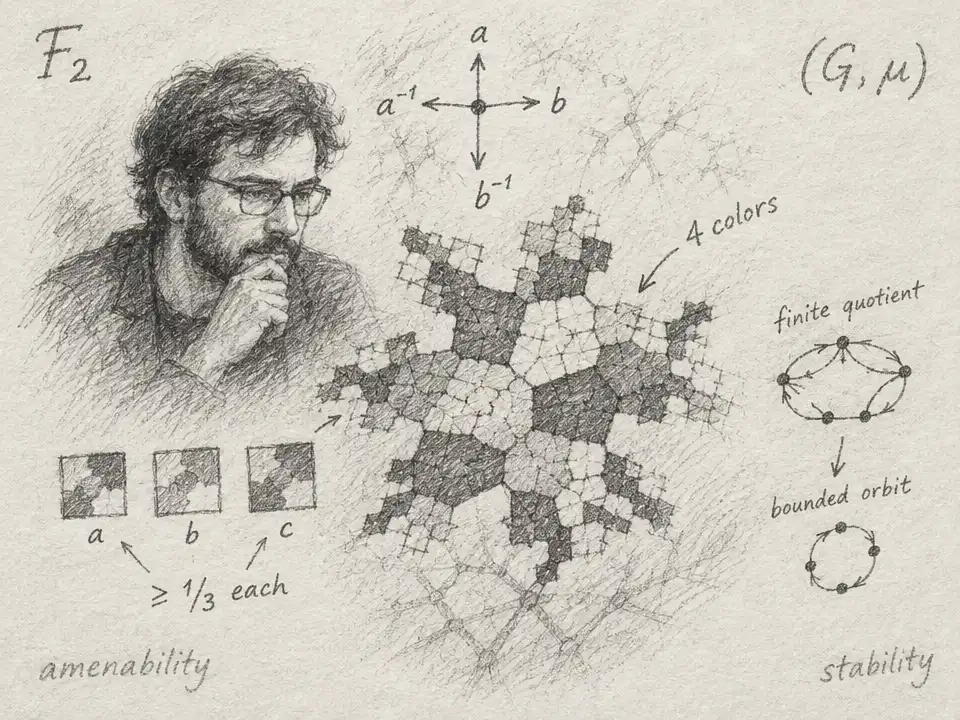
The first part uses color. Imagine a group whose elements are painted in four colors. This is not a casual coloring: the rules assign each color three designated moves. From any element, if you follow those three moves for a given color, at least one destination must have that color. The group is built from freely acting moves, so the pattern can be extended across the whole structure without getting trapped in a short cycle of conflicting instructions.
Now ask whether a translation-invariant probability measure could assign a fair share to each color. For any one color, the three translated copies of its color class cover the entire group: wherever you stand, one of the three routes lands in that color. If translation preserves measure, all three copies have the same measure as the original color class. For their union to cover a whole space of measure one, that color must account for at least a third of the total.
Here the arithmetic snaps shut. The same rule applies to all four colors, so each would need at least a third of the total. But the colors partition the group: every element has exactly one color, and the four shares must add up to one. They would instead add up to at least four-thirds. No translation-invariant probability assignment can satisfy both demands. The coloring doesn’t merely make fairness difficult; it makes the basic requirements contradict each other.
That leaves the harder question: how can a group that defeats fair averaging still host a global type with a bounded orbit? Chernikov’s route runs through the group’s finite shadows. A free group can be mapped into many finite groups, each of which forgets most of the infinite structure while retaining a small, manageable image. The paper considers all these finite views together and identifies elements that are invisible in every one of them.
Those invisible elements form a subgroup of bounded index: there are at most continuum many distinct classes when the large mathematical universe is chosen sufficiently large. Chernikov constructs a type that is unchanged by every translation from this subgroup. Since those translations make no new version of the type, its entire orbit stays bounded. The construction is delicate—the coloring and the finite-quotient argument must fit together inside a simple first-order theory—but the roles are distinct: color blocks invariant averaging; finite views control the type’s orbit.
The distinction matters. A type is not a probability distribution, and a bounded orbit is not itself a fair way to divide up a group. The conjecture proposed that one kind of logical regularity guaranteed the other. This example separates them: the translated descriptions stay within a bounded range, while the coloring forces any invariant measure into an impossible allocation.
There is a useful lesson in the shape of the counterexample. A pattern can look restrained when viewed through one lens and wildly unbalanced through another. Finite quotients give the type its limited orbit; the four-color rule exposes the group’s failure to support invariant averaging. Neither view is false. The surprise is that both can hold at once—and that a long-standing conjecture had treated them as inseparable.