Choose a number q between zero and one. Starting from a point on a line, mark distances of q, q squared, q cubed, and so on. The marks march toward the starting point forever, drawing closer but never reaching it. Now shift and stretch that entire pattern. Can a large set of real numbers be arranged so that no matter where the pattern goes or how it is stretched, at least one mark always lands outside?
A recent mathematical result says yes. For any fixed q and any desired tolerance, there is a compact set inside the unit interval whose length is greater than one minus that tolerance, yet which contains no translated and rescaled copy of the infinite pattern. The set can occupy almost all the interval while carefully missing every possible copy. The theorem is credited in a November 2026 arXiv exposition to an OpenAI manuscript released October 6, 2026; mathematicians Alex Iosevich and Alexia Yavicoli provide the detailed exposition of its proof.
The surprise is easier to feel if we begin with a finite pattern. A positive-measure set—one with genuine area along the number line—will contain a translated, sufficiently shrunken copy of any fixed finite collection of points. But an infinite sequence brings a new difficulty: adding each next mark pushes the scale smaller. The translation and scaling that worked for the first dozen points may fail for the next dozen. The whole, endlessly approaching pattern has to fit at once.
The proof turns the question inside out. Instead of building a set that avoids every copy, first build a small set that touches every copy. Remove that “hitting set,” and what remains is the large, pattern-free set. The challenge is to make the hitting set tiny without leaving even one copy untouched.
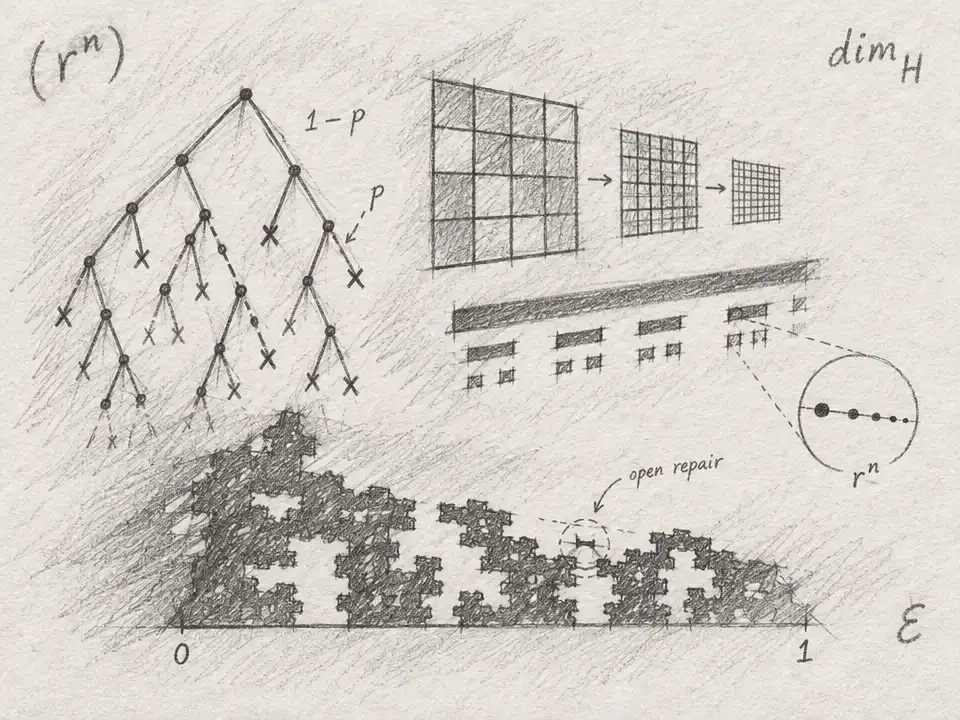
Here is the construction’s hidden machinery: a finite branching tree. Imagine that each real number is sent down a route from the tree’s top to one of its leaves. Random choices at the branches determine the route; then a separate random choice at the leaf decides whether to mark that number for removal. The crucial accounting trick is that every point has the same probability, p, of being marked, however many branches the tree contains. Add up those chances across the line, and the expected density of the removed set is still p. More branches do not automatically mean removing more of the line.
Why build a tree at all? Its branches let the proof test many points of the geometric pattern without paying for each test separately. Break the sequence’s indices into blocks and assign each block to a branch. The route taken by the pattern’s limiting point—the point that the marks approach—determines which branches are useful. At a certain branch, that limiting point may reach the last child only because all the earlier options were rejected. This default choice leaves those earlier branches available as fresh chances for the nearby sequence marks to be removed.
The geometry makes those chances work. The proof uses nested grids: coarse cells early in the tree, finer cells deeper down. A nearby pattern mark is so close to the limiting point that, in the earlier grids, it shares the same cell labels and follows the same route. But at the grid level assigned to its own block, each mark can occupy a different cell. So it inherits the earlier decisions, then encounters a fresh random choice where it matters. Conditional on the route choices, a test has a one-half chance of opening a new branch, followed by a p chance of being marked at the leaf. With enough tests, the chance that every one misses drops rapidly.
There is one more obstacle: a copy can be stretched by any amount in a continuous range, not just at a few convenient sizes. As the scale changes, each tested point slides through the grid and changes cells at boundary crossings. Rather than check infinitely many scale values, the proof checks a finite set of representatives. Between consecutive crossings, the cell labels—and therefore the tests’ outcomes—stay the same.
Now the tree’s branching earns its keep. For one fixed scale, many separate tests make total failure unlikely. The number of representative scales also grows as the blocks get longer, but the proof arranges the parameters so that the failure probability falls faster than that number grows. In effect, it makes the number of branches large enough to win this contest while keeping the average amount removed small.
What about the limiting points whose routes are disrupted by a grid boundary? The proof cannot simply take a union over all such points: there are uncountably many. Instead, it estimates the exceptional points by averaging their failure probabilities, then covers the troublesome set with a small open neighborhood. That neighborhood also handles the tail of each sequence. Since the marks converge toward their limiting point, all sufficiently late marks lie inside any open neighborhood around it. The limit point itself need not be part of the pattern for this repair to work.
The result is a small open hitting set, with density at most six times p in the exposition’s construction. Repeating the construction at successive powers-of-two scales, and for reflected copies as well, makes a barrier against patterns of every nonzero scale. The removed pieces can be given a summable total budget, smaller than the chosen tolerance. What is left inside the unit interval is compact, nearly full, and avoids every copy.
The deeper shift is one of perspective. The infinite pattern is not defeated by tracing all its marks at once. A finite tree divides the task into local tests, and nested scales make nearby points cooperate with those tests. Somewhere among the marks, the random barrier catches the pattern—even though the barrier takes up as little space as desired.