Imagine an AI agent midway through a long task. It has encountered rooms, objects, instructions, corrections, and failed attempts. The history is all there—but its working prompt has limited space. To decide what to do next, the agent must retrieve a handful of records from its external memory. Which ones keep making the cut?
A recent study suggests the answer can be surprisingly lopsided. In the researchers’ experiments, some stored states were retrieved again and again, while many others were rarely called up. The result was not simply a shorter memory. It was a memory with a busy front row and a dimmer, less-accessed back section.
That distinction matters. A long-horizon agent—one expected to keep acting across many steps or sessions—does not necessarily lose every record it fails to retrieve. But information left out of the current prompt has less chance to shape the next prediction or action. If those records contain unusual states, the agent may be less prepared for them. The team measured this uneven pattern as a property of retrieval, not as a claim that language models remember in the human sense.
To find out whether the imbalance was real, the researchers first built a controlled world of connected states, like locations on a map. They tracked how often an agent’s memory system revisited each state. Then they asked a crucial question: could a lopsided pattern arise even without an intelligent policy choosing where to go?
Yes. A random walk also revisited some states far more than others. Across 54 graph-and-size tests, however, those random-walk patterns did not pass the study’s test for a pure power-law distribution. Under semantic policies—where a language model selected actions—the access patterns were compatible with a truncated power law in scale-free, modular, and exponential graph settings, but not in a uniform graph. In plain language, semantic agents showed a recognizable pattern in which a small group of memories attracted repeated attention, alongside a long tail of less-visited ones. The authors are careful not to treat a heavy tail as proof of a single cause: uneven access alone is not enough to establish what produced it.
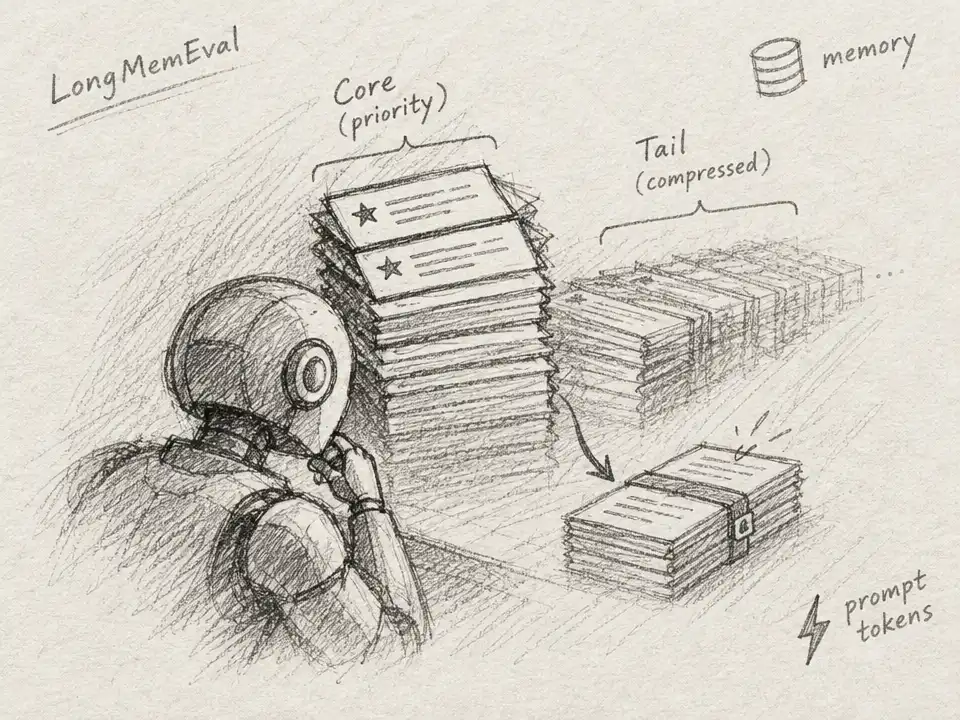
That statistical trail led to the paper’s practical idea: the Core–Tail Memory Controller. Rather than passing every record into the prompt, the controller ranks candidate memories by retrieval priority. It preserves high-ranking items as compact, detailed records, then folds lower-ranking items into a shared summary. An adjustable setting shifts how much prompt space goes to the detailed core versus the compressed tail. The underlying language model does not need to be retrained.
The point is not to declare the back of the memory unimportant. It is to stop spending equal space on every stored detail while still carrying a summary of the less-accessed material. Think of a field notebook: the most relevant observations are kept legible on the open page, while the rest are condensed into an index rather than tossed away.
In a synthetic graph-world test, the controller reduced prompt use and improved prediction on the least-accessed half of the states compared with a graph-memory baseline. Across three runs, the paper reports 5.89% lower token use and a 13.6% reduction in tail prediction error. The team also compared its ranked allocation with controls that gave memories uniform space, shuffled their ranks, or reversed the ranking. Those alternatives performed worse at nearly identical token budgets, suggesting the benefit came from using the retrieval order—not simply from giving the model more room.
The researchers then tested the approach in ALFWorld, a text-based environment for household tasks, and LongMemEval, a benchmark for long-term conversational memory. On LongMemEval, the controller used 24.48% fewer prompt tokens while maintaining aggregate accuracy. Across the tested ALFWorld settings, prompt-token reductions ranged from 3.90% to 6.61%. These results point toward a useful possibility: agents may be able to work across longer histories without paying to place every old detail in front of the model at every step.
But there is a price to choosing what gets the clearest view. A system that favors frequently retrieved information could let a rare but decisive fact fade into a summary. Imagine a user first gives one date, then later corrects it. If the correction is less often retrieved—or its wording is blurred during compression—the agent could lean on the stale version. That is a risk implied by the design, not a failure the paper claims to have demonstrated. Its controller keeps a tail summary, but summaries can preserve the gist while losing the exact detail a future question needs.
The study also has boundaries. Its tests cover a synthetic graph world, text-based household tasks, and a conversational-memory benchmark—not every kind of agent or real-world deployment. The measured token savings show lower prompt use in these settings; they do not by themselves guarantee lower total operating costs or better performance on new tasks. A memory controller also depends on the quality of the ranking it receives. If the ranking is wrong, allocating space more carefully may only make the wrong priorities more efficient.
The next frontier, then, is not just giving AI agents more memory. It is helping them decide what deserves detail, what can survive as a summary, and when an overlooked record should be brought back into view. A few memories may be enough to steer the next step. The harder problem is making sure the quiet ones are still there when the task takes an unexpected turn.