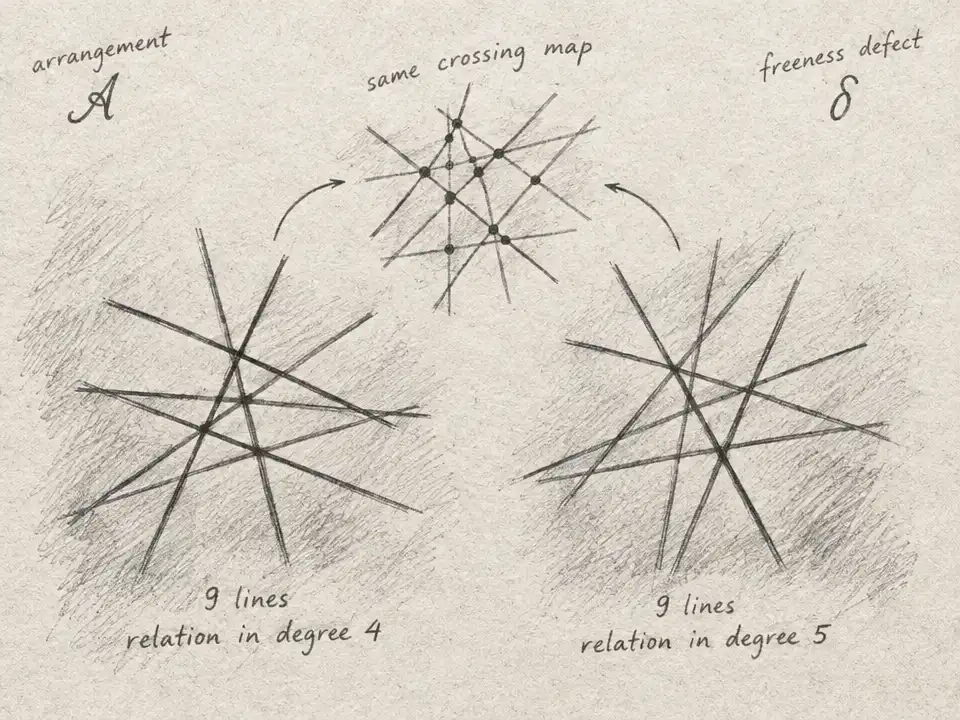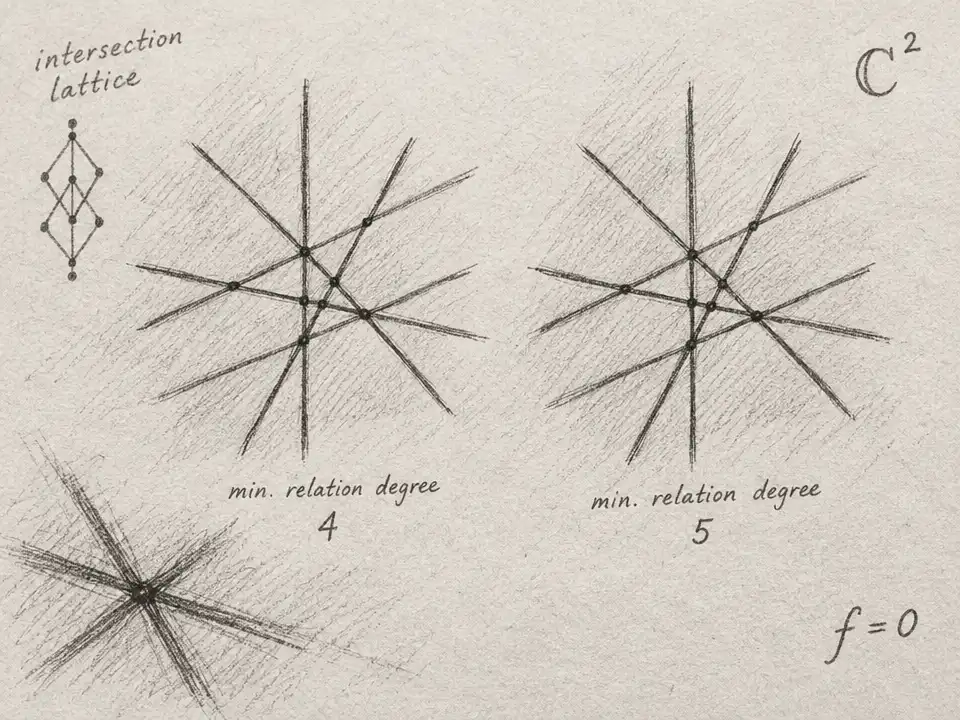
Imagine two maps made from nine lines. At first glance, they tell the same story: the same groups of lines meet at the same shared points. Then mathematicians ask a different question—not where the lines meet, but what hidden algebraic relationships their equations obey. Suddenly, the matching maps give different answers.
That is the surprise in a result by Alexandru Dimca and Piotr Pokora. They built two arrangements of nine lines in the complex projective plane. For a useful mental picture, set aside the exact locations and imagine a ledger recording which lines meet together. The two arrangements have identical ledgers: every multi-line meeting in one has a matching meeting in the other, involving the corresponding lines.
The shared pattern has nine ordinary meeting points where two lines intersect, seven where three meet, and one where four converge. Those counts account for all thirty-six pairs of lines. More importantly, the match goes beyond the totals: the authors show that the arrangements have isomorphic intersection lattices, a record of their complete pattern of shared intersections.
Why expect that record to predict anything beyond geometry? Because mathematicians often hope that a system’s structure can be read from its visible relationships. Here, however, the object being measured is not another meeting point. It is the first degree at which a particular kind of exact algebraic cancellation becomes possible.
Each arrangement can be encoded by multiplying together the nine linear equations that describe its lines. From that product, mathematicians calculate three related polynomials: they describe how the product changes as each of its three variables changes. A Jacobian relation is a way to combine those three polynomials, using polynomial weights, so the result cancels to zero everywhere—not just at one point. The degree of a relation measures the complexity of those weights. The smallest degree at which a nontrivial cancellation appears is a compact fingerprint of the arrangement’s algebra.
The two matching arrangements have different fingerprints. For one, the first such relation appears at degree four. For the other, no relation appears until degree five. In other words, the same incidence map hides a one-degree difference in how soon the defining equations can cancel against one another.
The researchers checked the result by turning each question into exact linear algebra. First, they verified which lines meet by testing determinants of their defining equations. Then they tested, degree by degree, whether any weighted combination of the three derivative polynomials could vanish. For degrees zero through three, neither arrangement has a relation. At degree four, the first arrangement has one; the second still has none. At degree five, both have relations, but the second arrangement’s first ones arrive only there. Because the computations use rational coefficients and exact rank tests, this is not a near-cancellation caused by rounding.
The mismatch overturns a proposed rule about what intersection patterns should determine. The rule concerned arrangements whose first relation appears below half their degree. With nine lines, that dividing point is four and a half. One arrangement’s first relation appears at four, below the threshold; its lattice-matched partner’s first appears at five. If the intersection lattice determined this algebraic degree in that range, the two values could not differ. They do.
The distinction matters, but it needs careful framing. The result does not disprove Terao’s famous conjecture about whether a line arrangement’s freeness is determined by its intersection pattern. Instead, it disproves a stronger related statement that would have implied Terao’s conjecture. A weaker version of that related statement remains open: its threshold is lower, and the degree-four example does not fall below it.
That boundary is part of the result’s value. The authors have not shown that an intersection ledger is useless; they have shown that one proposed ledger is not enough to settle this particular question. The lattice records who meets whom, but not every algebraic feature of the line equations themselves. Two configurations can therefore agree perfectly in their combinatorial portrait and still differ in the hidden dependencies among their equations.
Return to the two maps. Their points of convergence match line for line, as if the same pattern had been copied onto two different canvases. But beneath that familiar outline, the equations carry different kinds of algebraic tension. The unexpected lesson is modest and sharp: a perfect match in visible structure does not guarantee a match in what the structure can calculate.