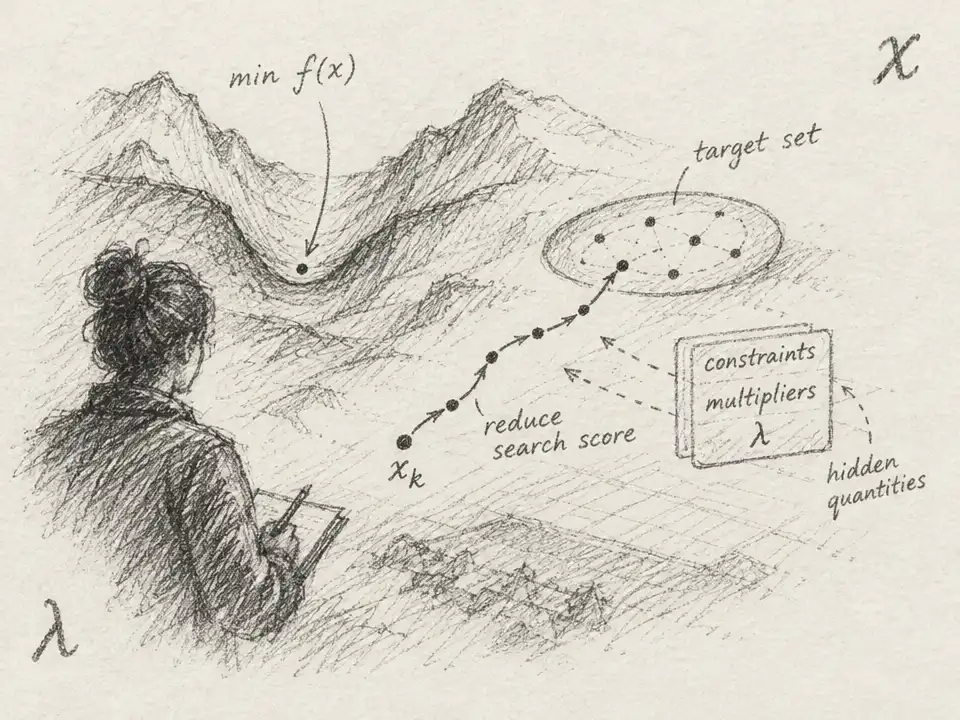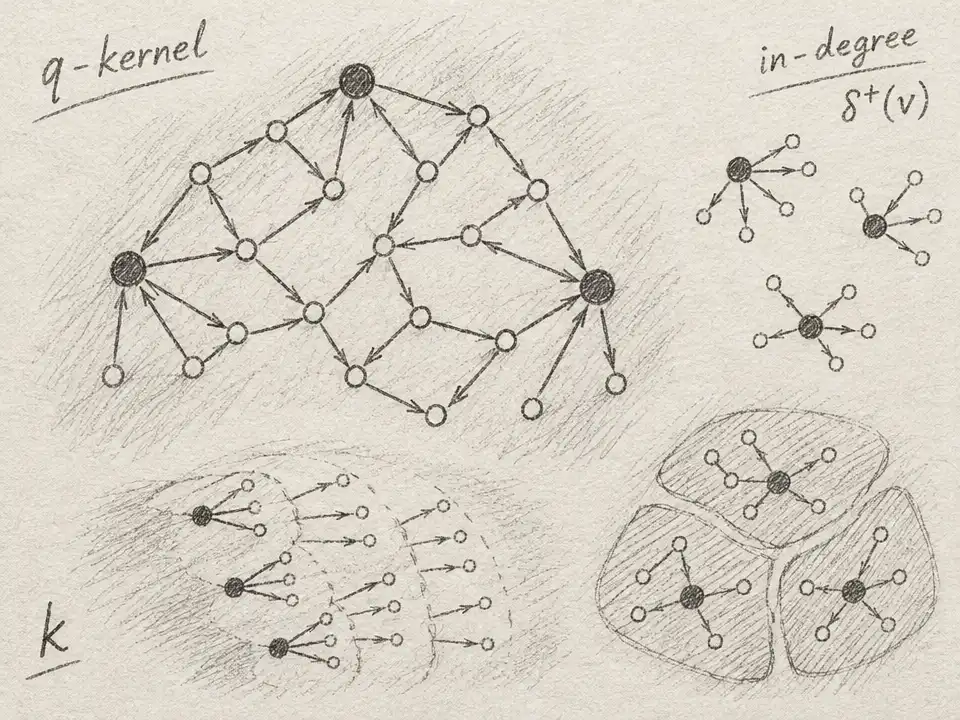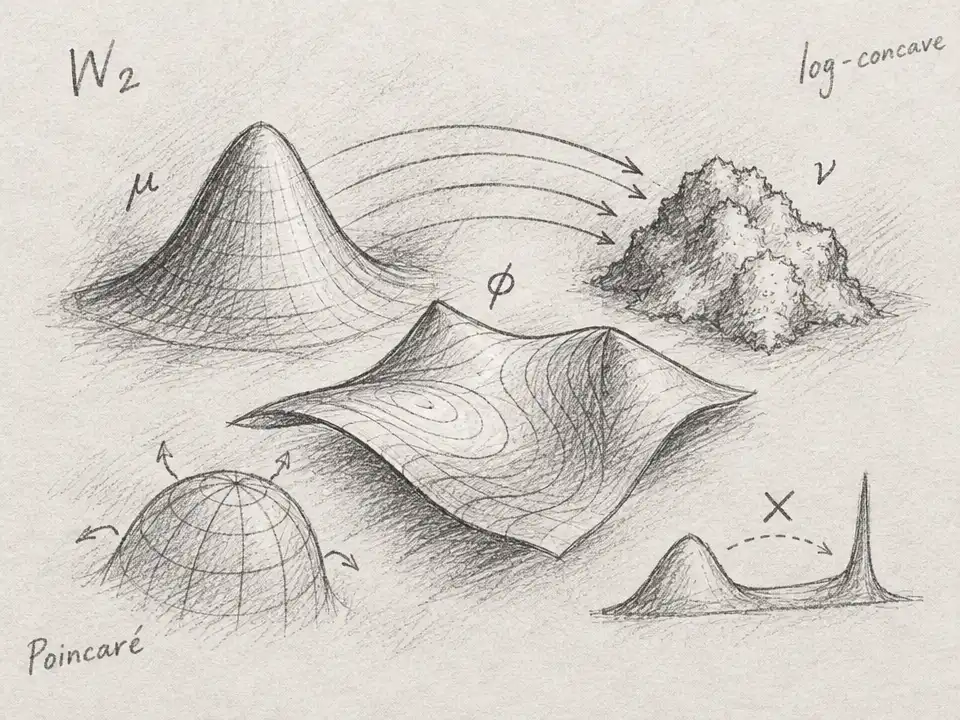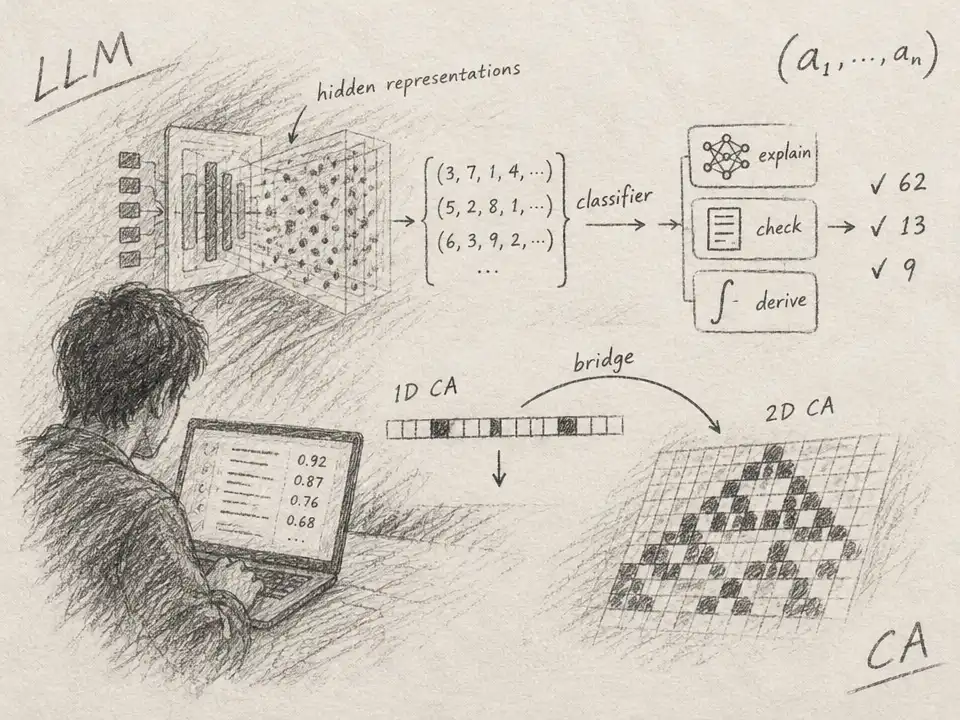
Picture a point moving inside an enormous mathematical space. Apply a particular rule, and it moves again—not just a little, but at least half a unit. Apply the rule anywhere in the space, and the same minimum jolt remains. This curious map was known decades before a recent mathematical manuscript put it to work on a different question: can a complicated group be averaged into behaving simply?
The group in question, Thompson’s group F, is built from transformations of the interval from zero to one. Its members are piecewise-linear maps with breakpoints at dyadic fractions and slopes that are powers of two. The group is a compact object to describe, but its internal structure has resisted a basic classification question: is it amenable?
Amenability is a way of saying that a group can support a fair average. Roughly, take a finite collection of group elements and shift it around. If the collection can be chosen so that the shifted versions differ by only a tiny fraction at the edges, then larger and larger collections can behave like stable averages. A group with this property is amenable. If every attempt at such averaging leaves a stubborn mismatch, the group is nonamenable.
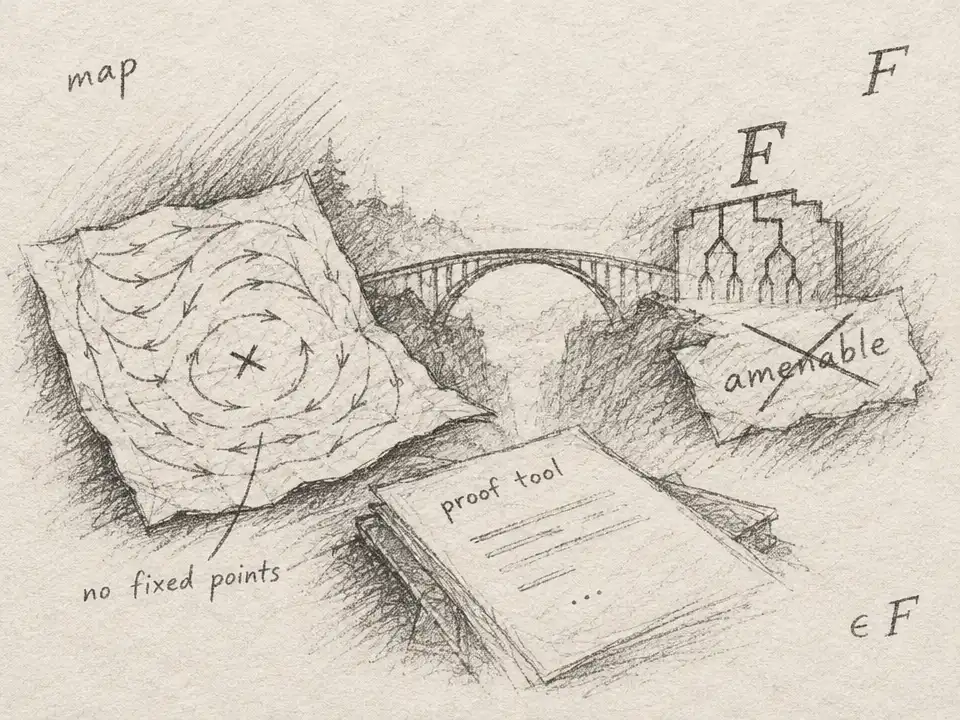
The new argument’s striking move is to bring in a tool from another corner of mathematics. In 1983, mathematicians made a Lipschitz map of an infinite-dimensional Hilbert-space ball that always moves each point a definite distance—in the example used here, at least one-half. A Lipschitz map is controlled: nearby inputs cannot suddenly become wildly separated outputs. Yet this particular map has no approximate resting place. It keeps pushing.
How might a map that pushes points around say anything about averaging a group? The manuscript’s proposed bridge is a recursive coloring of dyadic partitions. Think of each partition as carrying a value inside the Hilbert ball. When a partition splits into smaller pieces, its value is defined by applying the fixed-point-free map to the average of the values on those pieces. The construction turns a geometric rule—average, then push—into a repeated bookkeeping system.
Now let the group transform the interval and its partitions. If the group were amenable, the argument says, one could find finite averages that barely change under these transformations. But the recursive coloring keeps feeding averages into a map that refuses to sit still. By comparing how transformed partitions line up, the manuscript aims to force those two demands into conflict: the group’s averages must stay nearly put, while the map insists on moving them.
The argument claims this clash rules out amenability for Thompson’s group F, addressing a question raised in 1979. Its central novelty, as identified in a recent survey, is not the 1983 map itself. It is the attempted transfer of that map into a new setting, through recursively colored partitions and carefully chosen comparisons between their images. An old tool, pointed in a new direction, may expose a property that had been hard to see directly.
That kind of transfer suggests a broader frontier for mathematics. A proof can contain more than a route to one answer: it can contain a useful device that travels. A clever inequality, a special construction, or a way of organizing cases might solve an immediate problem and later help with another one. Researchers have always borrowed techniques across fields. The newer possibility is to make those hidden devices easier to find by describing them separately from the headline claims they were built to support.
A recent arXiv survey tries this with a selection of 38 families from a release containing 372 problem families. Instead of treating each manuscript only as a yes-or-no claim about a famous question, it identifies candidate “instruments”: the lemmas, constructions, and proof strategies doing the work. Across the selection, it points to recurring patterns such as using established theorems in unfamiliar settings. The goal is a map of possible tools—not a declaration that every destination has been reached.
That distinction is the price of the opportunity. The survey’s account of the argument for F checks selected statements and steps, but it explicitly says that this does not certify the entire proof. The manuscripts it examines had not been peer-reviewed when the survey was written. And although some are accompanied by Lean formalizations, the survey did not compile or kernel-check a Lean project. A label indicating formalization is not the same as an independently verified proof.
Even the claim that a technique is new needs care. A literature search can miss an older paper, an obscure source, or a result that was never published. The survey calls its novelty assessments provisional and acknowledges that its selection is only a fraction of the full collection. It also flags a subtle trap in the amenability argument: an averaging idea can fail if it fixes a partition level too early and that level has no weight in the average. The order of choices matters—the finite averaging set must be selected first, and the relevant partition level afterward.
If the argument survives fuller scrutiny, the payoff could be bigger than one answer about one group. The recursive coloring could become a reusable instrument, and other researchers might recognize a similar structure in problems that look unrelated. But that possibility depends on the hard work that comes next: checking each dependency, establishing what is genuinely new, and testing whether the tool works beyond its first proof.
Mathematical discovery may therefore have two frontiers. One is finding new answers. The other is learning to recognize the portable ideas hidden inside the attempts. A map that never settles down offers a vivid example of how a known result might travel. Whether it opens a reliable route—or only a promising trail—depends on verification.