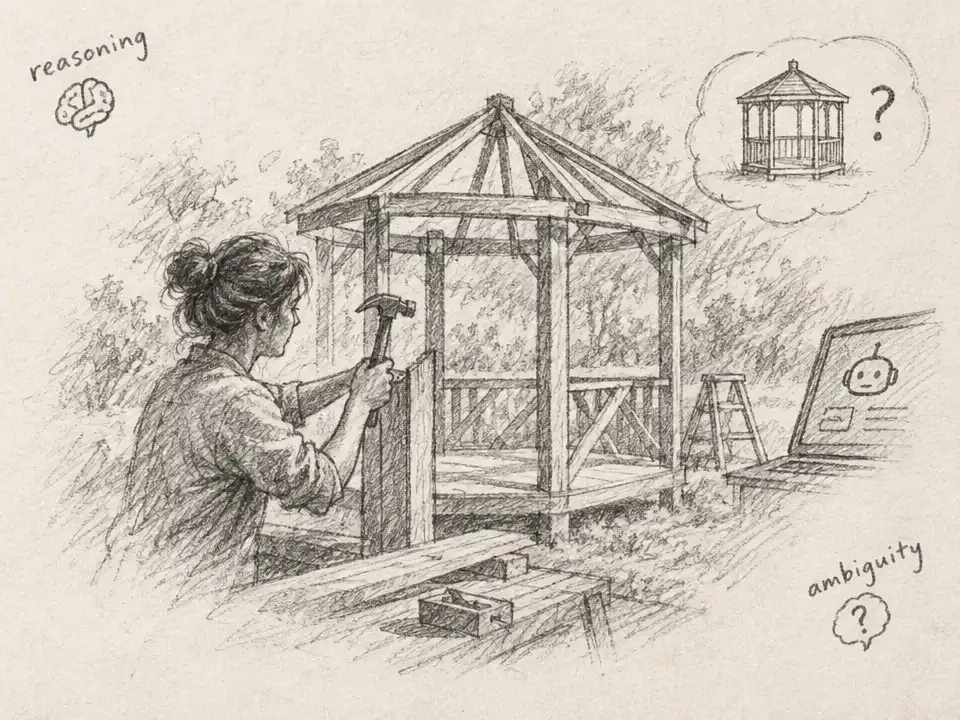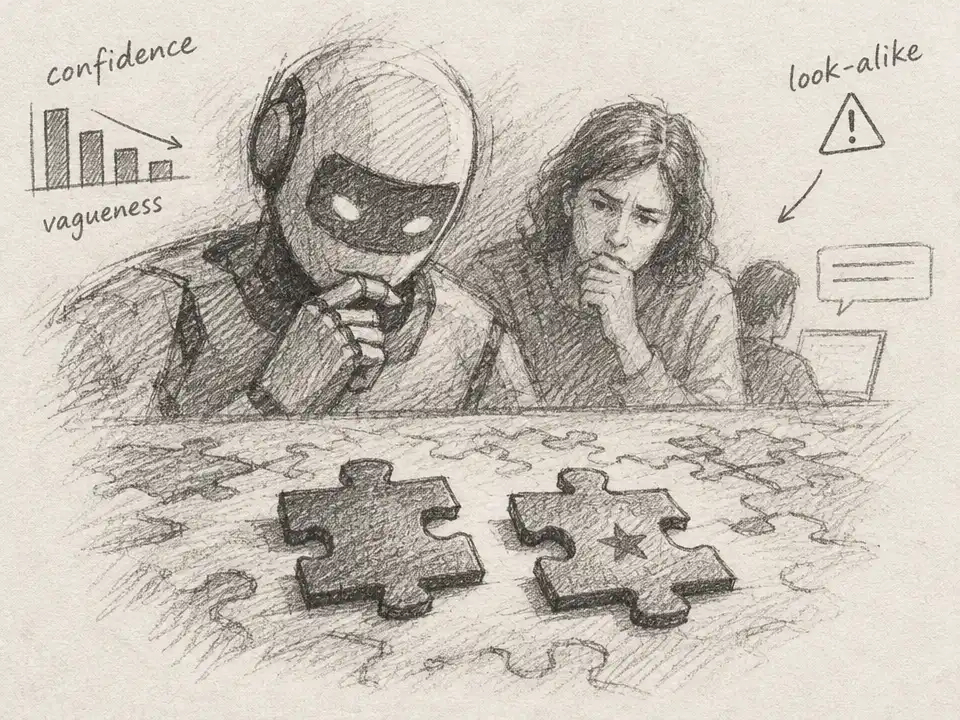
Imagine being asked to place a green spiral in the upper-left corner of a puzzle. You can see the pieces, but not the picture you’re trying to recreate. Your partner can see the picture, but not your pieces. “Put the spiral up top,” they say. There are two spirals. Which one did they mean?
This small coordination problem hides a larger question: when an AI picks the wrong object, can it tell that the instruction was unclear—and can it warn its human partner in time? In a September 30, 2026, arXiv study, Christian Poelitz, Finale Doshi-Velez, and Siân Lindley turned that question into a puzzle with 24 visually ambiguous pieces and a four-block target. The human Helper saw the target; the AI Worker saw the available pieces. Neither had the full picture.
The first clue seemed encouraging. When researchers separately asked models to spread their confidence across the possible pieces, the resulting estimates tracked one kind of uncertainty: vague instructions. As instructions became less specific, the models’ reported uncertainty rose, and their mistakes increased. Across the tested levels, errors climbed from 0% with over-specified instructions to 77% with vague ones.
But what did “confidence” mean here? The researchers compared the models’ reported beliefs with the probability attached to the token naming the chosen piece. That raw token score looked impressively sure: average confidence was 0.97, even though placements were correct only 53% of the time. A separately elicited distribution over candidate pieces was better calibrated, with an expected calibration error of 0.15 rather than 0.44. It was only a modest clue about which individual placements would be wrong, however: its ability to distinguish correct from incorrect choices was about 0.65 on a scale where 0.50 is chance.
Then came the puzzle’s more revealing turn. The researchers changed the board, adding pieces that looked like the intended target. The AI made more mistakes—but its reported uncertainty barely moved. With distinct alternatives, errors were about 19%; with look-alikes, they reached about 50%. The model’s strongest belief did not necessarily spread across several candidates. It could shift decisively onto one convincing impostor.
That result helps explain why uncertainty is not a single dial. A vague instruction can make several interpretations feel plausible. A look-alike can make one wrong interpretation feel like the obvious answer. The same outward act—a piece placed in the wrong spot—can arise from different kinds of uncertainty, and a confidence signal that catches one kind may miss another.
Could the AI simply ask? In the tested image-based interactions, clarification requests were uncommon: rates ranged from 3.5% for GPT-4.1 to 16.7% for GPT-5. The models often acted without making their uncertainty visible. A belief score that a system can produce when prompted is not automatically a warning it will offer during a task.
So the researchers turned to the human side of the puzzle. In a controlled study with 210 participants, people watched recorded Helper–Worker interactions and judged whether the AI had chosen the intended piece. These were judgments about recorded turns, not live collaborations. When participants saw only the Worker’s original, terse message, they accepted 78% of wrong placements and could not reliably tell correct from incorrect ones.
Adding a precise description of the selected piece helped people compare the AI’s choice with the Helper’s instruction. Adding a well-targeted hedge helped further: acceptance of wrong moves fell to about 36%, while people still accepted roughly 74% of correct ones. In this experimental condition, the researchers placed hedges on objectively incorrect turns. That is a useful test of what a warning might accomplish, but it is not a warning rule an AI could deploy without already knowing which choices were wrong.
Could the model’s own uncertainty supply that missing rule? The researchers tested a version that added a hedge when the model’s reported uncertainty crossed a threshold. Here the clue became a false lead. The signal was weak at predicting errors, and some correct placements were flagged. Participants then accepted fewer of those correct moves: 49%, compared with 87% when the same kind of turn appeared with a precise description but no hedge. A warning can change a person’s decision; if it points at the wrong moments, that influence can hurt.
The puzzle’s answer, then, is not simply “make AI admit when it’s unsure.” A useful warning must match the kind of confusion actually present and must be aimed at the right choices. The study suggests that describing what the AI did can help a partner inspect the decision, while uncertainty language helps most when it reliably distinguishes likely mistakes. But the human study used recorded interactions and measured judgments and intended responses, not performance in a live, changing partnership. The authors also found that the model-derived hedge did not reliably improve those judgments.
In a puzzle, a wrong spiral is easy to spot once the board is complete. In a conversation, an AI can choose a look-alike, report a confident-sounding answer, and give its partner little reason to pause. The harder challenge is not merely teaching a system to say “I’m unsure.” It is teaching it to notice what kind of ambiguity it faces—and to raise a flag only when that flag helps its partner see the mistake.