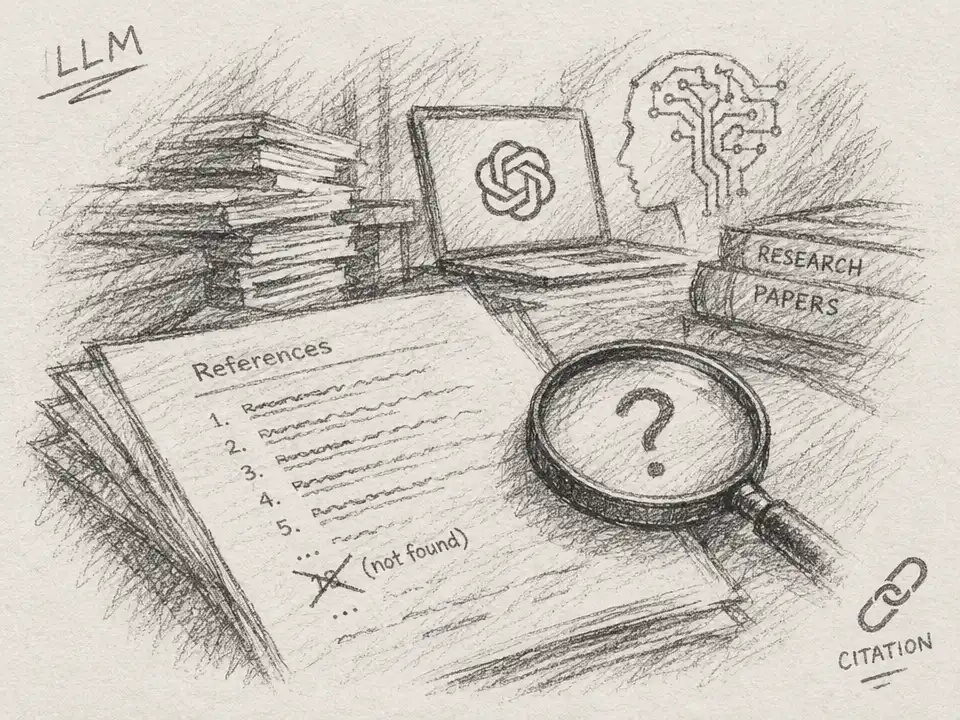
A scientific citation is a small promise: somewhere, there is a paper behind this title, and it says something relevant. When a language model invents a plausible-sounding reference, that promise breaks. But how often do those broken promises reach research papers—and what do they look like once they get there?
To investigate, researchers audited 111 million references across 2.5 million papers in four large research collections: arXiv, bioRxiv, the Social Science Research Network and PubMed Central. Their unexpected finding was not a wave of papers whose bibliographies were almost entirely fiction. Instead, the suspect references appeared like scattered grit: a modest number tucked into many otherwise ordinary-looking papers.
That distinction matters. If the problem were concentrated in a few extreme cases, screening a small set of bad manuscripts might contain it. A thin sprinkling across the literature is harder to spot—and easier to mistake for a routine typo or database mismatch.
The team could not simply label every reference their software failed to find as an AI hallucination. Some real works are obscure, formatted oddly or missing from databases. So the researchers built a verification pipeline, checked unmatched references against multiple indexes, and used the period before large language models became widespread to estimate the usual background rate of citation errors. They treated the rise above that baseline as the population-level signature of hallucinated citations—not as proof about the origin of any individual reference.
Across the four collections, the estimated rates began rising sharply in 2023, with the steepest growth starting in mid-2024. By August 2025, the estimated excess of unmatched references had reached 0.39% in arXiv, 0.21% in bioRxiv, 1.91% in SSRN and 0.27% in PubMed Central. Extending the observed trends through the end of 2025, the authors estimated 146,932 hallucinated citations across those collections that year. The estimate is not a count of confirmed AI-made references: it is a baseline-adjusted calculation, and the authors describe it as conservative.
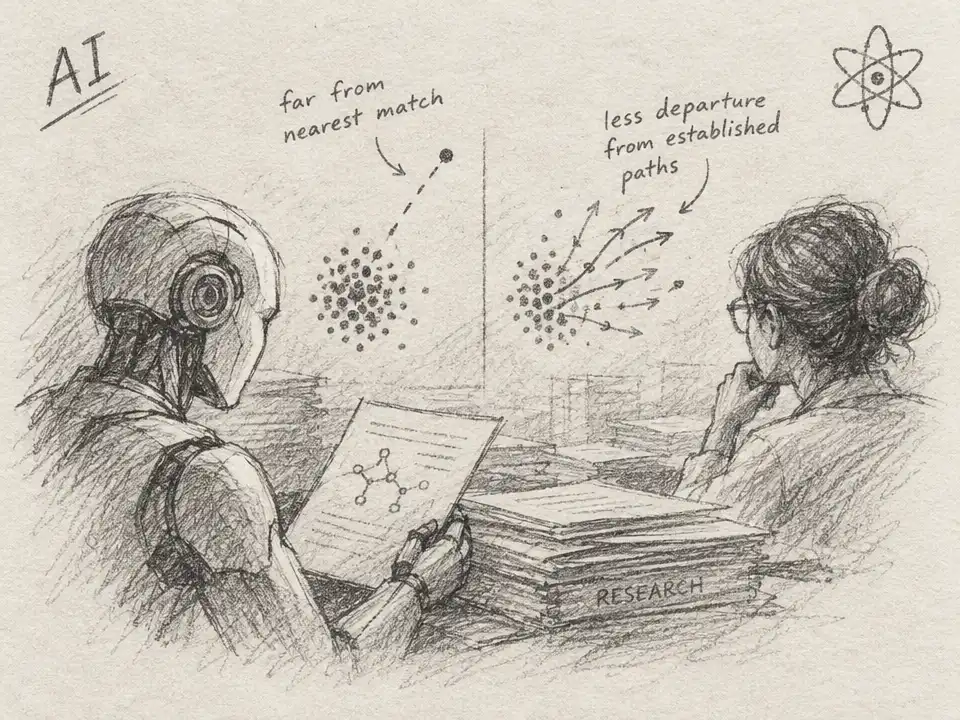
Why did the “few bad papers” explanation fail? The rise was concentrated in manuscripts with a small share of unmatched references, not in a growing cluster of papers with bibliographies mostly made up of them. The share of papers with at least one suspect reference increased by 2 to 23 percentage points across the collections. Meanwhile, the share with 50% or more unmatched references increased much less. The picture is less a single flood than a broad leak.
The researchers also looked for patterns that might connect the leak to language-model use. Across arXiv subfields, estimated hallucination rates rose alongside an estimate of AI-assisted writing, with a correlation of r = 0.441 and P < 0.001. That is a meaningful association, but it does not establish that AI use caused any particular citation error. The authors’ measure estimates AI-writing signatures; it does not identify the tool used, or prove that a given reference came from a model.
Some of the patterns raised a second question: who is most exposed to the error, and who gets credit from it? Papers containing unmatched references were more often associated with authors who had fewer prior publications than comparable researchers. Yet the difference in publication output between those groups had largely closed by 2025. The authors suggest that tools that lower the barrier to producing manuscripts may help explain why citation problems and rising output can coincide, but their analysis does not show that every less-experienced author used AI or acted carelessly.
When a fabricated title did point toward a real researcher, it tended to favor scholars who were already prominent: those authors had 68.8% more publications and 58.3% more citations than authors in a matched sample of genuine references. The apparent gender skew was smaller but still notable: these references disproportionately credited authors with male names, by 6.4 percentage points. The paper also found that real references in papers containing hallucinations leaned toward more prominent researchers. So the distortions may not stop at made-up papers; they may affect which genuine work is surfaced, too.
Existing checks caught some of the problem, but not most of it. Rejected arXiv submissions had higher rates of unmatched references than accepted ones. Still, the researchers estimated that 78.8% of non-existent citations passed arXiv moderation. In a separate analysis following 2,241 bioRxiv preprints with unmatched references to their published versions, 85.3% of those references persisted into the published record. These figures describe the samples and methods in this study, not a universal failure rate for every screening system or journal.
There is a further twist: after an invented citation appears in a paper, it can acquire the look of a real source simply by being repeated. The team found unmatched titles appearing as entries in Google Scholar and as references in other papers. If researchers and automated tools then draw on those records, a false citation could travel farther. The authors also warn of a possible feedback loop: future models may train on the same open research papers that contain today’s errors.
The study has important limits. It focuses on non-existent titles, the easiest kind of citation hallucination to check. A real paper cited as support for a claim it does not actually make is much harder to catch, and this audit did not measure that problem. Nor can the researchers reliably tell which unmatched references were fabricated by a model rather than produced by ordinary human or software errors.
Still, the unexpected result changes the scale of the question. The risk is not only that an AI might invent a spectacularly false bibliography. It is that small, plausible errors can be distributed widely enough to pass unnoticed—and then become part of the material that researchers, search tools and future AI systems treat as knowledge. A citation is a breadcrumb. The challenge is noticing when it leads nowhere before the next reader follows it.