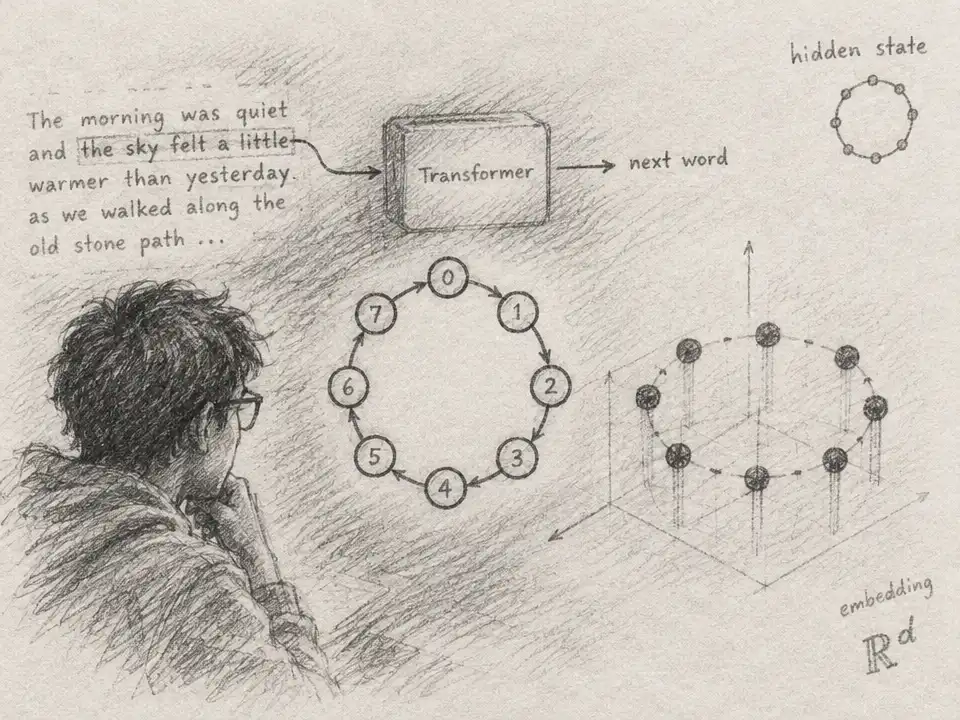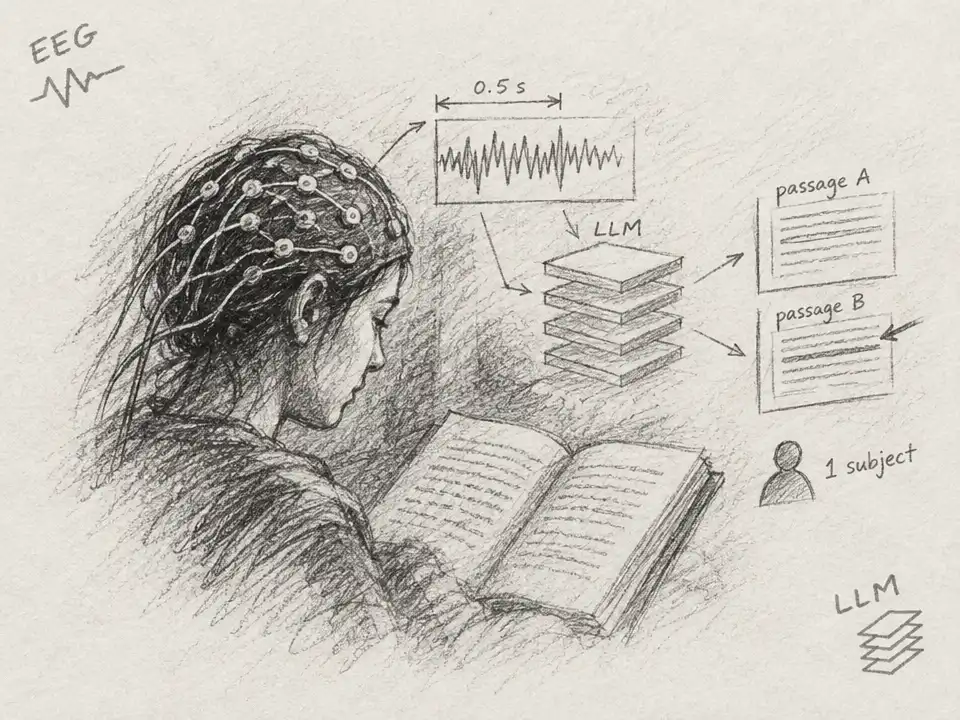
Imagine a word appearing on a screen, then vanishing as the next one takes its place. While one person silently read, researchers recorded electrical activity from 19 sensors on the scalp. Their surprising discovery was not that they could simply identify the word on the screen. A half-second slice of brain activity also carried a faint trace of the passage the reader was moving through—even when the decoder saw no neighboring brain signals.
The result overturned a straightforward expectation. If a brain signal corresponds to the word being read, perhaps the best match should be a language model’s simplest representation of that word: one that knows the word but not its context. If the decoder is to recognize a passage, it might need a sequence of brain signals, accumulating clues from several words. Instead, the clearest word-level matches came from early model layers, while deeper layers revealed more information about the passage. And a single EEG window could carry some of that contextual signal.
The experiment followed one participant across 52 sessions on 42 days over 146 days. The participant read detective stories, excerpts from fantasy and science-fiction novels, and newspaper articles, one word at a time. In total, the researchers recorded about 51 hours of reading across 409 runs of about 600 words each. The EEG system sampled 19 dry electrodes at 600 Hz. For each word, the team took a 0.5-s window of brain activity beginning at the word’s onset.
To give those signals something to match, the researchers used Llama-3.1-8B, a language model that processes text through 32 layers. Its first layer contains a word’s identity with little context; later layers incorporate more of the preceding text. The researchers trained a separate decoder for each layer, teaching it to map the EEG signal toward the model’s representation of the word. In one version, the decoder saw only the current EEG window. In another, a sequence model could also use signals from earlier words.
The team measured how much the decoder improved at retrieving the right word from a pool of candidates, compared with a shuffled baseline. This gain is reported in percentage points, not as the percentage of words the system could transcribe. For the decoder that saw only the current EEG window, word-level retrieval peaked at 11.8 ± 0.3 percentage points against layer 1, then declined as the target moved deeper into the model. With the sequence model, the peak was 16.8 ± 0.2 percentage points against layer 2. In other words, the word itself was easiest to match near the model’s entrance, not at its most context-rich depths.
Then came the counterintuitive part. The researchers tested whether predictions could help identify which passage a word came from, not just which word it was. That passage-tracking signal rose with model depth. With no sequence model at all, a decoder given just one 0.5-s EEG window showed a context-tracking gain of 7.2 ± 0.6 percentage points at layer 32. At that layer, passage tracking accounted for 42% of the decoder’s overall retrieval gain. Deeper targets made the decoder better at recognizing the passage—not better at identifying the current word.
That finding needs careful interpretation. The decoder was not handed a blank page and asked to read a person’s thoughts. Each language-model target had already been shaped by the preceding text. The question was whether the EEG response to one word could be mapped to a representation that also reflected that context. The answer, in this experiment, was partly yes. A single brain-signal window contains no sequence of neighboring EEG events, but the response to a word may still bear traces of the context in which the reader encountered it.
The researchers tested whether that trace was an artifact. One control estimated how much passage tracking could arise just because a decoder was good at matching words. It explained only about a tenth of the signal seen with the real decoder. Another compared nearby passages recorded in the same session with passages recorded in different sessions. Neighbors from a different session retained about three quarters of the tracking seen for neighbors from the same session. That suggests most of the effect followed the text rather than a signature of the recording session, though the authors noted that some slow recording drift remained possible.
The study also puts a boundary around the excitement. It involved one participant, so five repeat training splits do not show that the pattern holds across people. The validation runs were interleaved with training runs, and the researchers warn that the measured levels may be optimistic for later recordings. Nor can the tests rule out every non-semantic feature of the text presentation that might affect a single EEG window. The researchers point to passive listening as a future test that could remove visual cues.
So this is not a demonstration of a practical mind-reading device. It is a more precise clue about what a neural signal may contain: the response associated with a word can carry a subtle imprint of the wider passage, and a language model’s deeper layers can make that imprint easier for a decoder to detect. The surprise is that context did not have to arrive as a long stream of brain activity. Some of it was already present in the brief response to the word in front of the reader.