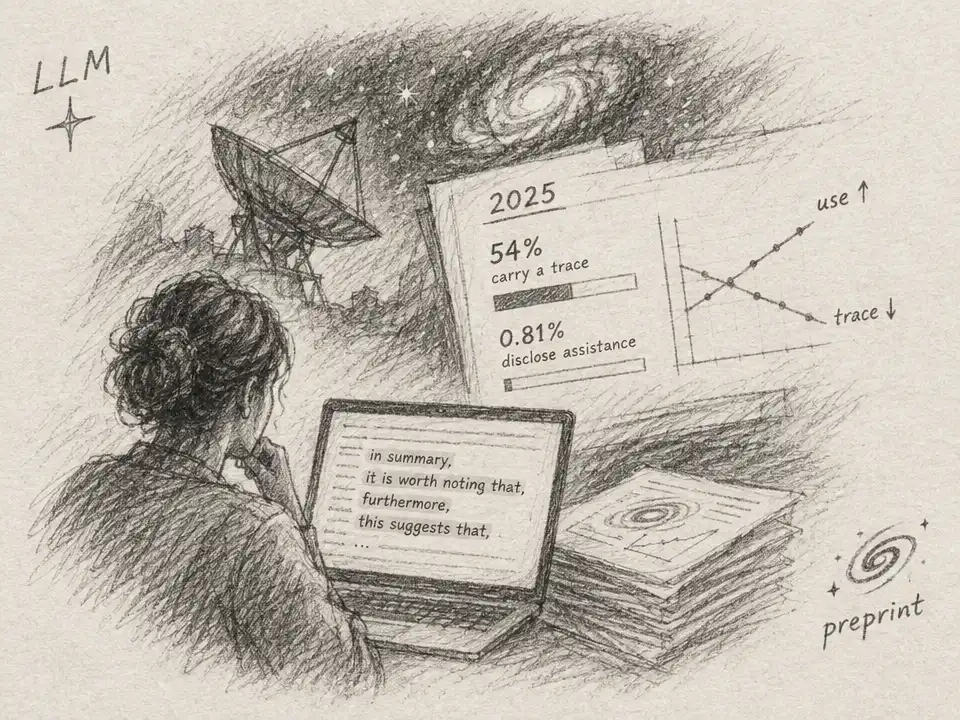
Astronomers hunt for faint signals in the universe. In a study posted to arXiv on September 9, 2026, two researchers searched for a different kind of signal: a subtle shift in the language of astronomy papers. Across more than 207,000 astro-ph papers published from 2015 to mid-2026, they tracked words that became unusually common after language models entered everyday use. Their main estimate: 54% of astronomy papers in 2025 carried a measurable trace of language-model assistance. But the result came with a twist. The more common the estimated assistance became, the harder its linguistic trace was to spot.
The team did not ask a language model to judge each paper, and they did not treat one fashionable word as proof. Instead, they counted groups of words across a vast archive. Some, including “delve” and “underscore,” had been identified in previous research as more common in language-model-assisted writing. The researchers compared their use with a baseline drawn from papers submitted before 2020, when tools like ChatGPT were not publicly available. They also accounted for differences in paper length and subject area, since a longer paper or a change in astronomy’s topics could naturally alter word counts.
To test whether their detector was mistaking ordinary scientific change for a model’s influence, they tracked control words such as “galaxy” and “redshift.” Those terms are central to astronomy, but there is no special reason to expect a writing model to favor them. The researchers also checked papers whose authors explicitly disclosed language-model use. Those 392 disclosures gave the team a reference for how strongly the marker words appeared in papers known to have received assistance.
That comparison matters because the study’s finding is not simply that certain words appeared more often after 2022. A word can rise because researchers are writing about a new subject, or because scientific style changes over time. The authors built a statistical model to separate those background shifts from the extra use of marker words in papers with declared assistance. They also tested a second set of markers drawn from astronomy papers themselves, rather than borrowing one assembled in other fields.
For 2025, the primary model estimated that 54% of papers carried a prose trace consistent with language-model assistance. The reported statistical 95% uncertainty was plus or minus 8 percentage points, with an additional one-sided systematic-background allowance of plus 26 and minus zero. Across the different versions of the analysis, the estimate did not fall below 36%. The range is a reminder that this is an inference built on assumptions about how academic language would have changed without language models—not a direct count of authors who used them.
The researchers found a striking gap between the estimated trace and what authors disclosed. Only 0.81% of 2025 papers included a statement about language-model use: roughly 66 papers with a trace for every one that declared it. The study’s authors emphasize that most disclosures they found described help with grammar, clarity, or language editing. Their results do not show that these papers were written by a machine, that authors hid scientific misconduct, or that any individual paper used a model. The analysis estimates a population-level pattern in prose.
Then the trail began to fade. In the model, the marker words’ excess over the background was about 3.5 times the background level in 2023, but only 1.5 times by 2026. Meanwhile, the estimated fraction of papers with an assistance-related trace rose: the authors’ estimate for the first half of 2026 was 87%, with reported statistical uncertainties of plus 8 and minus 10 percentage points. Put simply, more papers appeared to carry the trace, while each left a weaker signal.
That is the unexpected result. The obvious strategy—look for a fixed set of telltale words—can lose power as writers adapt. “Delve,” for example, rose and then moved back toward its earlier level after becoming widely recognized as a marker. Other words continued to rise. A detector that assumes the same vocabulary will keep signaling assistance could therefore mistake a changing writing style for a decline in use. The researchers let the signal’s strength change over time, using declared papers to help anchor that estimate.
There are important blind spots. A model might help with code, ideas, or a passage that an author later rewrites; this method would not necessarily detect any of that. Conversely, the authors note, some changes in vocabulary could spread through ordinary exposure to model-written text, even among researchers who never use a model on their own papers. The archive also contains later revisions of some older papers, so the presumed pre-2020 baseline may include a small amount of newer language. These uncertainties are why the authors describe their figures as a floor for prose assistance, not a census of all model use.
The paper offers no verdict on whether language-model editing improves or harms astronomy, and it does not test the accuracy of the research being published. Its narrower finding is about how a research community’s writing may change—and how quickly the clues can change with it. The authors say they drafted and revised their own paper, then used Claude Opus 5 to edit prose and grammar throughout, and Claude Code for software development. In a study about disclosure, that statement lands as part of the story: the evidence may be faint and imperfect, but stating what happened can be clearer than trying to read it from the words alone.