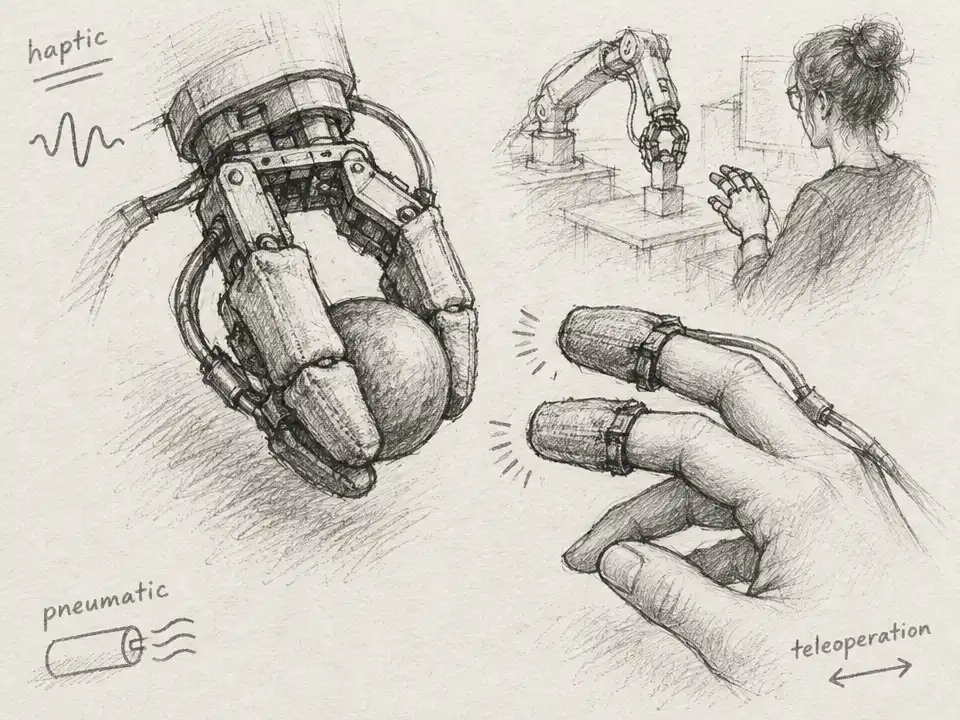
Watch a robot try to fit a pen cap onto a pen. Its arm carries the cap smoothly across the table, reaches the target—and then hesitates, bumps, or drifts away. The easy part looks polished. The last, tiny adjustment is where the task is won or lost. Why would a machine trained on an expert’s successful demonstration struggle precisely at the finish?
One suspect is the demonstration itself. A human operator can make a difficult insertion look almost effortless: approach quickly, make a fleeting correction, complete the task. But a robot learning by imitation does not automatically understand which instant mattered. It is trained on the recorded actions, frame by frame. If most frames show the arm traveling through open space, that is where most of the lesson appears to be.
In a recent study, Mingyu Liu and colleagues tested this mismatch in six real-world manipulation tasks, from stacking bowls and blocks to inserting a pen cap and opening a lock. Their first clue came from the pen-cap example. In a fluent demonstration, alignment occupied about 10% of the frames; the policy succeeded 35% of the time. In a deliberately slower demonstration, alignment took about 50% of the frames, and success rose to 75%.
That comparison pointed toward a simple explanation: perhaps the robot needed more practice at the critical moment. But it left a second possibility open. Was the benefit just a matter of showing more alignment frames, or did the robot need to see different kinds of alignment—especially what to do after approaching a little off-center?
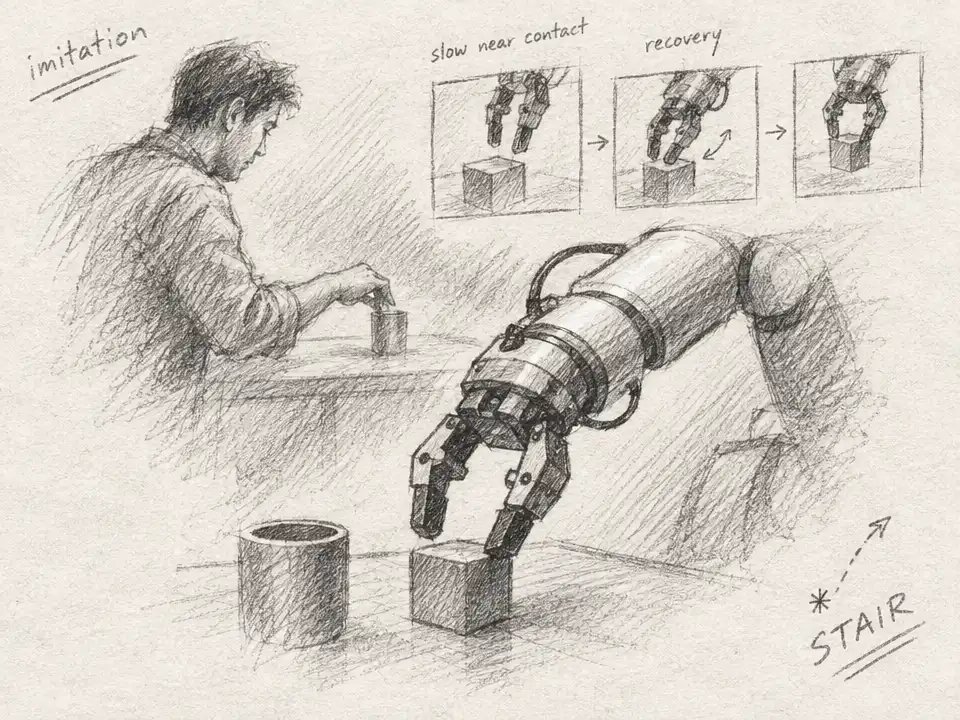
The researchers set up tests to separate those explanations. For each task, they collected 100 demonstrations and evaluated policies in 15 trials. In one version, an operator moved efficiently, as an expert normally might. In another, the operator slowed down near contact, made small adjustments, and sometimes approached with a mild offset before correcting it. This was not simply a longer pause: it put more examples of correction and recovery into the teaching material.
A third version tested whether the same effect could be achieved without collecting new demonstrations. The researchers resampled the fluent recordings, showing the policy frames near contact more often. The clue was in the comparison. On an independent robot policy, success averaged 52.2% with fluent demonstrations, 58.9% with resampling, and 67.8% with deliberate demonstrations. Giving existing moments extra weight helped, but it did not match demonstrations that included a broader range of corrections.
Why not? Resampling can replay a frame, but it cannot invent a recovery that never happened in the recording. In a controlled comparison, the team matched the number of alignment frames: resampling raised the effective count from 22 to 88 per trajectory, while deliberate demonstrations provided 95. Yet the deliberately collected examples covered more off-axis approaches and recoveries. The evidence favored coverage of possible states, not merely repetition of the same frames.
That solved one part of the puzzle, but suggested another: could a robot learn more about motion from ordinary demonstrations, without asking people to perform every task slowly? The team’s answer was a method called STAIR. During training, it uses a short video neighborhood around an action to create a compact feature representing local movement—cues such as approaching contact, slipping away, or correcting toward the target. The feature is then used to teach the action policy what motion matters near alignment.
The unusual twist is that the deployed policy does not need that video neighborhood. It receives the current image and instruction, then predicts the motion-aware feature it learned during training. In effect, the training videos help the model learn what a moment in a scene means for the next correction, while the finished policy keeps the ordinary single-image input.
In the team’s controlled study, a baseline trained on fluent demonstrations succeeded in 44.4% of trials across the six tasks. Adding STAIR raised that figure to 54.4%. For comparison, deliberate demonstrations raised the baseline to 56.7%, and combining deliberate demonstrations with STAIR reached 62.2%. The hardest tasks showed why fine alignment matters: inserting a coin into a safe or opening a lock demanded small, contact-aware corrections, and success remained far from guaranteed.
The answer, then, was not simply that robots need slower teachers, or that every training frame should count equally. Fluent demonstrations are efficient records of what an expert can do; they may be poor records of how to recover when the approach is imperfect. Slowing down can reveal those recoveries. A motion-aware training feature can help extract useful clues from recordings that already exist.
The findings come from a limited set of tasks and trials, not a guarantee that the method will solve every delicate manipulation problem. The authors also note that their approach relies mainly on vision; it does not replace tactile, force, or geometric feedback for highly constrained contact. Still, the experiment offers a useful answer to the opening riddle. For a robot, the most instructive demonstration may not be the one that looks most flawless. It may be the one that makes the small correction visible.