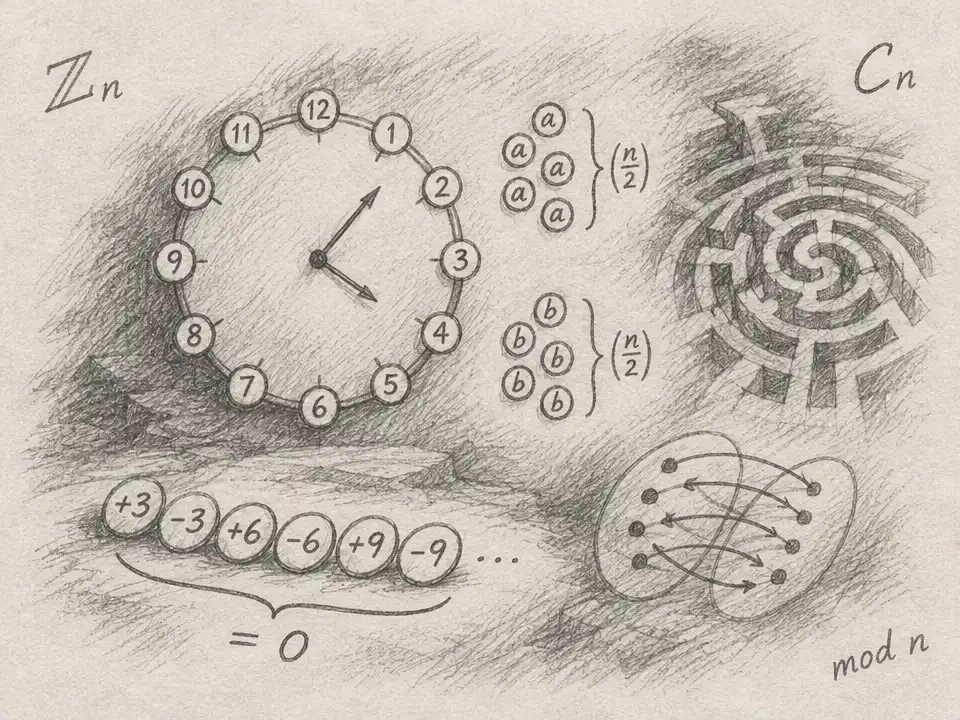
Picture a clock with its numbers replaced by labels. Add the labels as you move around the clock, wrapping back to the start whenever you pass the end. Now take a handful of tokens, exactly as large as the clock has positions. How many handfuls must add back to zero? The question sounds as if it should have an easy answer. It does not—even when the tokens are all laid out in advance.
The labels may repeat, and each token counts as its own item. A group is zero-sum when its labels, added around the clock, bring you back to the starting point. The challenge is to arrange a long sequence of tokens so that as few groups of the required size as possible have this property. A result posted by Guoqing Wang and Xiangneng Zeng on October 27, 2026, settles a conjecture about that minimum, first proposed in 1992.
The proposed answer points to an almost comically simple arrangement: make two piles, with the numbers of tokens as even as possible. Put a zero label on one pile and the same nonzero label on every token in the other. For a five-position clock, imagine five tokens in each pile. Choose five tokens. Their labels add to zero only if all five came from the zero pile or all five came from the other pile: any mixture uses the nonzero label a number of times that does not wrap back to zero. There are exactly two successful choices.
That split is not merely an example with few zero-sum groups. The conjecture said it is the stingiest possible arrangement. However complicated the labels and repetitions, the number of successful groups cannot fall below the count produced by two balanced piles. In effect, the simplest pattern sets a floor for every possible pattern.
Why should two piles be so hard to beat? One tempting guess is that a complicated sequence spreads its sums evenly around the clock, leaving plenty of routes back to zero. But repeated labels can make sums highly uneven. And even if most groups miss zero, the question is not about an average: it asks for a guaranteed minimum across every arrangement. The researchers needed clues that survive the most lopsided and awkward cases.
The first clue comes when one label dominates. Shift every label by the same amount so the most common one becomes zero. This does not change the sum of any chosen group: the shift is added once for every clock position, so a full turn cancels it out. Now imagine selecting the required number of tokens from the remaining, nonzero pile. List them in any order and keep track of the running total after each token. There are more running totals than clock positions, so two must match. The tokens between those matching totals add to zero.
That collision is a small but powerful guarantee: every sufficiently large sample from the nonzero pile contains a smaller zero-sum group. The proof counts how many samples can be charged to these smaller groups, then combines them with the zeros in the dominant pile. Balancing the two sides of that count recovers the conjectured floor. It is a neat resolution—but only when one label is common enough to create a majority.
What if no label dominates? The next clue is to stop looking at the whole clock and inspect its simpler shadow. A cyclic group can be projected into a smaller group by grouping labels that share the same residue. If a residue class suddenly contains many tokens, the problem has become more lopsided at a smaller scale, where an inductive argument can help. The proof repeatedly uses these reductions, including separate routes for even group sizes and sizes divisible by three.
The three-way route is especially revealing. When the labels fall into three residue classes, the authors analyze how many tokens sit in each class and how the classes are distributed. Some arrangements are dispatched by a large class; others require comparing the number of ways to choose matching triples. This part of the paper is a careful sorting operation: the authors divide the possible class-size patterns into cases and show that each supplies enough zero-sum selections. The underlying idea stays simple—find structure in the distribution—but the estimates needed to cover every pattern are not.
After these reductions, a harder case remains: the sequence is balanced enough that neither a label nor its residue shadows provide an obvious majority. Here the authors turn to pairs. They pair up token positions so that, when viewed through each relevant prime-sized quotient, too many pairs do not collapse into the same residue. Then they choose one token from each selected pair. A theorem about sums of sets, together with a separate count of how often sums can be represented, ensures that enough choices reach the target. Pairing does not make the sequence simple; it makes the many possible selections manageable.
These are not guesses about what a random sequence is likely to do. They are deterministic counts that have to hold even for an adversarial arrangement. Nor is the finished proof a single clever trick: it builds on earlier results for particular group sizes, handles small and long sequences with different estimates, and uses strong induction to assemble the reductions. The authors’ achievement is to make the awkward cases fit the same promised lower bound.
The two-pile construction also explains why the result is sharp. It does not merely show that every sequence has at least some number of zero-sum groups; it shows that some sequences attain exactly that minimum. The theorem therefore identifies the worst case for this counting question, though it does not claim that every arrangement attaining the minimum must look like two piles.
A clock can hide its return-to-zero groups in a tangle of repeated labels, residue classes, and modular coincidences. Yet the count cannot sink below what two plain piles already allow. The puzzle that began with a simple split of tokens ends with a proof that even the messiest arrangement cannot do better at concealing zero.