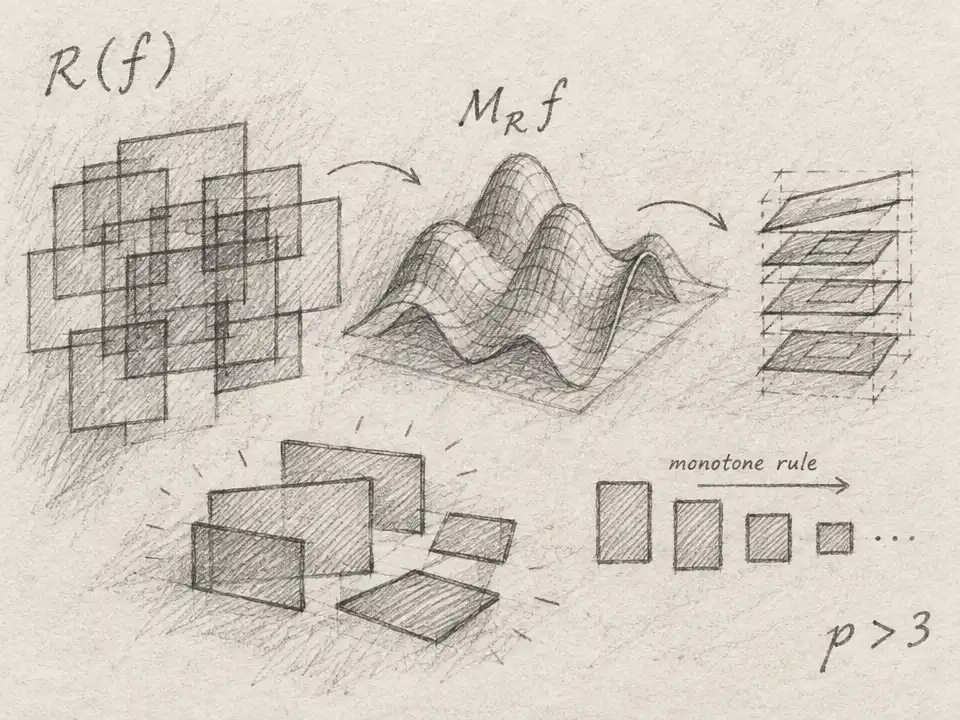
Imagine trying to find a hot spot in a huge aerial image. You can lay down rectangles of many sizes, average the brightness inside each one, and ask: where can some rectangle find an unusually high average? The challenge is that the rectangles may stretch differently in different directions. As the number of directions grows, the number of ways to search can overwhelm a simple estimate.
A recent paper by mathematician Henri Martikainen finds a new route through that problem. Its central move is not to tame every rectangle directly, but to change the function being averaged—carefully enough that the important averages stay exactly the same. The trick proves a difficult estimate for whole families of rectangles and, along the way, resolves a related conjecture about how densely those rectangles can pile up.
The setting is a higher-dimensional version of a familiar search. A rectangle has one side length in each direction, but the lengths are not entirely free: one is set by a monotone rule applied to the others. Make any of the first side lengths larger, and the rule does not make the final one smaller. The rule can otherwise be irregular; the proof needs no continuity or doubling assumption.
For each point in space, imagine testing every allowed rectangle that contains it and recording the largest average of a nonnegative function inside one of them. This “maximal” average is useful because it spots concentrations at whichever scale and shape happens to reveal them. But it also creates a mathematical headache: there may be an enormous range of overlapping candidates.
A weak-type estimate controls the size of the region where that maximal average exceeds a chosen threshold. For these linked-side rectangles, the bound involves the function multiplied by a logarithmic correction raised to the power m minus 2, where m is the number of groups of coordinates. By comparison, the unrestricted strong maximal problem carries a power of m minus 1. That saved logarithm matters: it says the link between side lengths genuinely reduces the cost of searching. The estimate is uniform across the monotone rules, and the paper establishes it for every m at least 3. The result is new in dimensions with more than three parameter groups; the three-group case had already been proved.
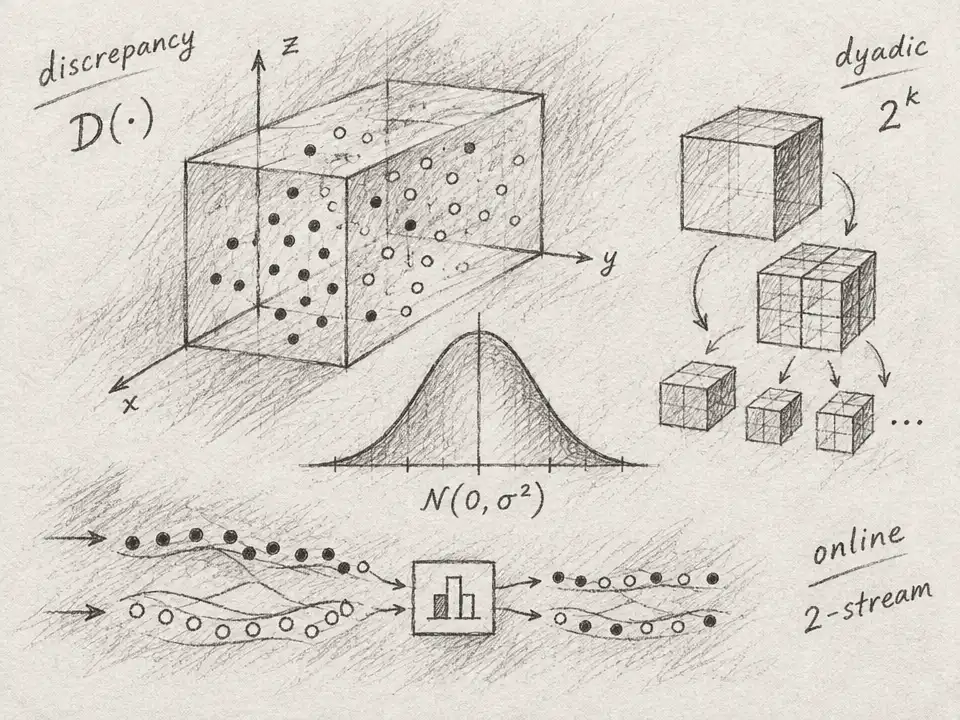
To reach it, Martikainen first focuses on a simpler-looking geometry: a family of dyadic rectangles in which no rectangle contains another. Mathematicians call such a family incomparable. The condition sounds modest, but it creates an opening. If the rectangles cannot nest inside one another, their averages can be preserved while some of the small-scale detail inside them is removed.
Here is the key construction. Start with the original function and subtract selected pieces of its fine-scale variation—pieces that live entirely inside members of the incomparable family. Those pieces are chosen so that the average over each important rectangle remains unchanged. Remarkably, one altered function works for the entire family, rather than requiring a different repair for each rectangle.
The altered function may take positive and negative values, even if the original did not. That is not a flaw; it is what makes cancellation available. The preserved averages can now be expressed using averages over proper subsets of the coordinate directions, never requiring all m directions at once. In effect, the construction strips away exactly the part that would force the proof to confront every coordinate simultaneously.
That reduction does not finish the job by itself. The remaining averages must still be controlled together, and there may be many of them. The paper handles this with square-function estimates, a way of measuring the combined size of many oscillations without simply adding every contribution as if they peaked in the same place. The resulting maximal estimate grows like a power of m minus 1 of the usual near-one integrability factor. Crucially, the estimate holds even without a sparsity assumption on the incomparable family.
Why care about a maximal estimate for a family that may not even be sparse? Because it unlocks a second question: how much overlap can a sparse, incomparable family create? Sparse means each rectangle has a substantial piece set aside, with those reserved pieces disjoint from one another. It does not mean the rectangles themselves barely overlap. At a point covered by many rectangles, define the overlap count as the number covering it.
Martikainen’s estimate, combined with a duality argument, shows that the overlap count has strong exponential integrability: its tail falls quickly enough to be controlled by an exponential involving the count raised to the power one over m minus 1. This is not a claim that heavy overlap never happens. It says that, across the family’s overall footprint, extreme pileups are sufficiently rare. The power is sharp: examples rule out improving it.
That overlap result is the bridge back to the linked-side problem. A selection argument picks a manageable subfamily of rectangles while preserving a comparable amount of the region they cover. Then the geometry is sliced: fix a location in the final coordinate and look at the rectangles’ cross-sections in the other coordinates. Monotonicity of the side-length rule gives those slices enough structure to apply the overlap bound. Integrating the slice estimates recovers control of the full region.
There is one more obstacle: real rectangles have arbitrary side lengths, while the cleanest argument uses dyadic grids. The paper covers each real rectangle with a suitably sized dyadic one and uses a finite collection of shifted grids to do it. The rounding preserves the monotone relationship well enough for the selection-and-slicing argument to survive.
The result is a proof strategy built around a change of viewpoint. Instead of trying to track every overlap head-on, remove just enough hidden variation to make the averages simpler, prove that the remaining pileups are controlled, and then assemble the full geometry one slice at a time. It turns a sprawling search over shapes into a sequence of more structured problems—and shows how a carefully chosen alteration can make a high-dimensional question easier to see.