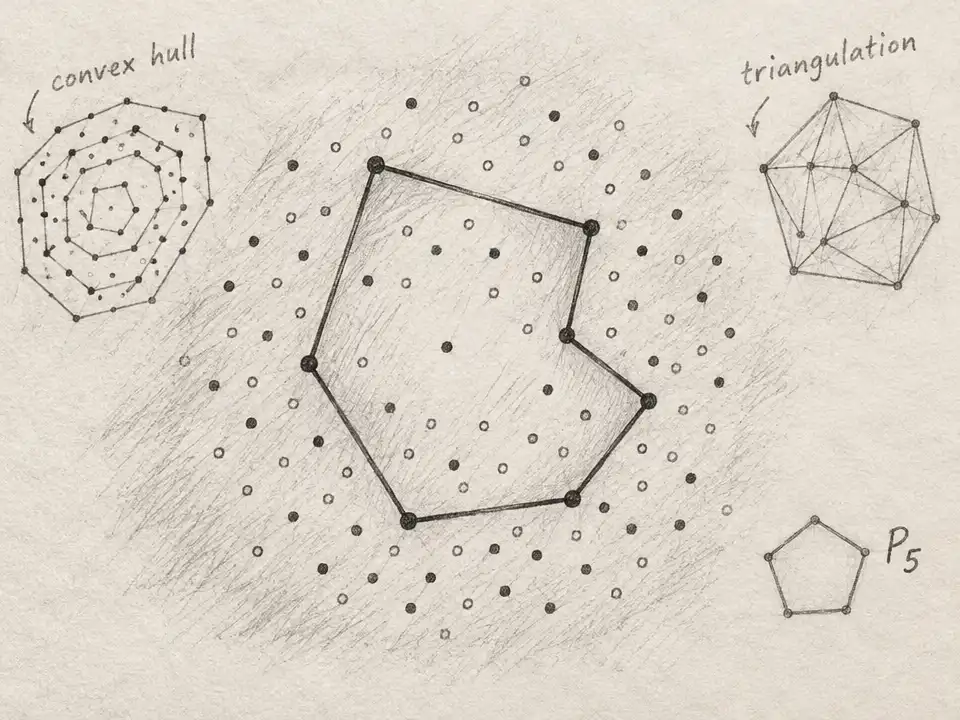
Scatter dots across a sheet of paper, coloring each one red or blue. Let the pattern get messy: clumps, gaps, long chains, points tucked inside other points. Now try to find six dots of one color that form a loop—and leave almost the whole inside empty.
It sounds like a game that a clever arrangement could defeat forever. A new result in geometry says otherwise. Once a two-color point set in the plane has at least 306,447 points, it must contain a monochromatic six-sided polygon with no more than one point of the set inside it. The points must be in general position, meaning no three lie on a straight line.
There is an important catch, and it is also what makes the result possible: the hexagon need not be convex. Its sides can fold inward, like a simple paper outline with a notch, as long as they do not cross. And the theorem allows one point—not necessarily of the other color—to sit inside. The authors prove a guarantee, not that 306,447 is the smallest number that works.
That small concession opens a door. For decades, geometers have asked how large a collection of points must become before it is forced to contain a particular shape. Color the points, and the challenge sharpens: can any single color supply all the corners? Require the polygon to be convex and completely empty, and some versions of the problem run into stubborn counterexamples. Relax the demand just slightly, and hidden structure begins to show.
The proof starts by separating the more common color from the less common one. Imagine drawing the tightest rubber band around all the red points. That boundary is their convex hull. If it has plenty of corners, the researchers can build many red hexagons that do not overlap in their interiors and contain no red points inside. If none has at most one point altogether, each must hide at least two blue points. Those blue points, in turn, create a smaller hull inside the red one. Repeating the process makes alternating layers of red and blue hulls. The layers cannot keep meeting the required point counts indefinitely: eventually the assumed absence of a nearly empty hexagon contradicts the finite supply of points.
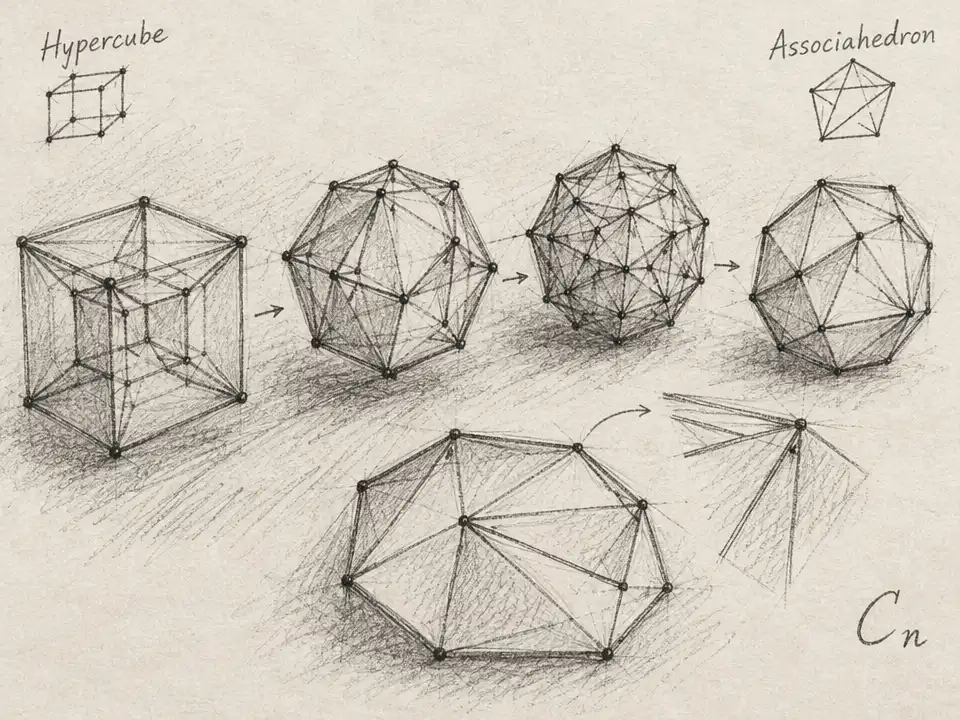
But a point cloud can foil that first route by keeping the majority color’s outer hull relatively small. Here the proof shifts from boundary to scaffolding. The researchers triangulate the red points, connecting them with straight edges so that the enclosed regions are triangles. They use a particularly robust kind of triangulation: even removing up to three vertices cannot disconnect its network.
Now the triangles become tiles in a puzzle. Four suitably arranged triangular regions can combine into a six-sided red outline. Because the triangulation uses only red points, the outline encloses no red points from its own set. The question is how many blue points the enclosed faces contain. The authors track those counts across the triangulation and its dual network—a second graph in which each triangle becomes a node, and neighboring triangles are joined.
This translation lets the proof count patterns rather than inspect every possible drawing. Some clusters of faces with very few blue points would already assemble into the desired hexagon. If the hexagon is being avoided, those clusters are forbidden. The remaining configurations are constrained by the connectivity of the triangulation and by how neighboring faces fit together. Careful counting then shows that a large point set cannot avoid all the forbidden patterns at once.
The two routes—alternating hulls when the boundary is generous, triangulation when it is not—meet in a numerical guarantee. In the paper, the authors choose a parameter that divides the cases and combine their estimates to obtain the threshold of 306,447. That number is a product of the proof’s bookkeeping, not a mysterious tipping point in nature. A smaller threshold may also work; the theorem does not settle that question.
What the result unlocks is a way to search for shape without demanding perfection. The hexagon may be indented, and one point may remain inside, but the guarantee holds no matter how the two colors are arranged once the set is large enough. The same paper extends the investigation to more colors, where the best known lower and upper estimates still leave a gap that grows with the number of colors.
The next step is to try to remove the concession. Can every sufficiently large two-color point set contain a monochromatic hexagon with nothing inside? The authors point to an even earlier open test: whether such a set must contain a truly empty monochromatic pentagon, with no convexity requirement. For now, one spare point is the price of a sweeping guarantee. The frontier is the search for a loop that leaves no trace inside at all.