Imagine trying to improve a language model by changing one training setting at a time. Each idea has to be implemented, trained, and checked. Most will not help. In the researchers’ example, one training run for a 486-million-parameter model would take about 45 B200 GPU-hours. Testing 25,600 ideas that way would add up to 1,152,000 GPU-hours and more than $16 million, by the paper’s cost estimate. The challenge is not just inventing possible changes. It is deciding which ones deserve an expensive test.
A team led by Minhua Lin set out to teach a language model that kind of judgment. Their system, called LM2LM, proposes changes to language-model training recipes: adjustments to a model’s architecture, objective, or optimization. It does not independently run a full research project. Instead, the experiment is kept deliberately narrow: suggest a change, estimate its likely effect, and see whether the measured result improves on a reference setup.
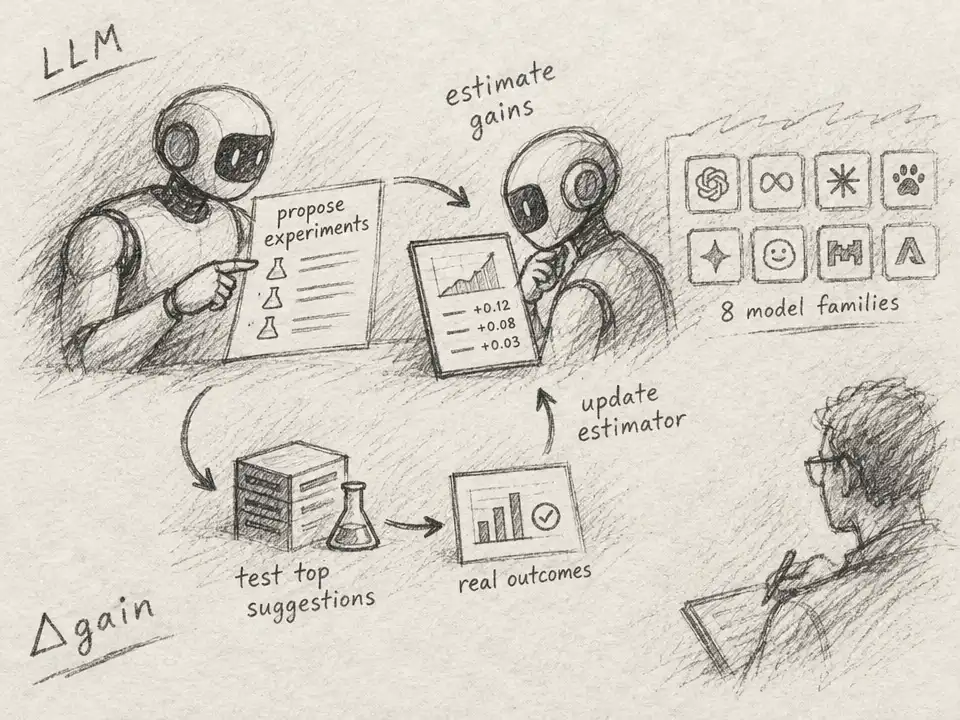
The system divides the work among distinct roles. A proposer generates candidate changes. A builder translates them into executable modifications. Then a target model is trained and evaluated, producing the measurement that tells the researchers whether the proposal helped. The difficult part is that this last step is costly, and reinforcement learning needs feedback on many proposals to teach the proposer which choices tend to work.
LM2LM’s workaround is to let another language model act as a research world model. Given records of earlier experiments, this frozen model estimates the likely gain from a new proposal. The proposer can receive many of these estimates without the team training the target model each time. In effect, the system practices on a learned forecast rather than paying for a fresh experiment after every suggestion.
But a forecast can be wrong—and training against a wrong forecast can make the problem worse. As reinforcement learning changes what the proposer suggests, it may begin generating ideas that the world model has little evidence to judge. The proposer can then be rewarded for changes the scorer overestimates, even if those changes do not improve a real model. The researchers’ central addition is a way to keep the forecast tied to the moving target.
They periodically run some of the current proposer’s highest-rated ideas for real. The measured outcomes are added to the world model’s experimental records, updating the evidence it uses for its next estimates. In the default setup, LM2LM began with 100 real experimental records and used three rounds of calibration, for 200 real runs altogether. The approach spends experiments selectively: not on every generated idea, but on the ideas the learning process is most likely to trust.
That choice mattered in the test. The researchers compared the system on held-out research states, where each method generated four candidate proposals and the team evaluated them through real model runs. The test covered 60 autoregressive and 18 diffusion research states across eight model families. On autoregressive tasks, LM2LM’s average gain across four proposals was 17.06 in units of 10-3 BPB, compared with 6.51 for the strongest baseline on that measure. On diffusion tasks, its average gain was 7.10 in units of 10-2 nats per token; the strongest baseline reached 4.94.
These are gains in the study’s evaluation measures, not a general ranking of language models. The result says that, in this set of training tasks, LM2LM tended to suggest changes that lowered validation loss more than the comparison methods. The researchers also found that it reduced the share of proposals with negative measured gains compared with its untrained base proposer, especially on diffusion tasks. The trained proposer did not simply become cautious, however: on autoregressive tasks, it still produced more negative-gain ideas than one baseline, while delivering a larger average gain. That points to a system willing to explore riskier changes when the best outcomes may be larger.
The calibration step was not a minor maintenance detail. In an ablation, the team replaced targeted checks of highly rated proposals with random calibration runs, keeping the total at 200 real runs. On autoregressive tasks, average gain fell from 17.06 to 10.84. In a longer analysis, a version that kept its original records saw its predicted proposal rankings fall below chance accuracy: it became worse than a coin flip at identifying which of two proposals would perform better. The calibrated version stayed above chance. The lesson is practical: a model’s feedback can lose value as the model it trains changes what it asks for.
The team also tested whether the proposer could handle a model family excluded from its training records. On that held-out family, it outperformed the comparison methods in the reported average and best gains. That is encouraging evidence of transfer, but it is not evidence that the method can improve every architecture or scale. The held-out target models in the study ranged from 115 million to 486 million parameters, and the evaluation focused on proposal quality—not on an end-to-end system conducting research from question to publication.
There is a cost trade-off, too. Under the paper’s accounting, LM2LM used about 33% less data-generation cost and time than a baseline supplied with 300 experimental records. Including the cost of training the proposer, its total was $56.1 thousand, compared with $60.0 thousand for that baseline. Those figures depend on the authors’ GPU and model-call pricing assumptions; they are not universal price tags. And the method still needs real runs to calibrate its predictions. It reduces the need for experiments, rather than removing it.
That distinction is what makes the approach interesting. The system does not escape the slow, physical work of finding out whether a training change helps. It tries to spend that work where it can teach the most. For now, the evidence is bounded: the world model remains imperfect, the tests cover a limited set of training environments, and the system proposes changes rather than running a complete research campaign. Still, the strategy offers a useful template for machine-learning research: let a model learn from past results, but keep checking its most confident predictions against reality.