A neuron fires, and the electrical signal rises and falls in a pattern scientists can measure. For decades, a classic model has explained much of that pattern by tracking currents through sodium and potassium channels, along with a background leak. But when researchers compare the model with recordings from real neurons, small mismatches remain. Are the model’s settings off—or is a piece of the biology missing?
That distinction matters. Adjusting numbers inside a model can make its predictions fit better without changing the story it tells about the cell. Adding a new mechanism changes the story. A recent AI-assisted method takes aim at that harder question: it searches for changes to the simulator itself, while keeping track of more than one plausible answer.
The researchers started with a widely used version of the Hodgkin-Huxley neuron model. They gave the system voltage data from ten real recordings in the Allen Cell Types Database. The recordings were summarized using seven standard measurements. The task was not simply to tune the model’s existing settings, but to propose additional ion-channel mechanisms that might explain patterns the original version missed.
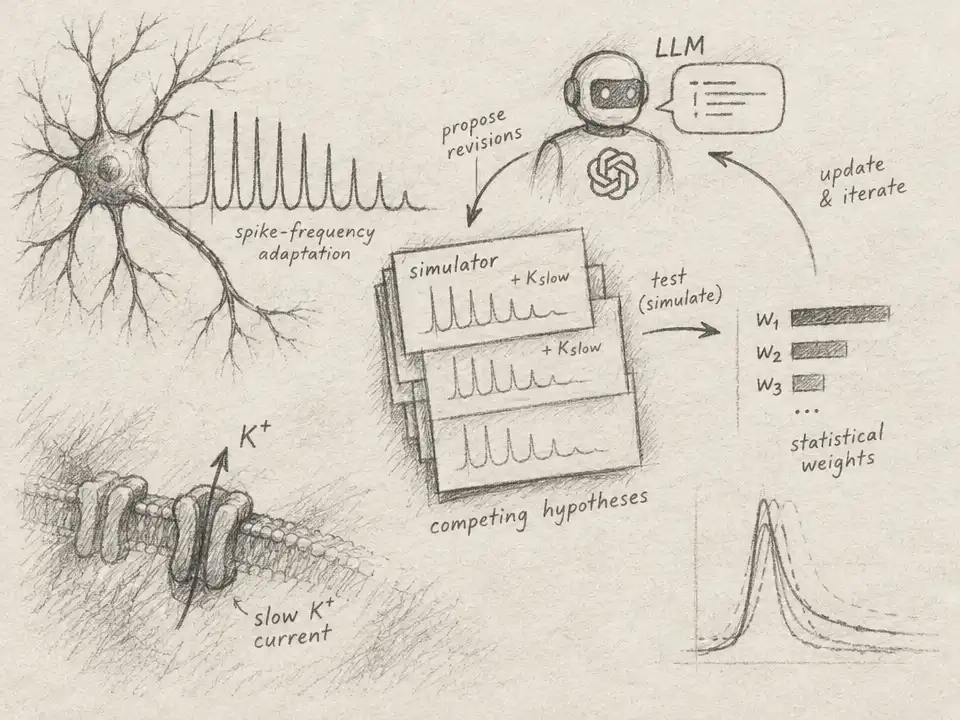
This is where the approach parts company with a chatbot asked to guess. The system, called ModelSMC, treats each executable simulator as a candidate hypothesis. A language model proposes or revises candidate programs. The system then runs simulations and estimates how well each candidate accounts for the observations. Better-supported candidates receive more weight; when the population needs refreshing, weaker candidates are less likely to continue. The process repeats, preserving a collection of contenders rather than picking a single champion at the start.
The method borrows a strategy from a family of statistical techniques called sequential Monte Carlo. Imagine a search party carrying several maps. After each round of checking them against the terrain, the party makes more copies of promising routes and spends less effort on routes that lead nowhere. Here, the maps are computer programs, and the terrain is measured data. Crucially, the language model can suggest revisions, but the candidates are weighed using statistical evidence, not the model’s confidence in its own prose.
A related 2024 study showed another way language models can help revise scientific models: researchers asked one to improve a predator-prey model while keeping the result interpretable to an ecologist. The proposed changes improved predictions on the study’s test data. ModelSMC tackles a different part of the problem. Its weighted population makes uncertainty among candidate mechanisms part of the output, rather than an inconvenience to hide.
Before the neuron test, the researchers tried the method on a kidney model. They deliberately replaced part of its aldosterone-regulation mechanism with a constant, then asked the system to infer the missing dynamics from sparse observations. Across runs, it gave high weight to a narrow family of feedback mechanisms that closely resembled the original mechanism. That test offered a useful check: the search could recover a known structure after it had been removed, even with limited data. It did not show that the system could independently validate every biological detail.
In the neuron task, the search repeatedly favored models that added an M-type slow potassium current. The strongest candidates often included another channel mechanism as well, such as persistent sodium, A-type, or HCN currents. Some refinements also altered the potassium reversal potential. Together, these changes improved agreement with the recorded voltage patterns, particularly a feature called spike-frequency adaptation: the way a neuron’s firing rate can change during sustained stimulation.
But the result was not one definitive replacement for the classic model. Several versions remained plausible. The researchers found consistent support for adding slow-current mechanisms, while the data did not pin down exactly which mix of channels produced the improvement. That distinction is the method’s central promise: a population of weighted models can show both where evidence gathers and where it still leaves room for alternatives.
It is also a reason to resist the headline that an AI discovered a new fact about neurons. The study demonstrates a way to search and compare mechanistic models; it does not establish that these proposed extensions are newly discovered biological mechanisms. The model’s conclusions depend on the data, the assumptions used to construct candidates, and the system’s ability to propose useful structures in the first place.
There are practical limits, too. Testing candidates requires repeated simulations and likelihood estimates, making the search computationally expensive. The likelihood estimates are approximations, which can introduce bias. And if the language model fails to suggest a relevant mechanism, statistical scoring cannot rescue an idea that never enters the contest. The framework also depends on having an executable simulator and a reliable way to compare its predictions with observations.
The advance, then, is not an automated neuroscientist delivering a final answer. It is a more careful search procedure: one that lets an AI suggest revisions, lets data weigh them, and keeps track of uncertainty among the survivors. In a field where several mechanisms can produce similar signals, that could help researchers decide what a model explains—and what a new experiment would need to distinguish.