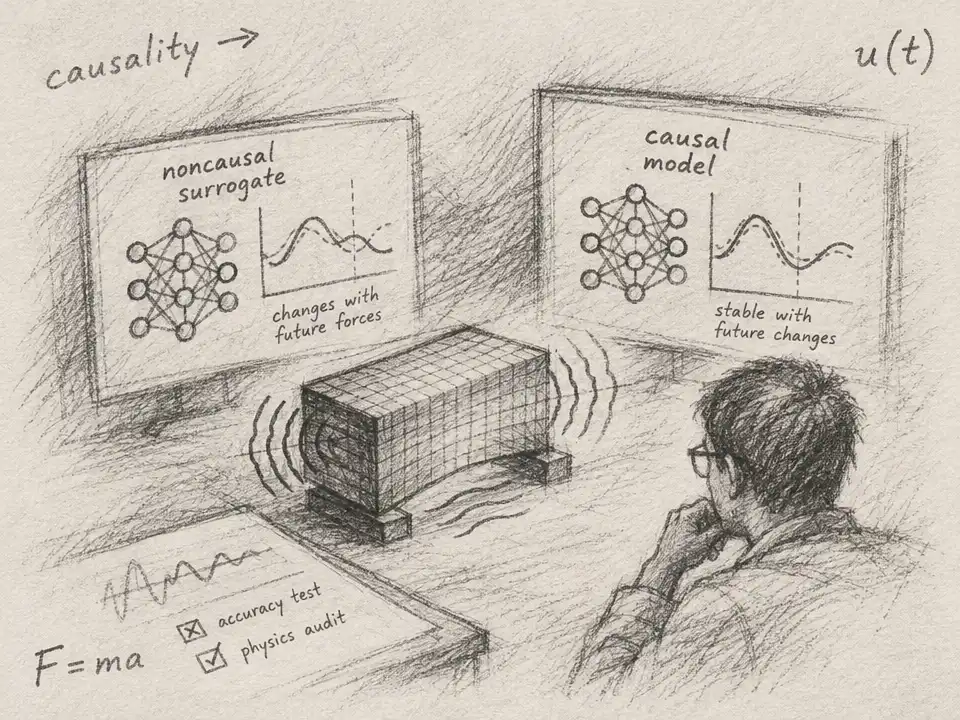
Imagine a narrow strip of solid material, fixed at one end and tugged at the other. It starts from rest. At any moment, its current movement should depend on forces that have already acted—not on a tug that has yet to happen. That simple rule became a surprisingly sharp test of an AI model.
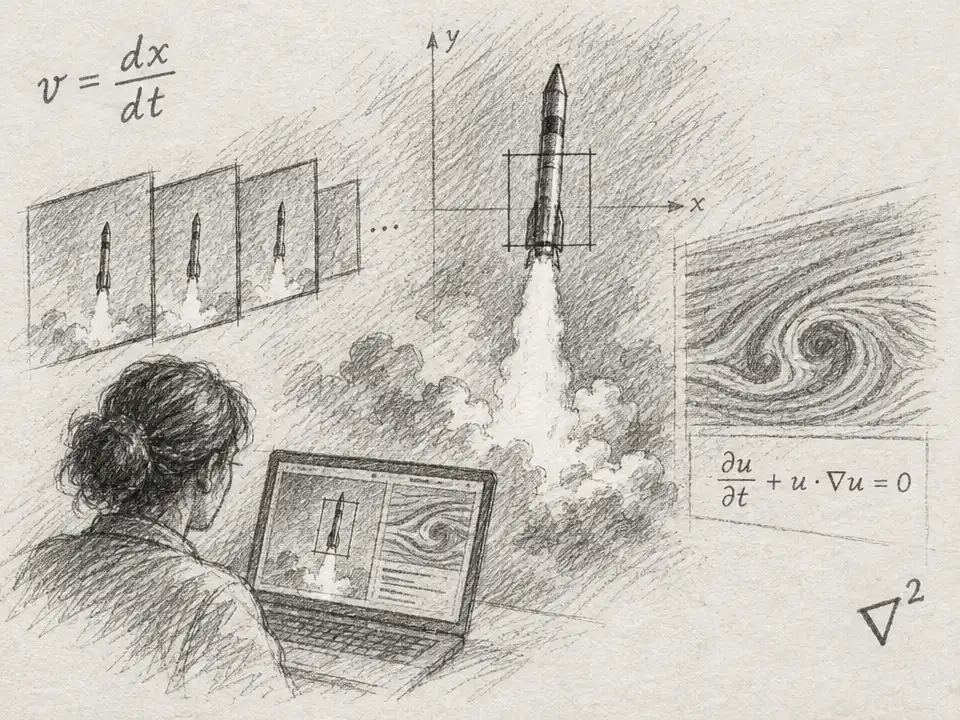
Researchers are teaching AI systems to build fast-running stand-ins for physical simulations. These surrogates can approximate how a material bends or vibrates without solving the underlying mechanics from scratch each time. In principle, that can make repeated calculations much quicker. But a familiar measure of success—how close the model’s predicted motion is to a reference simulation—can miss a deeper question: does the model behave like the physical system it is supposed to represent?
A July 2026 arXiv paper brings mechanics into the process of AI model discovery. Its framework, called Physics-Audited Agentic SciML, lets AI agents propose and train candidate models, then checks their predicted outputs against explicit physical requirements. The crossover is the point: machine-learning search supplies the candidate, while mechanics supplies tests that a good-looking score cannot.
The researchers tried the approach on two numerical examples. In one, a model predicted the displacement of a two-dimensional elastic body under changing material properties and loads. In the other, it predicted how a thin elastic strip moved over time as its right edge was driven. The second example turned a fundamental rule of motion into a test of what an AI had learned: causality.
To see why the test matters, picture two versions of the strip’s driving motion. They are identical up to the halfway point, then differ afterward. A physically sensible forward model should give the same predicted movement before that midpoint in both cases. The future portions of the drives have not happened yet; they should not reach backward and alter the earlier motion.
The team compared an error-selected surrogate with one chosen in an audit-enabled workflow. On held-out simulated motion, the audit-enabled model had a mean relative error of 2.629 × 10⁻³, compared with 2.724 × 10⁻³ for the error-only baseline—about 3.5% lower. Those close scores make the contrast striking. The baseline’s average prediction was nearly as accurate, but accuracy did not reveal how it handled time.
The researchers changed only the later part of the driving motion and checked whether each model’s earlier predictions shifted. The baseline’s predicted displacement before the midpoint changed by about 63% in relative L2 norm. With a 5% tolerance, that corresponded to a normalized causality violation of 12.62, above the pass threshold of 1. In a separate search over allowed inputs, the baseline’s causality violation reached 2750.62.
There was a straightforward architectural explanation. The baseline used a bidirectional encoder for the driving history: it could read the entire sequence, including the future portion, when producing predictions. That design can help match a complete recorded trajectory, but it is a poor fit for forecasting or control when the future is unknown. A curve can hug the reference and still answer a question using information it would not have at the time.
The selected model was built differently. Its input pathway was causal, so predictions at a given time could use past load values rather than later ones. The researchers report no causality violation for that surrogate under the stated checks. Its construction also imposed some physical features directly, rather than asking training alone to discover them.
There is an important wrinkle: causality was recorded as a soft diagnostic during the live search, not used to reject candidates. The decisive comparison came in a post-run audit, where the researchers treated causality as a hard requirement for both models. So this example does not show that the live gate caught and removed the noncausal baseline as the search unfolded. It shows that a separate, clearly stated physics test exposed a flaw that ordinary trajectory-error scoring had left hidden.
The first numerical example offers a different, less dramatic result. In static elasticity, both the audit-enabled model and the error-only baseline passed the common physics checks. The selected audit-enabled surrogate also had lower held-out error in that single-run comparison. There, the audit added evidence that named requirements were satisfied; it did not uncover a failure in the baseline.
That distinction matters. A physics audit is not a universal stamp of truth. The researchers checked specific requirements—such as causality, zero response to zero input, and prescribed boundary motion—over specified inputs and tolerances. The tests do not establish that a model is valid under every condition, or that its underlying simulation matches the real world. The paper also reports modest searches of 28 and 16 candidate models, single-seed comparisons, and a causality check that became decisive only in the post-run audit.
Still, the experiment points to a useful division of labor. AI agents can explore model designs and optimize predictions; physical principles can challenge the winners with questions about how a system must behave. For a moving solid, one such question is deceptively plain: can the model’s present depend on a force from the future? In this case, a physics test found that a low-error answer could still be wrong in a way that mattered.