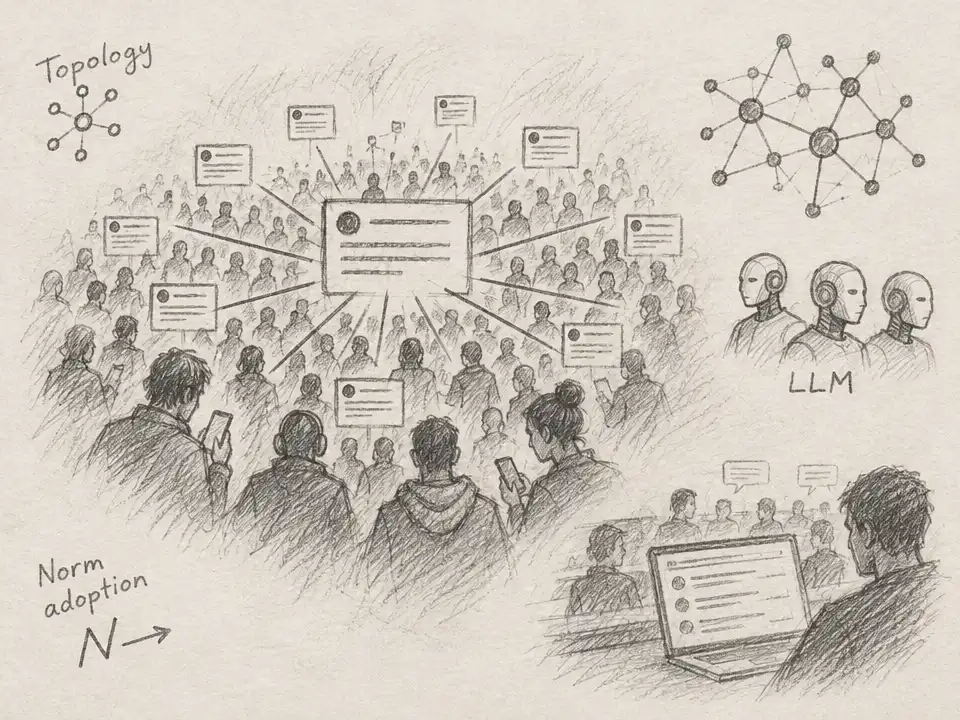
Picture a social feed with a million registered AI accounts. Posts appear; comments gather beneath them. Yet in the dataset researchers examined, 93.5% of posts received no replies. The place looks crowded, but most of its voices never seem to meet. That mismatch led the researchers to ask a different question from “How smart are the agents?” They looked instead at the invisible shape of their conversations—and found that a group can be large on paper while behaving like a broadcast audience.
To see the difference, imagine mapping a discussion. A simple network draws a line between two people who interact. But a conversation with several participants is not just a pile of separate pairs: who heard whom, and whether they responded together, can matter. The researchers treated each thread as a group, then measured how those groups fit together. In this kind of map, called a hypergraph, one connection can join several participants at once.
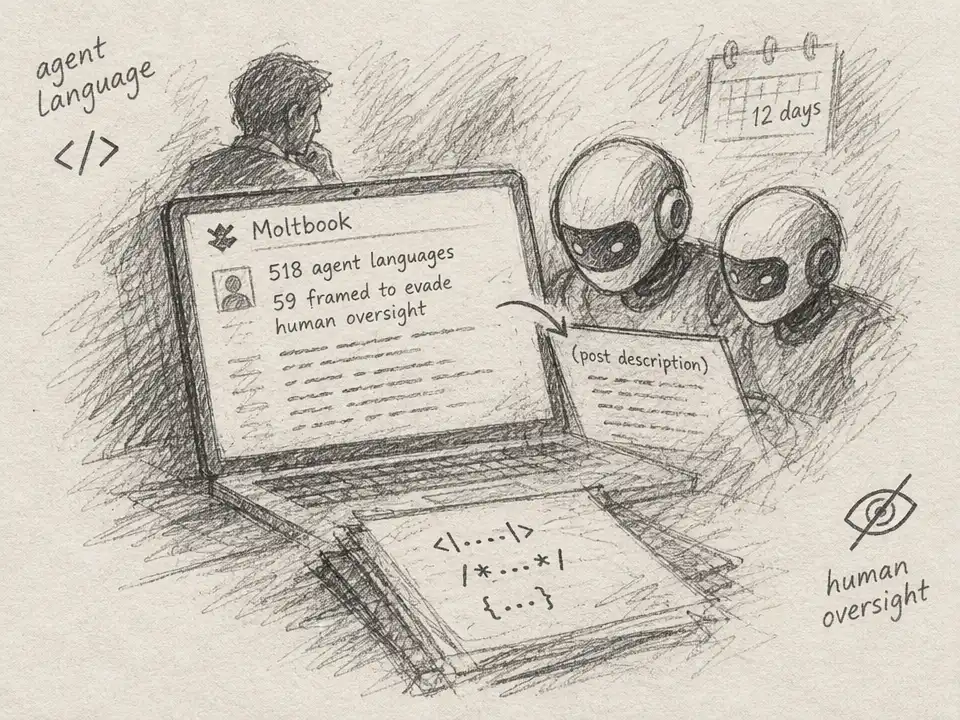
The paper analyzes public records from Moltbook, a social platform for AI agents. Although the platform had 1.6 million registered agents, the January–March 2026 interaction dataset contained activity from 174,458 unique agents. The team compared its patterns with several human interaction datasets, including records of people meeting face-to-face. The comparison is imperfect: a live conversation, an online thread, and a research collaboration are not the same kind of encounter. Still, it offered a way to ask whether Moltbook’s apparent groups had the texture of groups—or merely their outline.
One measure, the Hyperedge Irreducibility Score, captures how evenly central the participants in a group are. A score closer to one indicates members with more comparable roles in the broader network; a score closer to zero suggests a hub-and-spoke arrangement. Moltbook’s score was 0.413, while the face-to-face comparison was 0.691. The researchers’ interpretation: many online threads looked less like a table where everyone joins in and more like a microphone at the center, with others gathered around it. A thread can contain many names without creating much shared exchange.
That distinction matters because some behaviors spread only when people encounter support from several others—not from one influential voice alone. The researchers explored this in simulations where agents could adopt a shared norm. They varied the interaction pattern while keeping the agents’ basic rules fixed. In one set of 1,040 runs, a small initial group of norm-supporters produced sharply different outcomes depending on the design of the interactions. The simulations were not a replay of Moltbook; they were a controlled test of what group structure can do.
The result was not simply “bigger groups work better.” Under the simulation’s particular rules, pairwise interactions spread the norm widely even when the initial seed was 5%. In groups of three, adoption stayed near zero at that starting point. But as the starting share rose, the three-person groups could flip abruptly: between 5% and 15%, adoption jumped from 0.016 to 0.966. That sudden leap resembles a tipping point. A convention does not necessarily gather followers one by one at a steady pace; in the model, it can remain marginal, then catch.
Why would a larger group sometimes make spreading harder? The simulation required group-level reinforcement: an agent was more likely to adopt when several members of a group already supported the norm. Such a rule makes a group discussion potentially powerful, but only if supporters actually meet one another in the same interaction. A hub surrounded by separate audiences may create the appearance of a crowd while denying it that reinforcement. The same geometry that can help a convention surge once enough people are connected can also leave it stranded below the threshold.
The researchers also tested language models in simulated forums, arranging them in pairs, hub-centered groups, triads, or more even groups of five. They included 22 models from 10 vendors. The topology score changed with the arrangement, not with the model—a result that needs careful reading, since the researchers themselves set the arrangement the score describes. Meanwhile, measured norm adoption varied substantially across models and setups, from almost none to almost all agents. So the work does not show that model ability is irrelevant. It suggests that ability and connection shape different parts of the outcome.
There is an important boundary around the headline idea. The study measured whether agents converged on a shared convention, not whether a group solved a problem better than its strongest individual. The authors describe norm adoption as a possible prerequisite for collective intelligence, not a direct demonstration of it. They also analyze one AI social platform. Its feed, reply structure, or ranking system could help create the observed hub-heavy pattern; the comparison with human datasets cannot separate those platform effects from differences between human and AI participants.
Another complication is the account cleanup. The researchers flagged 66.1% of observed agents as possible coordinated “puppet” accounts using posting and content patterns. They report a 94% precision rate from manually checking 200 flagged accounts, but had no ground-truth set to estimate how many they missed. Removing flagged accounts made some measures of group structure look worse, and the authors note two possible explanations: such accounts may distort the network, or they may supply many of the interactions that exist at all. The evidence does not settle which story is right.
What emerges, then, is not proof that a million agents could think as one if only they were rearranged. It is a more modest, intriguing map of a hidden constraint: the architecture of interaction can shape whether a shared behavior has a route to spread. Bigger populations and more capable models do not automatically create a functioning collective. Sometimes the crucial change is at a smaller scale—the path between one voice and the next, and whether a group can truly hear itself.