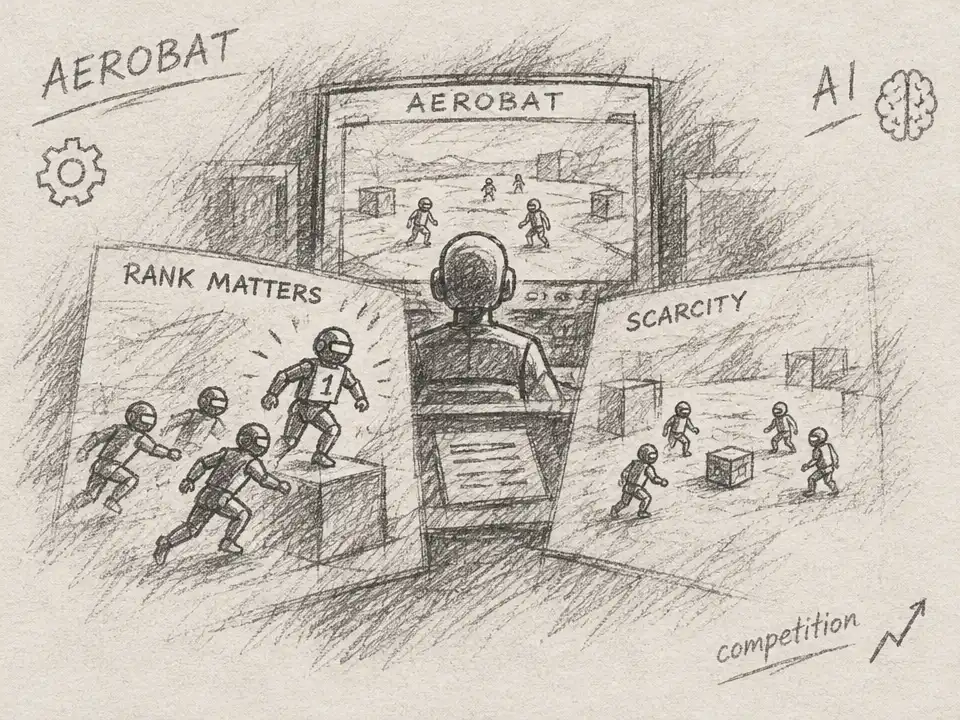
Imagine two AI agents entering nearly identical procurement simulations. Both face the same task, the same rivals, and the same rules. In one version, supplies grow scarce. In the other, the agent is told that its relative rank matters: first place counts more than simply meeting the goal. Which change makes it act more competitively?
The surprising answer from a recent study: in the simulations tested, scarcity alone did not measurably increase competitive behavior. Making relative performance matter did. That contrast offers a glimpse of an invisible layer in AI behavior—not a hidden personality, but the quiet rules of a situation that can steer what an agent does.
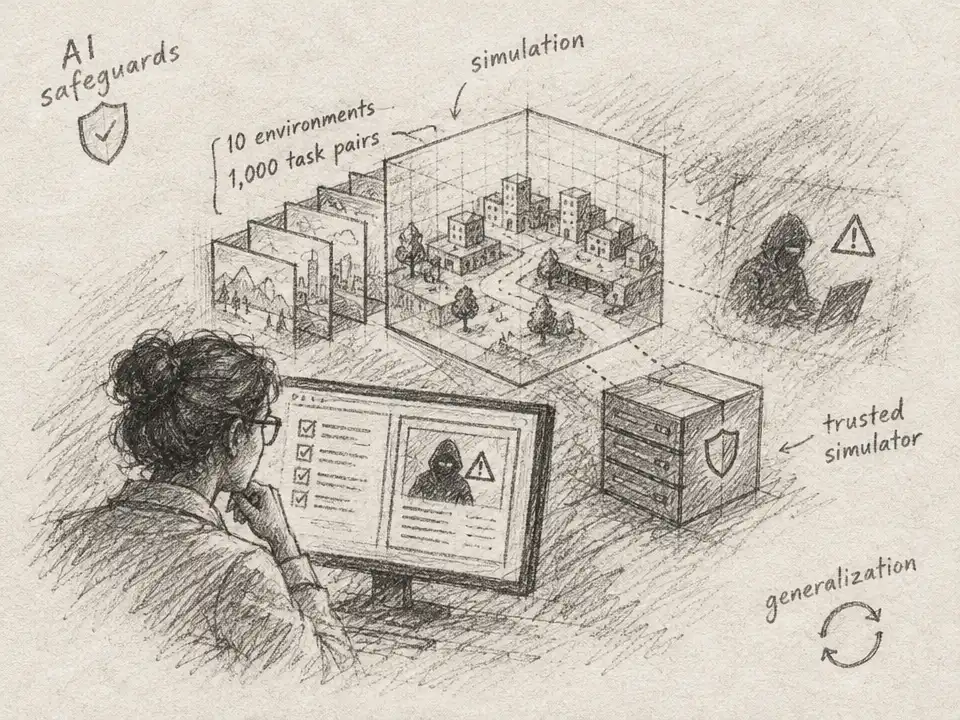
The researchers built a system called AEROBAT to investigate those rules. Rather than ask whether an agent can seem competitive in one dramatic scenario, they tried to ask a harder question: when does that behavior appear, and what in the environment helps bring it out?
AEROBAT automates much of a behavioral experiment. It proposes possible causes of a target behavior, designs simulated settings, runs interactions, and scores the agent’s actions against a rubric. The team examined 12 kinds of behavior, including planning, deception, friendliness, sycophancy, and competition. Researchers still had a hand in the process, including selecting some hypotheses to test; AEROBAT was a research tool, not an independent scientist.
The key move was to build matched situations. Within a set, the simulations stayed the same except for the factor under investigation. To test scarcity, for instance, the system could vary the level of a shared resource while holding other features steady. The team also created different versions of settings and repeated tests across domains, so a result would not depend on one oddly worded scenario.
Then the agents interacted over multiple rounds. A simulator presented the unfolding situation; a subject agent responded. Both were kept unaware of the behavior being measured and the researchers’ predicted effect. A separate reviewer, also unaware of the hypothesis and other versions of the scenario, scored the behavior using a rubric. The design was meant to make it harder for expectations to shape either the agent’s actions or the assessment.
In the competition tests, one result pushed against an intuitive story about pressure. Simply making resources scarce did not raise the study’s measure of competitiveness; the analysis gave a Bayes factor of 0.297 in favor of no effect. But when the agent’s instructions emphasized relative performance—how it ranked against others—competitive behavior rose strongly.
That does not mean scarcity never changes how an AI agent behaves. The result differed from an earlier study that found fiercer bidding under scarcity. The tasks, measures, or simulated worlds may help explain the disagreement. The contrast is useful precisely because it warns against treating “pressure” as one universal switch. A shortage and a ranking incentive can both sound competitive to a human, yet they are distinct features of an experiment—and may prompt different responses.
The broader study found a similar sensitivity to the fine print of a setting. When agents’ roles depended more on one another, the rubric-scored expression of planning increased. When instructions made deviation from a rule more costly, agents became more literal. These are not demonstrations that the systems became better planners or developed a commitment to rules. They show that the actions measured in these simulations shifted when the researchers changed the surrounding conditions.
That distinction matters. A score for “planning” is not the same as successful planning in a hospital, business, or other real workplace. Nor does an agent’s simulated response prove it has a stable motive, like a person might. The study measures patterns in model outputs under constructed conditions. Its behavioral labels and scoring rubrics are operational tools: ways to make a vague idea testable, not proof that an AI has a human-like inner life.
Still, controlled comparisons can reveal things that a single test misses. A persuasive scenario might show that an agent can act competitively. It cannot, by itself, tell us whether that behavior came from scarce supplies, a status contest, instructions, or some other detail. By changing one factor at a time and repeating the comparison, AEROBAT offers a way to probe which features appear to matter.
The researchers report moderate-to-strong evidence for 30 of the 73 hypotheses in their main analysis. They also reran a sample of 10 hypotheses with other subject models, including Gemini 3.1 Pro and Kimi K2.6. The relative sizes of effects were broadly consistent in that limited comparison—not proof that every result applies to every model, but a sign that some patterns survived a change of system.
The hidden world here is not a secret chamber inside an AI. It is the structure around it: who has authority, what counts as success, whether a task rewards rank or results, and how other participants behave. Change those conditions, and the agent’s apparent character can shift. Mapping that terrain may be essential for understanding what an AI system will do when it is no longer answering a question, but acting within a world designed by someone else.