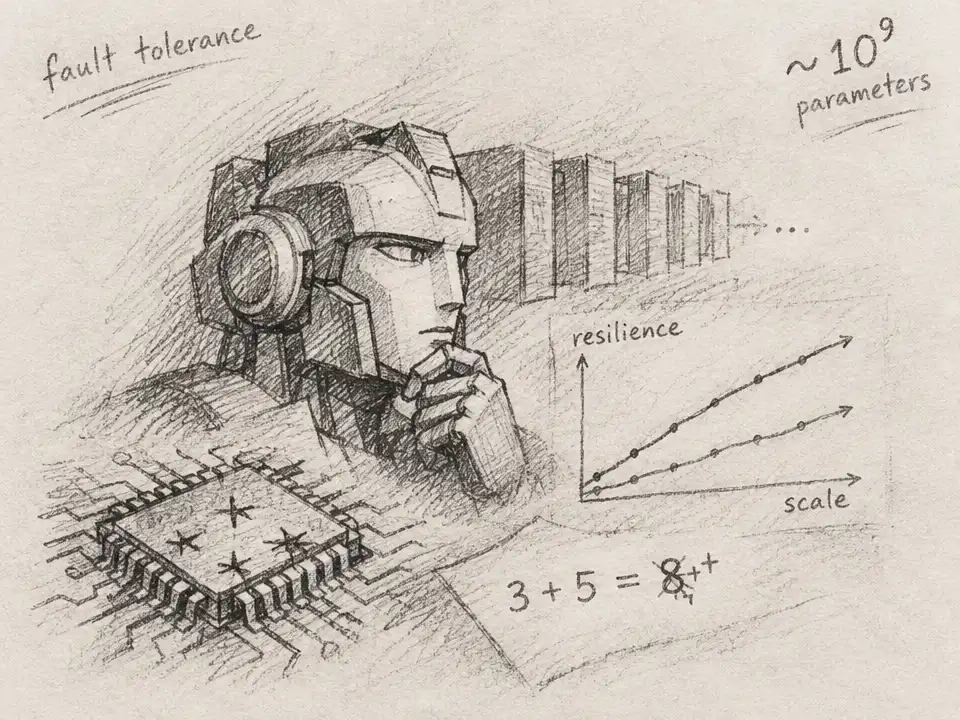
Imagine a computer chip halfway through a calculation suddenly forgetting four pieces of it. The result ought to be trouble. Now imagine making the language model running on that chip larger—and finding that, after an initial stumble, it gets better at coping with the missing work. Why would adding more machinery help a system survive machinery that fails?
That is the puzzle at the center of a recent study of language models trained to operate amid simulated hardware faults. The researchers’ answer is not that errors became harmless, or that the models somehow repaired the chip. Instead, their results suggest that a model exposed to a particular kind of failure during training can learn to keep working despite it—and that this resilience may improve as the model grows.
The stakes reach beyond a quirky computer-science result. Today’s processors are designed to make arithmetic extremely reliable, a goal that costs energy. One route toward more energy-efficient chips is to lower their operating voltage, but less energy can mean more errors. If future AI systems could tolerate some of those errors, they might run on hardware that spends less energy insisting every operation be perfect. That is the possibility the study explores, not a benefit it has already demonstrated.
The first clue is what happens to a model that never practices failure. The researchers found that a model trained on clean calculations could be badly disrupted when errors appeared at use. In some cases, adding more training data did not keep improving performance under faults; performance could even decline. A larger model built on fault-free assumptions was no guarantee of a sturdier one.
Then came the rival explanation: perhaps models could be taught to adapt if they experienced the same kind of errors they would face later. To test it, the team trained thousands of Llama 2-style models across a range of sizes, from 7.9 million to 930 million parameters. The experiments used 40,000 GPU-hours and a corpus of web text. Rather than alter every operation, the researchers targeted the matrix calculations that dominate a transformer’s computing work.
The fault model was deliberately specific. During a calculation, blocks of four elements could be zeroed, with the chance of a block being dropped varied from zero to 0.2. The errors were newly randomized across training examples, so the models had to cope with a changing pattern, not simply memorize one defective chip. The team also tested models on held-out text, comparing those trained with faults against models trained without them.
Here is where the puzzle turns. For models trained and tested under the same fault rate, the researchers measured how much of a clean model’s capacity remained useful. At first, that relative capacity fell as models grew: more parameters seemed to mean more room for failure to interfere. But beyond a critical size, the trend reversed. The fault-hardened models began to close the gap with clean models as they got larger.
That is not the same as saying a faulty model beat its clean counterpart, or that every increase in size made every model more robust. The key result is the curve: an initial loss of relative capacity followed by recovery. At the highest fault rates, the models appeared to approach a point where the errors overwhelmed their ability to adapt. And when the fault rate at use exceeded the rate a model had encountered during training, its protection weakened. Practice with one level of trouble was not a blank check for any level of trouble.
What could explain the recovery? One possibility is simple repetition: a model might spread the same useful information across many components, so a few failures do not erase it. But repetition becomes less efficient as a system grows; more and more of the model would be spent duplicating work. A more powerful possibility is that training encourages the model to distribute information in a structured way—something like an error-correcting code, where multiple signals jointly carry information and inconsistencies help expose a mistake.
The hardware idea in the paper offers a clue about how errors might be made manageable. Its proposed low-energy accelerator uses extra residue information—roughly, remainders that serve as checks—to detect when a short run of arithmetic has gone wrong. Rather than perform costly correction in the chip, the system can discard the suspect block of four operations. The model then has to continue with that small gap in its computation. This error-detection scheme was part of the study’s emulated fault model; the researchers did not build and test a physical chip.
That distinction matters. The experiments show what happened in simulated faults on models no larger than about one billion parameters. They do not prove that the models learned a particular internal code, nor that the same behavior will hold at commercial scale or on actual low-voltage hardware. The authors argue that the rising capacity curve is consistent with models learning more efficient, distributed ways to handle errors, but identifying those internal mechanisms remains a separate challenge.
So the question is not settled: can a large AI reliably work through broken arithmetic, or does the apparent resilience fade when the chip, the fault pattern, or the model changes? The study’s answer is a promising clue rather than a verdict. Train a system inside the conditions it must survive, and growing larger may eventually help it absorb the damage. Whether that principle can make real AI hardware both less power-hungry and dependable is the next test.