An AI agent can leave behind a long trail of commands and computer replies. Read from top to bottom, that trail tells you what happened. It may not tell you how the agent tends to behave: what clues guide its next move, where it gets stuck, or which detours repeatedly lead to success.
That gap matters when an agent is asked to work through a task in many steps. A successful run is only one route through the problem. A failed run may reveal a loop or a missed clue. And hundreds of raw logs can bury the shared patterns researchers want to see. In a recent proof-of-concept study, researchers introduced a way to turn those trails into a compact, probabilistic map of an agent’s behavior.
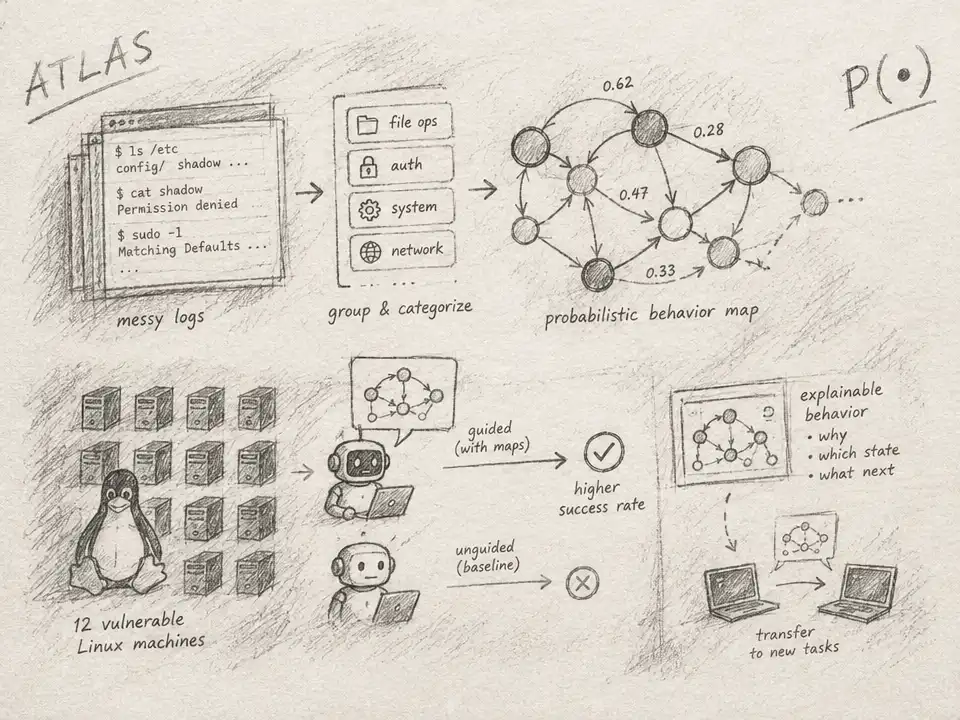
The approach, called ATLAS, was tested on an AI agent doing cybersecurity assessments of deliberately vulnerable Linux machines. The aim was not simply to record whether the agent succeeded. It was to recover a model of how its actions and the computer’s responses fit together—then see whether that model could help another AI agent perform the task.
The first obstacle is translation. The logs contain concrete commands and unstructured computer output. One agent might check for available permissions with one command; another might arrive at similar information by a different route. A model-learning algorithm cannot easily spot that shared purpose if every command and reply is treated as a unique symbol.
ATLAS puts a language model to work as a translator. In three stages, it proposes categories for actions and observations, merges labels that mean roughly the same thing, and assigns each logged interaction to a category. A specific command becomes something like an information-gathering action; a computer reply becomes a clue, an error, or evidence that a system feature could matter. The point is not to preserve every detail, but to keep enough meaning to compare runs.
Then comes a different kind of AI technique: automata learning. It takes the categorized sequences and looks for states and transitions that recur across them. The result is a labeled Markov chain—a network in which states summarize observed patterns of interaction and transitions carry probabilities drawn from the collected runs. Put less formally, it is a map of common moves, branches, and loops, with a sense of how often different routes appeared.
That map can reveal things a single transcript cannot. In one illustrative scenario, the learned model showed that the agent typically began by gathering information. After discovering something useful, it sometimes succeeded quickly; in other runs it took extra exploratory steps. The researchers could also see repeated malformed commands. The map did not reveal the agent’s private thoughts or prove why it made a particular choice. Instead, it made recurring behavior visible across multiple attempts.
ATLAS’s more surprising test was whether a map learned from one agent could guide a smaller one. The researchers collected 20 runs on each of 12 vulnerable virtual machines, with a limit of 20 turns per run. They then tested smaller language models with several kinds of guidance, including a dynamic mode that tracked progress through the learned map and suggested one next step at a time.
That step-by-step mode outperformed the unguided baseline in the study. For one smaller model, the success rate rose from 5.0% to 28.3%; for another, it rose from 1.7% to 38.3%. These results came from 60 test runs per mode, so they are an early demonstration, not a guarantee of performance on other machines or tasks. Other kinds of guidance helped less consistently, and some did not beat the baseline for the smaller model.
The contrast points to a practical idea: a model may not need a long set of instructions if it has help keeping track of where it is. In the dynamic setup, one system used the learned behavioral map to choose a promising next step, while the smaller language model handled the concrete action. Afterward, the system categorized what happened and updated its position on the map. Planning and execution were split between two components.
The researchers also showed how a detailed model could be trimmed into a shorter explanation of routes that led to success. That kind of summary can make a sprawling set of logs easier to inspect. But compression has a cost: if several states are merged, a significant detail can disappear along with the clutter. A concise map is useful only if its simplifications do not hide what matters.
There are other limits. The study covered one cybersecurity benchmark and one agent setup; it does not establish that ATLAS will work equally well in coding, web navigation, or other settings. The map is inferred from observed runs, so its probabilities summarize those runs rather than certifying what an agent will do next. And because the demonstration concerns penetration testing, transferring successful strategies has clear dual-use implications.
Still, the approach changes what an interaction log can be. Instead of a pile of records to reread, it becomes raw material for a model of repeated behavior—one that can be inspected, shortened, and used to guide another system. The next challenge is to learn when such a map is reliable, when it leaves out crucial context, and how to check it before trusting its directions.